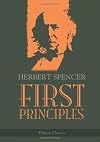
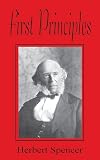
First Principles
by Herbert Spencer
On This Page
Description
In 1862, the British philosopher Herbert Spencer (1820-1903) published this preamble to a planned series of publications on biology, psychology, sociology and morality. In it, he states that religion and science can be reconciled by their shared belief in an Absolute, and that ultimate principles can be discerned in all manifestations of the Absolute, particularly the general laws of nature being discovered by science. Spencer divides his text into two parts. Part I, 'The Unknowable', show more discusses early philosophical ideas that human knowledge is limited and cannot meaningfully conceive of God; faith must be the bridge between human experience and ultimate truth. Spencer refutes this as he examines religion and science in detail. In Part II, 'Laws of the Knowable', Spencer argues that religion and science can be reconciled in the underlying unity from which the visible complexity of the universe has evolved. show lessTags
Recommendations





















Member Reviews
This is the first American edition of Herbert Spencer's classic work, the first volume of his Synthetic Philosophy. On this aged paper and between these green boards one can find the first mature statement of Spencer's rather unique take on evolution. Later editions expanded Spencer's basic model, so reading this volume is important for the history of ideas.
I've written elsewhere about the main argument of the first section of the book, "The Unknowable." It's not a thesis I find particularly persuasive, nor a formulation I find compelling. But it has something going for it. (See my essay on Instead of a Blog.) Besides, it gave George Santayana a good excuse to restate Spencer's main point in far more sophisticated terms, in his lecture show more "The Unknowable" ("Obiter Scripta") . . . which is itself one of the classic essays in philosophy, and the lynchpin to Santayana's fascinating and nonsense-free ontology.
The second section is called "The Laws of the Knowable," and tries to set up a general systems theory of science, built around the notion of evolution. And by that he didn't mean "descent with modification" (which is not evolution at all), but a kind of progress, an increase in differentiation and unification. A fascinating work, marking a watershed moment in human thought. show less
I've written elsewhere about the main argument of the first section of the book, "The Unknowable." It's not a thesis I find particularly persuasive, nor a formulation I find compelling. But it has something going for it. (See my essay on Instead of a Blog.) Besides, it gave George Santayana a good excuse to restate Spencer's main point in far more sophisticated terms, in his lecture show more "The Unknowable" ("Obiter Scripta") . . . which is itself one of the classic essays in philosophy, and the lynchpin to Santayana's fascinating and nonsense-free ontology.
The second section is called "The Laws of the Knowable," and tries to set up a general systems theory of science, built around the notion of evolution. And by that he didn't mean "descent with modification" (which is not evolution at all), but a kind of progress, an increase in differentiation and unification. A fascinating work, marking a watershed moment in human thought. show less
This is the foundation for Herbert Spencer's philosophical "synthesis," what he called his "Synthetic Philosophy." In this volume he lays out a metaphysics and, upon a theory of relative knowledge, his schema for evolution.
Though his conception of evolution has much to recommend it, science has mutated away from his position. The agnostic metaphysics in the first part, "The Unknowable," has even less to say for it (by most lights), and yet it is extremely readable. There are many passages of brilliance, and, as 19th century attempts at metaphysics go, one of the few worth returning to.
A challenging work, very clear, now hopelessly out of fashion, but charming and worth reading nonetheless.
Though his conception of evolution has much to recommend it, science has mutated away from his position. The agnostic metaphysics in the first part, "The Unknowable," has even less to say for it (by most lights), and yet it is extremely readable. There are many passages of brilliance, and, as 19th century attempts at metaphysics go, one of the few worth returning to.
A challenging work, very clear, now hopelessly out of fashion, but charming and worth reading nonetheless.
Ratings
Members
- Recently Added By
Lists

Trinity College Booklist (1951): Class Three, Philosophy and Religion
80 works; 3 members
Author Information

128+ Works 1,260 Members
Herbert Spencer, an English philosopher-scientist, was---with the anthropologists Edward Burnett Tylor and Lewis Henry Morgan---one of the three great cultural evolutionists of the nineteenth century. A contemporary of Charles Darwin (see Vol. 5), he rejected special creation and espoused organic evolution at about the same time. He did not, show more however, discover, as did Darwin, that the mechanism for evolution is natural selection. He was immensely popular as a writer in England, and his The Study of Sociology (1873) became the first sociology textbook ever used in the United States. With the recent revival of interest in evolution, Spencer may receive more attention than he has had for many decades. (Bowker Author Biography) show less
Awards and Honors
Series
Belongs to Publisher Series
Classifications
- Genres
- Philosophy, Nonfiction, Sociology, Science & Nature, General Nonfiction, Religion & Spirituality, Economics
- DDC/MDS
- 113 — Philosophy & psychology Metaphysics (existence, purpose, and the nature of reality) Cosmology (Philosophy of nature)
- LCC
- B1653 .F4 — Philosophy, Psychology and Religion Philosophy (General) By period Modern By region or country
- BISAC
Statistics
- Members
- 178
- Popularity
- 183,681
- Reviews
- 2
- Rating
- (3.75)
- Languages
- English, French, German, Yiddish
- Media
- Paper, Ebook
- ISBNs
- 25
- ASINs
- 21