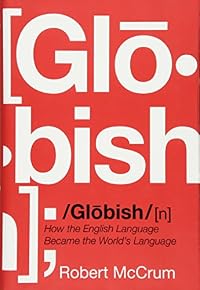
Globish: How the English Language Became the World's Language
by Robert McCrum
On This Page
Description
Robert McCrum, coauthor of the best-selling book and television series The Story of English, shows how the language of the Anglo-American imperium has become the world's lingua franca. --from vendor descriptionTags
Recommendations





Member Reviews
Only last 2,5 chapters deal with the current situation of English's global dominance. And that was the reason I took the book in the first place. Despite its promising name first 12,5 chapters deal largely with the history of English. Interesting read, but still not exactly what I was looking for. Those of you how like me think that Globish is a subject of the XX-XXI centuries only beware - and thus forearmed - dash straight to the last 60 something pages ;)
How did a tiny island, beset by wave after wave of conquerors, become the dominant power of one century, and then one of its colonies become the dominant power of another? Language.
Globish explores how English became English, how it spread, and how American English took over the world. The author also explores how a new kind of global English – Globish – will continue to conquer.
This is a fun story about language and its impact. The fact that English is so adaptable and eager to swipe words from other languages, that it’s the language of the people instead of the academy, is why it’s been so successful.
There are many anecdotes and signposts to the future of the language. Some posit that Chinese, on sheer numbers, will overtake show more English, but the writer makes a good case against it.
Admittedly, you have to be a bit of a language nerd to appreciate this book, but if you are, you’ll delight at it.
Read more of my reviews at Ralphsbooks. show less
Globish explores how English became English, how it spread, and how American English took over the world. The author also explores how a new kind of global English – Globish – will continue to conquer.
This is a fun story about language and its impact. The fact that English is so adaptable and eager to swipe words from other languages, that it’s the language of the people instead of the academy, is why it’s been so successful.
There are many anecdotes and signposts to the future of the language. Some posit that Chinese, on sheer numbers, will overtake show more English, but the writer makes a good case against it.
Admittedly, you have to be a bit of a language nerd to appreciate this book, but if you are, you’ll delight at it.
Read more of my reviews at Ralphsbooks. show less
I like books about the development of language, and was hoping for good things from this book. But it didn't fully live up to those expectations.
The book is split into several sections, and the first is about the co evolution of the English language and the people of this country. He writes about the way that we have moved from the Celtic languages, and the influx of Saxon, Norse and French peoples and the way that they have shaped the words we speak today. There is a whole section on the American revolution, and the way that the American English and English have devolved; all interesting stuff, but there was a lot of history in this part.
He then goes on to cover how Britain acquired new words from other cultures - i.e. mainly by show more invading them. It has made our language richer, but the world was poorer for a long time because of it. Other parts of the book cover the two world wars and the influence of the British / American partnership in creating global institutions, UN IMF, that had English as its core language.
The final part covers the way that the world is going now. Lots of countries are insisting that English is a compulsory second language, Mexico for example, and when China starts to work with African countries, they converse in English. That coupled with global trade, outsourcing and so on, means that more people will speak English with an accent rather than learn a different language.
In essence, good, but not great show less
The book is split into several sections, and the first is about the co evolution of the English language and the people of this country. He writes about the way that we have moved from the Celtic languages, and the influx of Saxon, Norse and French peoples and the way that they have shaped the words we speak today. There is a whole section on the American revolution, and the way that the American English and English have devolved; all interesting stuff, but there was a lot of history in this part.
He then goes on to cover how Britain acquired new words from other cultures - i.e. mainly by show more invading them. It has made our language richer, but the world was poorer for a long time because of it. Other parts of the book cover the two world wars and the influence of the British / American partnership in creating global institutions, UN IMF, that had English as its core language.
The final part covers the way that the world is going now. Lots of countries are insisting that English is a compulsory second language, Mexico for example, and when China starts to work with African countries, they converse in English. That coupled with global trade, outsourcing and so on, means that more people will speak English with an accent rather than learn a different language.
In essence, good, but not great show less
The thesis of McCrum's book is that English (for which he provides a somewhat scattered historical tail) is evolving into a new language or dialect which he has dubbed Globish. From his account it's really difficult to figure out whether this now has local variants that are mutually incomprehensible, or whether we now truly have a global language.
This is a somewhat scattered book. As at least an amateur historian, I expect a coherent historial narrative, unfortunately this book wanders from point to point trying to prove a thesis. The author does begin at the beginning. The first part I found particularly interesting because it puts Beowulf and Chaucer in context. The narrative mostly focuses on the seminal documents of early English show more and Medieval history, with an eye toward their lasting impact on the language. A brief account of the Reformation (which he seemed to want to blame on the influence of Anne Boleyn), the King James Bible, and the ongoing impact of Shakespeare.
The second part migrates to the American colonies and seems mostly taken up with a mixture of dictionaries and political theory. Abraham Lincoln is paired with Mark Twain. The impact of African Americans in the evolution of English is covered in one chapter that stretches from the early days of slavery to the election of President Barak Obama.
Part three is homage to the long nineteenth century of the British Empire. Modern history in the last third of the book seems even more vague. It's also tilted. He never discusses, or appears to visit, Latin America. What of the thriving Hispanic commercial sector in the U.S.?
What he really wants to say is that the mother tongue of the Web is English and that the mother tongue of a vast proportion of international business is English. I don't know enough about either of those subjects to check his assumptions.
His thesis, nevertheless, is poignant. Is it really true that, given that I have the misfortune of only being fluent in English, that I can now wander the world without getting lost? show less
This is a somewhat scattered book. As at least an amateur historian, I expect a coherent historial narrative, unfortunately this book wanders from point to point trying to prove a thesis. The author does begin at the beginning. The first part I found particularly interesting because it puts Beowulf and Chaucer in context. The narrative mostly focuses on the seminal documents of early English show more and Medieval history, with an eye toward their lasting impact on the language. A brief account of the Reformation (which he seemed to want to blame on the influence of Anne Boleyn), the King James Bible, and the ongoing impact of Shakespeare.
The second part migrates to the American colonies and seems mostly taken up with a mixture of dictionaries and political theory. Abraham Lincoln is paired with Mark Twain. The impact of African Americans in the evolution of English is covered in one chapter that stretches from the early days of slavery to the election of President Barak Obama.
Part three is homage to the long nineteenth century of the British Empire. Modern history in the last third of the book seems even more vague. It's also tilted. He never discusses, or appears to visit, Latin America. What of the thriving Hispanic commercial sector in the U.S.?
What he really wants to say is that the mother tongue of the Web is English and that the mother tongue of a vast proportion of international business is English. I don't know enough about either of those subjects to check his assumptions.
His thesis, nevertheless, is poignant. Is it really true that, given that I have the misfortune of only being fluent in English, that I can now wander the world without getting lost? show less
A bit long-winded - the writing style wore me down at times. I got the impression that the author likes the sound of his own voice. One might be disappointed if expecting to be plunged straight into a 'Slumdog Millionaire', contemporary account of modern globish: this is primarily a history book. It's not until the last 30 pages or so that we even get into the last 50 years. On the other hand, it's very erudite, very well-researched, and it is important to know why English - sorry, Globish - is so prevalent nowadays.
I enjoyed this book. It combines a readable and entertaining introduction to the development of the English language, with a broad history of the English-speaking world. I found it full of fascinating detail and was interested in the "Globish" concept that the language has released itself from its attachment to traditionally English speaking countries and is evolving across the world in ways of its own.
This book is titled "Globish: how the English Language Became the World's Language," and the author seems to focus on the "how" part of the title and not as much on English itself. I personally happen to like reading about history, so I enjoyed this book as a tour of Anglo-American history with a linguistic tint. There are those who don't really like history, and if you're one of them, you may not fully appreciate this book. Parts of the book deal directly with development of English as a language, but they are not the majority.
If you're looking to read about English as a global language, I recommend the last section of the book. Having exhausted all of the available history, the book shifts into overdrive and the author starts show more talking about English on the current global stage (the "Globish" part of the title).
I liked the book over all, and if you like history and the history of language, I think you will too. show less
If you're looking to read about English as a global language, I recommend the last section of the book. Having exhausted all of the available history, the book shifts into overdrive and the author starts show more talking about English on the current global stage (the "Globish" part of the title).
I liked the book over all, and if you like history and the history of language, I think you will too. show less
Members
- Recently Added By
Published Reviews
ThingScore 50
It’s a wide-ranging — if etymologically flawed — work, which will be of interest to readers coming fresh to the history of the way the English language has developed.
added by jimroberts
Author Information

27+ Works 4,164 Members
Robert McCrum is the author of Wodehouse: A Life and the Coauthor of the best-selling book and television series. The Story of English. He is the associate editor of the Observer and lives in London with his wife, Sarah Lyall.
Awards and Honors
Distinctions
Common Knowledge
- Original publication date
- 2010
- Epigraph
- For certainly our language now used varyeth far from that which was used and spoken when I was born. For we Englishmen have been born under the domination of the moon, which is never steadfast, but ever wavering and waxing o... (show all)ne season.
--WILLIAM CAXTON, PROLOGUE TO ENYDOS
In all pointed sentences, some degree of accuracy must be sacrificed to conciseness.
--SAMUEL JOHNSON, "THE BRAVERY OF THE COMMON ENGLISH SOLDIER"
The English language is not an abstract construction of dictionary makers. It is the powerful language of resistance; it is the dialect of common sense. It is the speech of the proud and melancholy races and of all who aspi... (show all)re; it has its basis broad and low, close to the ground.
--WALT WHITMAN, PREFACE TO LEAVES OF GRASS
[Prologue]
The twenty-first century has revealed a world more intertwined than at any time . . . Will we stand for the human rights of the dissident in Burma, the blogger in Iran or the voter in Zimbabwe? Will we give mea... (show all)ning to the words "never again" in Darfur?
BARACK OBAMA, SPEAKING IN BERLIN, 24 JULY 2008
[Chapter One]
I felt an unconscious thrill, as if something had stirred me, half-wakened from sleep. There was something very remote and strange and beautiful behind those words, if I could grasp it, far beyond Ancient En... (show all)glish.
--J. R. R. TOLKIEN
[Chapter Two]
"I see somebody now," said Alice. "But he's coming very slowly -- and what curious attitudes he goes into!"
"Not at all," said the king. "He's an Anglo-Saxon Messenger -- and those are Anglo-Saxon attitu... (show all)des. He only does them when he's happy."
--LEWIS CARROLL, THROUGH THE LOOKING-GLASS
[Chapter Three]
Big Brother and the Party and the Thought Police could all be swept into nothingness by a single splendid movement of the arm. That too was a gesture belonging to the ancient time. Winston woke up with th... (show all)e word "Shakespeare" on his lips.
--GEORGE ORWELL, NINETEEN EIGHTY-FOUR
[Chapter Four]
Our English tongue, which hath been the most harsh, uneven and broken language of the world . . . is now continually refined, every writer striving in himself to add a new flourish unto it; so that in proces... (show all)s, from the most rude and unpolished tongue, it is grown to a most perfect and composed language.
--THOMAS HEYWOOD, APOLOGY FOR ACTORS (1612)
[Chapter Five]
If you want to live intelligently beyond the blackmail of the slogans and the unexamined rules, you have only to find your own . . . The Declaration of Independence. The Bill of Rights. The Gettysburg Addr... (show all)ess. The Emancipation Proclamation. The Fourteenth Amendment.
--PHILIP ROTH, THE DYING ANIMAL
[Chapter Six]
You must know I have undertaken to prophesy that English will be the most respecable language in the world and the most universally read and spoken in the next century.
--JOHN ADAMS, 1780
[Chapter Seven]
Abused and scorned though we may be, our destiny is tied up with the destiny of America. Before the Pilgrims landed at Plymouth, we were here. Before the pen of Jefferson scratched across the pages of hist... (show all)ory the majestic words of the Declaration of Independence, we were here . . .
--MARTIN LUTHER KING JR., "LETTER FROM BIRMINGHAM JAIL", AUGUST 1963
[Chapter Eight]
The genius of the English language [lies in] its naturalness, which does not shun either the basest or most monstrous ideas; in its energy, which other nations might take for harshness; in its daring, which... (show all) minds less accustomed to foreign usage would consider gibberish.
--VOLTAIRE, APPEAL TO ALL THE NATIONS OF EUROPE
[Chapter Nine]
And then, before I could open my lips, the East spoke to me, but it was in a Western voice . . . The voice swore and cursed violently; it riddled the solemn peace of the bay by a volley of abuse. It began b... (show all)y calling me Pig, and from that went crescendo into unmentionable adjectives -- in English.
--JOSEPH CONRAD, YOUTH
[Chapter Ten]
The "decline" of England seems to me a tremendous and even, almost, an inspiring spectacle, and if the British Empire is once more to shrink up into that plethoric little island, the process will be the great... (show all)est drama in history.
--HENRY JAMES, 1877
[Chapter Eleven]
The Americans are doing what the Elizabethans did -- they are coining new words. In England, save for the impetus given by war, the word-coining power has lapsed.
--VIRGINIA WOOLF, AMERICAN FICT... (show all)ION (1925)
[Chapter Twelve]
A. Ah bet tha heard Churchill.
B. Aye -- I did.
A. He doesn't half give it to them. I corn't go to sleep when he's on.
--CONVERSATION IN BOLTON, OCTOBER 1939
[Chapter Thirteen]
Because it amplifies our potential in so many ways, it's possible that the long-term impact of the Internet could equal that of electricity, the automobile and the telephone all rolled together.
-... (show all)-BILL GATES, CHAIRMAN OF MICROSOFT, IN DECEMBER 2000
[Chapter Fourteen]
China is the elephant in the room that no one is quite willing to recognise. As a result, an extraordinary shift in the balance of global power is taking place sotto voce, almost by stealth.
--MA... (show all)RTIN JACQUES, WHEN CHINA RULES THE WORLD
[Chapter Fifteen]
Our nation, though it has no drinking water, electricity, sewage system, public transportation, sense of hygiene, discipline, courtesy, or punctuality, does have entrepreneurs. Thousands and thous... (show all)ands of them. Especially in the field of technology. And these entrepreneurs -- we entrepreneurs -- have set up all these outsourcing companies that virtually run America now.
ARAVIND ADIGA, THE WHITE TIGER
[Epilogue]
I never mastered Dari, the Persian dialect spoken by the Khan family, but several family members spoke English.
--ASNE SEIERSTAD, THE BOOKSELLER OF KABUL - Dedication
- For my mother,
Christine McCrum,
who gave me English:
with love and thanks. - First words
- The Renmin University of China, also known as the People's University, in Beijing, has about 36,000 students, studying everything from politics to social anthropology.
- Last words
- (Click to show. Warning: May contain spoilers.)"I hope," he concluded, "that this is a turning-point for our country."
- Blurbers
- Gladwell, Malcolm
Classifications
Statistics
- Members
- 287
- Popularity
- 111,821
- Reviews
- 12
- Rating
- (2.97)
- Languages
- Czech, English
- Media
- Paper, Audiobook, Ebook
- ISBNs
- 16
- ASINs
- 3