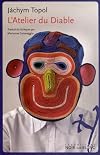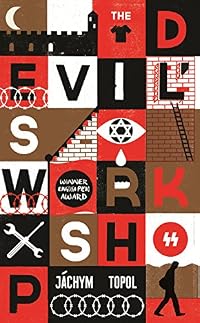
The Devil's Workshop
by Jáchym Topol
On This Page
Description
A surreal, comic and disturbing novel about the horrors of history, the commodification of the past, and dark edges of the present.Tags
Recommendations












Member Recommendations

Member Reviews
Recently, a screencap from a Swedish high schooler's Facebook made the rounds on social media. It pictured her and her friends on a school trip to Auschwitz, dancing under the ARBEIT MACHT FREI sign, captioned with "Refuse to be PC, lol!"
In The Devil's Workshop, a young Swedish woman comes to Theresienstadt looking for her family history, winds up staying and masterminding the campaign to turn what's left of the city into a tourist attraction, complete with slogans like "If Franz Kafka had survived, they would have killed him here". Unlike the moronic brats in the example above, it's done for the best of reasons; to make sure this is remembered. She's horrified at the cavalier attitude towards atrocities in the so-called "East" (to show more which everyone, all the way to Vladivostok, responds "What do you mean, East? This is Central Europe!"). Concentration camps turned into pig farms, goats grazing in the ruins of Theresienstadt, etc. In the West, we've learned to compartmentalize, to turn monuments into safe Never Again-Lands. In the parts of the world where millions died at their neighbours' hands, it all got hushed up by the next tyrant.
The fact that it's Theresienstadt - constructed by the Nazis as the "nice" face of concentration camps - is not coincidental. The fact that I, as a Swede, have spent much of the review talking about a minor character in the book probably isn't either. Our hero, of course, is the guy who grew up in what's left of the city, with a mother traumatized by literally being fished out of a pile of corpses and a father who represented the new oppressors. How do you make a memorial to something that's ongoing? Well, he's not sure, but there's always demand for it, especially with the likes of Lukashenko and Putin working for political points... Conscripting the dead to fight ideological battles for you has rarely not worked. Once we've picked the martyrs, we can point them at any villain we want. At the same time, we need to remember, don't we? How can we promise "never again" if we don't know what happened - how can we promise it if we define it as ONE event, safely stored away behind glass? If we only honour the dead, how do we rate the living?
The Devil's Workshop works partly exactly because it's a quick, picaresque romp, with a bleak sense of humour not miles away from Vonnegut or Hrabal. Our nameless hero is swept up in a story older and bigger than himself, one where nobody really has any say, but everyone tries to wrest control of the narrative to make it play along. Memory is a tricky beast, but so is The Devil's Workshop. That it works fine as a short, sharp companion piece to the equally excellent Museum of Abandoned Secrets doesn't hurt either.
As I write this, Europe is once again scuttling back towards the slogans and easy answers of the 30s, in many cases spearheaded by the very countries who grew up on rhetoric about the Soviet friends smashing fascism. Wasn't it a Czech who said "When you smash monuments, keep the pedestals - they'll come in handy"? show less
In The Devil's Workshop, a young Swedish woman comes to Theresienstadt looking for her family history, winds up staying and masterminding the campaign to turn what's left of the city into a tourist attraction, complete with slogans like "If Franz Kafka had survived, they would have killed him here". Unlike the moronic brats in the example above, it's done for the best of reasons; to make sure this is remembered. She's horrified at the cavalier attitude towards atrocities in the so-called "East" (to show more which everyone, all the way to Vladivostok, responds "What do you mean, East? This is Central Europe!"). Concentration camps turned into pig farms, goats grazing in the ruins of Theresienstadt, etc. In the West, we've learned to compartmentalize, to turn monuments into safe Never Again-Lands. In the parts of the world where millions died at their neighbours' hands, it all got hushed up by the next tyrant.
The fact that it's Theresienstadt - constructed by the Nazis as the "nice" face of concentration camps - is not coincidental. The fact that I, as a Swede, have spent much of the review talking about a minor character in the book probably isn't either. Our hero, of course, is the guy who grew up in what's left of the city, with a mother traumatized by literally being fished out of a pile of corpses and a father who represented the new oppressors. How do you make a memorial to something that's ongoing? Well, he's not sure, but there's always demand for it, especially with the likes of Lukashenko and Putin working for political points... Conscripting the dead to fight ideological battles for you has rarely not worked. Once we've picked the martyrs, we can point them at any villain we want. At the same time, we need to remember, don't we? How can we promise "never again" if we don't know what happened - how can we promise it if we define it as ONE event, safely stored away behind glass? If we only honour the dead, how do we rate the living?
The Devil's Workshop works partly exactly because it's a quick, picaresque romp, with a bleak sense of humour not miles away from Vonnegut or Hrabal. Our nameless hero is swept up in a story older and bigger than himself, one where nobody really has any say, but everyone tries to wrest control of the narrative to make it play along. Memory is a tricky beast, but so is The Devil's Workshop. That it works fine as a short, sharp companion piece to the equally excellent Museum of Abandoned Secrets doesn't hurt either.
As I write this, Europe is once again scuttling back towards the slogans and easy answers of the 30s, in many cases spearheaded by the very countries who grew up on rhetoric about the Soviet friends smashing fascism. Wasn't it a Czech who said "When you smash monuments, keep the pedestals - they'll come in handy"? show less
This novel by Czech writer Jáchym Topol is a dark satire which asks troubling questions on what we should remember and what we should forget.
The unnamed narrator grows up in Terezín, a town which houses a Medieval fortress and a former Nazi prison. His father is a military bandsman, his mother a survivor of the prison, as are most of the people of the town. The narrator grows up, in a mockery of a pastoral idyll, herding goats on the fortifications, scrabbling in underground tunnels for Nazi memorabilia and failing to live up to his father’s ambitions before he is forced to leave.
Years later he returns to Terezín. The army has left and the authorities no longer want to maintain the town. His “uncle”, Lebo, born in the Nazi show more prison, is determined that nothing should be lost. They begin a protest movement which draws international attention – and lucrative opportunities as they sell souvenir T-shirts and accommodate visitors and obtain funding from philanthropists worldwide. Then political upheaval means the narrator has to leave for Belarus where the book takes a darker turn.
The narrator has a sly naivety. He recounts events as he experiences them, stripped of context. This can make it difficult at times to follow events. There is an afterword by the translator which fills in some of the gaps but I think he was right to put it at the end. It means that like the narrator, the reader experiences conflict and instability as most people do when they are at the heart of them –seeing details, specifics, without a coherent narrative, which is only imposed later, and somehow make whatever occurred seem inevitable.
The narrator has no sense of history, only of a home. He accepts the world as he finds it and makes the best of the opportunities he sees. In contrast, Terezín attracts what he calls the “bunk seekers”. They are distinct from the casual sightseers who take photos and walk the heritage trail. They are western descendants of Holocaust survivors who believe they have a personal interest in the town’s story. They look for meaning in the prison camp, something to give them an identity.
The book’s humour lies in the way it overturns assumptions. Sara, a bunk seeker from Sweden, berates the narrator. She, not he, is the one that truly suffers the legacy of Terezín. His complexes only arise because of what he’s lived through. Hers are a product of her unique personality.
The simple language of the book contrasts with the complexity of the ideas as the story turns in on itself. How is the past commodified, and for whose benefit? If you don’t know your history, does it still shape you? Does it even make sense to call it "yours"?
This book is dark, unsettling and raises lots of questions. It also resolutely refuses to provide any answers.
-
This review first appeared on TNBBC's book blog http://thenextbestbookblog.blogspot.co.uk/2015/04/kate-reviews-devils-workshop.h... show less
The unnamed narrator grows up in Terezín, a town which houses a Medieval fortress and a former Nazi prison. His father is a military bandsman, his mother a survivor of the prison, as are most of the people of the town. The narrator grows up, in a mockery of a pastoral idyll, herding goats on the fortifications, scrabbling in underground tunnels for Nazi memorabilia and failing to live up to his father’s ambitions before he is forced to leave.
Years later he returns to Terezín. The army has left and the authorities no longer want to maintain the town. His “uncle”, Lebo, born in the Nazi show more prison, is determined that nothing should be lost. They begin a protest movement which draws international attention – and lucrative opportunities as they sell souvenir T-shirts and accommodate visitors and obtain funding from philanthropists worldwide. Then political upheaval means the narrator has to leave for Belarus where the book takes a darker turn.
The narrator has a sly naivety. He recounts events as he experiences them, stripped of context. This can make it difficult at times to follow events. There is an afterword by the translator which fills in some of the gaps but I think he was right to put it at the end. It means that like the narrator, the reader experiences conflict and instability as most people do when they are at the heart of them –seeing details, specifics, without a coherent narrative, which is only imposed later, and somehow make whatever occurred seem inevitable.
The narrator has no sense of history, only of a home. He accepts the world as he finds it and makes the best of the opportunities he sees. In contrast, Terezín attracts what he calls the “bunk seekers”. They are distinct from the casual sightseers who take photos and walk the heritage trail. They are western descendants of Holocaust survivors who believe they have a personal interest in the town’s story. They look for meaning in the prison camp, something to give them an identity.
The book’s humour lies in the way it overturns assumptions. Sara, a bunk seeker from Sweden, berates the narrator. She, not he, is the one that truly suffers the legacy of Terezín. His complexes only arise because of what he’s lived through. Hers are a product of her unique personality.
The simple language of the book contrasts with the complexity of the ideas as the story turns in on itself. How is the past commodified, and for whose benefit? If you don’t know your history, does it still shape you? Does it even make sense to call it "yours"?
This book is dark, unsettling and raises lots of questions. It also resolutely refuses to provide any answers.
-
This review first appeared on TNBBC's book blog http://thenextbestbookblog.blogspot.co.uk/2015/04/kate-reviews-devils-workshop.h... show less
I have many good friends in Belarus, very involved in the struggle for freedom and human rights in Europe’s last dictatorship. They have all fared badly in the horrors after the presidential “election” in December: being arrested, harassed and beaten. My friends in Free Theatre Belarus are in the USA at the moment – smuggled out of Belarus on trucks. It’s at the moment very unclear if they are at all able to return home, and back in Minsk their families are getting harassed by the KGB (which is blatantly still called just that…). All this creates a chilling backdrop to the rioting going on in Minsk when our main character arrives there.
Tópol’s novel deals with a difficult subject matter: the concept of “horror show more tourism”, bringing in tourists to the death camps and slaughter grounds of WW2. On one hand, it’s of course important not to forget history. On the other hand, there’s something slightly unseemly with making an industry of human misery. Tópol doesn’t shy away from the many aspects of this issue, but paints a complex picture with nightmarish streaks.
Our unnamed narrator is born in Theresienstadt just outside Prague. A military town built on the bones of the dead under communist times, it crumbles under the years he spends in prison for accidently killing his father. When he returns to the only home he knows, it’s a ruin populated with outcasts and junkies. But the first misery tourists are beginning to find their way there – descendants to the victims of the Nazis looking for answers – and under the leadership of the local father figure Lebo, the inhabitants begin to build a small industry. They sell “This is where Kafka would have gone if he hadn’t died first” T-shirts, ghetto pizza and relics from the underground catacombs. They get press. Celebrities are supporting them. Funding is trickling in.
But then our main character is more or less kidnapped by a couple of agents from the Belarusian tourist authorities. They are adamant to make Belarus the centre of European horror tourism. After all, this is “The devil’s workshop”, where most people got killed. But there are also forces that would rather just forget about the past, since not every mass murder was committed by Nazis. Soon our main character is in the middle of a very violent conflict. And a very bizarre museum indeed.
My first Tópol was a very interesting and provocative read. I’m left with many thoughts. show less
Tópol’s novel deals with a difficult subject matter: the concept of “horror show more tourism”, bringing in tourists to the death camps and slaughter grounds of WW2. On one hand, it’s of course important not to forget history. On the other hand, there’s something slightly unseemly with making an industry of human misery. Tópol doesn’t shy away from the many aspects of this issue, but paints a complex picture with nightmarish streaks.
Our unnamed narrator is born in Theresienstadt just outside Prague. A military town built on the bones of the dead under communist times, it crumbles under the years he spends in prison for accidently killing his father. When he returns to the only home he knows, it’s a ruin populated with outcasts and junkies. But the first misery tourists are beginning to find their way there – descendants to the victims of the Nazis looking for answers – and under the leadership of the local father figure Lebo, the inhabitants begin to build a small industry. They sell “This is where Kafka would have gone if he hadn’t died first” T-shirts, ghetto pizza and relics from the underground catacombs. They get press. Celebrities are supporting them. Funding is trickling in.
But then our main character is more or less kidnapped by a couple of agents from the Belarusian tourist authorities. They are adamant to make Belarus the centre of European horror tourism. After all, this is “The devil’s workshop”, where most people got killed. But there are also forces that would rather just forget about the past, since not every mass murder was committed by Nazis. Soon our main character is in the middle of a very violent conflict. And a very bizarre museum indeed.
My first Tópol was a very interesting and provocative read. I’m left with many thoughts. show less
This was not exactly an enjoyable book but it wasn't meant to be. In an intimate manner, it explores the conflict between the need to know about horrors committed in the past, and the inappropriateness of either wallowing in it or making a tourist spectacle of it.
3.6 stars... tipped to four for the last section of the book, set in Khatyn.
Je suis probablement passé à coté de quelque chose, mais pas pu finir...
Feb 24, 2018French
Ratings
Members
- Recently Added By
Published Reviews
ThingScore 69
Autor si zřejmě uvědomuje, že nezájem o Chladnou zemi pramení z neznalosti jejích dějin (čímž nechtěně potvrzuje ironicky citovaný a vskutku otřepaný výrok fiktivního běloruského obrozence Kagana, podle něhož „kdo nemá minulost, nemá ani budoucnost"), a právě proto se snaží vnímat tuto zemi skrze „příliš živou" běloruskou historii 20. století. Rad bych show more věřil, že Bělorusko, které se z české perspektivy pořád nachází ve stínu mnohem větší, chladnější a typologicky rozhodně „vý(c)hodnější" země, Ruska, jednou vystoupí zpod svícnu i díky Topolově ochotě upřímně vypovědět o něm to, co momentálně vypovědět dokázal a mohl. Stín tohoto svícnu ani ten svůj ale nepřekročil: Chladná země podle všeho zanechala autora knihy chladným. Doufám, že to nebude případ jejích českých čtenářů. Alespoň pro demokraticky smýšlející „hrdé Bělorusy", kteří si zvykli slyšet ze Západu jen slova povinného a často neupřímného povzbuzování, bude rozhodně důvodem k zamyšlení. show less
added by _eskarina
Topol tedy zjevně ani nerozlišuje žánry, jen bez ladu a skladu produkuje text; ve svém projevu je důsledně typický, ale namísto slušné beletrie nabízí ve výsledku angažované zpravodajství.
Myslím, že má smysl tuto knihu číst kvůli potěše z povedených jednotlivostí, které bytostnému lyrikovi Topolovi upřít nelze; kupříkladu hned na první straně textu lze mezi show more dalšími číst větu „Takhle pomalinku jdu do Prahy na letiště." - tedy ucelenou báseň.
Chce-li však člověk utržit pořádnou uměleckou i morální facku z naší nedávné běloruské historie, nechť raději zhlédne film Elema Klimova Jdi a dívej se. show less
Myslím, že má smysl tuto knihu číst kvůli potěše z povedených jednotlivostí, které bytostnému lyrikovi Topolovi upřít nelze; kupříkladu hned na první straně textu lze mezi show more dalšími číst větu „Takhle pomalinku jdu do Prahy na letiště." - tedy ucelenou báseň.
Chce-li však člověk utržit pořádnou uměleckou i morální facku z naší nedávné běloruské historie, nechť raději zhlédne film Elema Klimova Jdi a dívej se. show less
added by _eskarina
Jediným problémem novely Chladnou zemí je její předimenzovanost. V kontextu současné prózy je to nedostatek paradoxní. Většinou je tomu právě naopak, tedy že se povídka zřeďuje do novely a novela do románu. Topol bohužel pro čtenáře zhustil velký román do velké novely. Proto je četba Chladnou zemí místy jako chůze bažinou. Skrze autorovu řemeslnou zručnost je show more text sice velmi čtivý, ale jako bažina působí právě kvůli tematické zahuštěnosti, komplikovanosti a snad až přílišné zkratkovitosti. Přesto je dílo jedním z velikých literárních počinů nejen letošního roku a dokazuje, že jméno Jáchym Topol čeká zajisté vytesání do literárních dějin přelomu století. show less
added by _eskarina
Lists

Books Read in 2023
5,547 works; 145 members
Author Information

28+ Works 542 Members
Some Editions
Awards and Honors
Series
Belongs to Publisher Series
Common Knowledge
- Canonical title*
- L'officina del diavolo
- Original title
- Chladnou zemí
- Original publication date
- 2009
- People/Characters
- Uncle Lebo
- Important places
- Theresienstadt concentration camp, Terezín, Czech Republic; Minsk, Belarus
- Epigraph
- on a river of emotion
on a hillside without emotion
a tin sun
founds
a colony of terror
Pavel Zajíček
Look, I've got someone else's scars, how did they get there?
Dorota Masłowska - Dedication
- This translation is dedicated to Jáchym,
my brother from another mother - First words
- I'm on the run to the airport in Prague.
- Last words
- (Click to show. Warning: May contain spoilers.)We'll definitely go. We'll make it somewhere. Save ourselves. Yeah, it might work out.
- Blurbers
- Rourke, Lee; Gowers, Rebecca
- Original language*
- Tsjechisch
*Some information comes from Common Knowledge in other languages. Click "Edit" for more information.
Classifications
- Genres
- General Fiction, Fiction and Literature
- DDC/MDS
- 891.8636 — Literature & rhetoric Asian Literature East Indo-European and Celtic literatures West and South Slavic languages (Bulgarian, Slovene, Polish, Czech, Slovak, Serbo-Croatian, and Macedonian) Czech Czech fiction 1989–
- LCC
- PG5039.3 .O648 .C4913 — Language and Literature Slavic languages and literatures. Baltic languages. Albanian language Slavic. Baltic. Albanian Slavic Czech
- BISAC
Statistics
- Members
- 116
- Popularity
- 279,749
- Reviews
- 6
- Rating
- (3.53)
- Languages
- 10 — Czech, Dutch, English, French, German, Italian, Norwegian, Romanian, Spanish, Swedish
- Media
- Paper, Ebook
- ISBNs
- 14
- ASINs
- 2