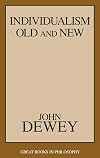
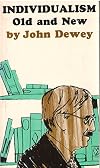
Individualism, Old and New
by John Dewey
On This Page
Description
America's most renowned social philosopher John Dewey shines his powerful intellect on the serious public and cultural issues surrounding the place of the individual in a technologically advanced society. In this penetrating study, he addresses the fear that personal creative potential will be trampled by assembly-line monotony, political bureaucracy, and an industrialized culture of uniformity. Armed with his pragmatic approach and his belief in the power of critical intelligence, Dewey show more argues that individualism has in fact been offered a uniquely higher plane of technological development upon which to grow, mature, and redefine itself. show lessTags
Recommendations

























Member Reviews
Dewey's notes on the impact of the industrial age on artisans and politicians, written long before Etsy, Amazon.com or the 2016 presidential election, are worth revisiting.
On art: "Those who are still called artists either put themselves, as writers and designers, at the disposal of organized businesses, or are pushed out to the edge as eccentric bohemians."
On politics: "The business mind, having its own conversation and language, its own interests, its own intimate groupings in which men of this mind, in their collective capacity, determine the tone of society at large as well as the government of industrial society, and have more political influence than the government itself."
Prescient insights indeed.
On art: "Those who are still called artists either put themselves, as writers and designers, at the disposal of organized businesses, or are pushed out to the edge as eccentric bohemians."
On politics: "The business mind, having its own conversation and language, its own interests, its own intimate groupings in which men of this mind, in their collective capacity, determine the tone of society at large as well as the government of industrial society, and have more political influence than the government itself."
Prescient insights indeed.
Ratings
Members
- Recently Added By
Author Information

243+ Works 9,989 Members
John Dewey was born in 1859 in Burlington, Vermont. He founded the Laboratory School at the University of Chicago in 1896 to apply his original theories of learning based on pragmatism and "directed living." This combination of learning with concrete activities and practical experience helped earn him the title, "father of progressive education." show more After leaving Chicago he went to Columbia University as a professor of philosophy from 1904 to 1930, bringing his educational philosophy to the Teachers College there. Dewey was known and consulted internationally for his opinions on a wide variety of social, educational and political issues. His many books on these topics began with Psychology (1887), and include The School and Society (1899), Experience and Nature (1925), and Freedom and Culture (1939).Dewey died of pneumonia in 1952. (Bowker Author Biography) show less
Series
Belongs to Publisher Series
Common Knowledge
- Canonical title
- Individualism, Old and New
Classifications
- Genres
- Philosophy, Nonfiction, Sociology, Politics and Government, General Nonfiction
- DDC/MDS
- 306.0973 — Society, government, & culture Social sciences, sociology & anthropology Social Behavior - Dating, Marriage, Divorce Social history North America United States
- LCC
- HM136 .D4 — Social sciences Sociology (General) Sociology These are obsolete numbers no longer used
- BISAC
Statistics
- Members
- 123
- Popularity
- 266,209
- Reviews
- 1
- Rating
- (3.21)
- Languages
- English, Spanish
- Media
- Paper, Ebook
- ISBNs
- 3
- ASINs
- 5