The Last Houseparty
by Peter Dickinson
On This Page
Description
In this gripping novel by CWA Gold Dagger winner Peter Dickinson, the survivor of a manor-house crime delves into the past to solve a mystery At the elegant English manor known as Snailwood, tourists come daily to hear decades-old gossip about the second wife of the sixth earl. Zena was a remarkable young woman whose scandalous reputation has been dimmed neither by time nor by her bizarre death. In the 1930s, Zena was the star of a notorious party set whose members included playwrights, show more politicians, and Nazi sympathizers. They passed wild weekends at Snailwood, arguing about politics and drinking until dawn. At the center of their parties was the manor's magnificent tower clock. The clock stopped long ago, but the darkness of its legacy continues to spread. When a workman offers to fix the clock for free, the only remaining survivor of the old days is forced to revisit her memories of Zena's last mad party, when death came to Snailwood and Britain changed forever. show lessTags
Recommendations















Member Reviews
I can't say I liked this book. I am always drawn to Peter Dickinson's writing, even though it is often unsettling, and this is probably the most disturbing of his books that I've read. He wrote an impressive range of books for children and for adults: science fiction, fantasy, mystery, historical fiction, suspense. This one might be considered mystery or suspense, I guess, or psychological fiction, and is definitely written for adults.
Most of the story takes place at Snailwood Castle in 1937 and 1980, bouncing back and forth in time, with isolated episodes occurring at various times and places in between. The main timelines are tied together by a spectacular tower clock with moving figures. The effects of events that happened at the show more house party in 1937 are still being felt in 1980. What happened at the house party? We don't find out until over two thirds of the way through the book. There is no traditional mystery structure. As often happens, Dickinson's conclusion leaves us with as many questions as it answers.
I found the book hard to get into at first, because political discussion was pretty central to the 1937 stream of the story. But I kept going because I wanted to find out what the crime was. By the time I got to the crime—and it was a nasty one—I was deeply invested in the characters and had to finish. Both the crime and the solution were disturbing, but I can't help admiring Dickinson's skill at creating the puzzle, building suspense, and messing with my expectations.
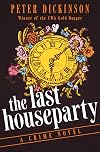
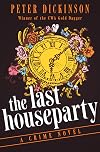
The cover illustration on my copy of The Last House-Party is excellent. It perfectly matches the descriptions of the castle clock. And the back cover shows a scene from the book with the clock tower in its courtyard. It's nice to see a cover that so accurately matches the story. show less
Most of the story takes place at Snailwood Castle in 1937 and 1980, bouncing back and forth in time, with isolated episodes occurring at various times and places in between. The main timelines are tied together by a spectacular tower clock with moving figures. The effects of events that happened at the show more house party in 1937 are still being felt in 1980. What happened at the house party? We don't find out until over two thirds of the way through the book. There is no traditional mystery structure. As often happens, Dickinson's conclusion leaves us with as many questions as it answers.
I found the book hard to get into at first, because political discussion was pretty central to the 1937 stream of the story. But I kept going because I wanted to find out what the crime was. By the time I got to the crime—and it was a nasty one—I was deeply invested in the characters and had to finish. Both the crime and the solution were disturbing, but I can't help admiring Dickinson's skill at creating the puzzle, building suspense, and messing with my expectations.
The cover illustration on my copy of The Last House-Party is excellent. It perfectly matches the descriptions of the castle clock. And the back cover shows a scene from the book with the clock tower in its courtyard. It's nice to see a cover that so accurately matches the story. show less
The story stayed with me and kept my interest even though it seems to spend a lot of time discussing seemingly irrelevant details, such as a long description of a game of croquet, and take forever to even tell us what crime was committed. There is a lot of bouncing back and forth in time. And there is a man who may or may not be someone who disappeared soon after something happened at the houseparty. I thought that the book would end with an acknowledgement that we may never definitively know what happened, but we do learn what got done and whodunit. It does end with uncertainly however: now that someone knows, what next?
A quote from a paragraph in which the author discusses describing / remembering / explaining an event to oneself or show more others:
There are monsters in our museums, skeletons pieced together and given plaster flesh and painted skin and then taken by visitors for accurate portrayals of the creatures that paddled in ancient swamps, until some maverick palaeontologist reinterprets the crushed and exiguous fossil-finds and one of the monsters discovers that it was never that shape at all. [p. 149] show less
A quote from a paragraph in which the author discusses describing / remembering / explaining an event to oneself or show more others:
There are monsters in our museums, skeletons pieced together and given plaster flesh and painted skin and then taken by visitors for accurate portrayals of the creatures that paddled in ancient swamps, until some maverick palaeontologist reinterprets the crushed and exiguous fossil-finds and one of the monsters discovers that it was never that shape at all. [p. 149] show less
one of my favorite British mystery authors
This man makes me proud to be classified as a mystery writer.
Ratings
Members
- Recently Added By
Author Information

109+ Works 10,500 Members
Peter Dickinson was born in Livingstone, Northern Rhodesia, now Zambia on December 16, 1927. He served in the British Army before receiving a B.A. in English literature from King's College, Cambridge in 1951. He was an assistant editor and reviewer for Punch Magazine for seventeen years. His first book, The Weathermonger, was published in 1968. He show more has written over 50 books for adults and young adults. His works for adults include Death of a Unicorn, Skeleton-in-Waiting, Perfect Gallows, The Yellow Room Conspiracy, and Some Deaths Before Dying. His works for young adults include The Iron Lion, The Ropemaker, Angel Isle, and In the Palace of the Khans. He has won several awards including the Boston Globe Horn Book Award in 1989 for Eva, the Carnegie Medal in 1979 for Tulku and in 1980 for City of Gold, the Whitbread Children's Prize for Tulku, and the Crime Writer's Golden Dagger for Skin Deep in 1968 and A Pride of Heroes in 1969. In 2009, he was awarded the OBE for services to literature. He died after a brief illness on December 16, 2015 at the age of 88. (Bowker Author Biography) show less
Some Editions
Common Knowledge
- Canonical title
- The Last Houseparty
- Original title
- The Last Houseparty
- Original publication date
- 1982
- People/Characters
- Sally Quintain; Harry Quintain; Vincent Masham
- First words
- One cannot say for certain that there was something in the Snailwood genes to cause the men of that family to become partially stuck in their childhoods.
- Last words
- (Click to show. Warning: May contain spoilers.)On the wall to the right of him the fourteen-foot pendulum swung steadily to and fro, beating the double seconds away.
- Blurbers
- Rendell, Ruth
- Original language
- English UK
Classifications
Statistics
- Members
- 120
- Popularity
- 270,167
- Reviews
- 4
- Rating
- (3.89)
- Languages
- English, German
- Media
- Paper, Ebook
- ISBNs
- 8
- ASINs
- 1