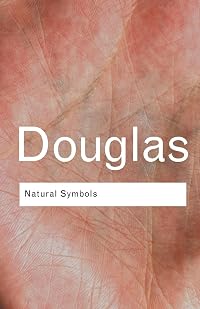
Natural Symbols: Explorations in Cosmology
by Mary Douglas
On This Page
Description
Every natural symbol - derived from blood, breath or excrement - carries a social meaning and this work focuses on the ways in which any one culture makes its selections from body symbolism. Each person treats their body as an image of society and the author examines the varieties of ritual and symbolic expression and the patterns of social ritual in which they are embodied.Natural Symbols is a book about religion and it concerns our own society at least as much as any other. It has show more stimulated new insights into religious and political movements and has provoked re-appraisals of cu show lessTags
Recommendations













Member Reviews
Mary Douglas did anthropology in a structuralist vein, and this book probably had its greatest significance for the discipline in her introduction of the idea of "group and grid" defining a coordinate plane on which to position the social-symbolic dispositions of different cultures. She arrived at this form in the process of attempting to apply the socio-linguistic theories of Basil Bernstein to the medium of ritual and ceremony.
An inquiry driving the development of this model concerns the varying affinity of different cultures for ritual expression and magical postulates. Douglas identifies the sacramental perspective rather explicitly with the magical one (26), and nicely deflates the secularization hypothesis regarding contemporary show more societies. There is nothing essentially religious about the "traditional or primitive," nor is secularism either predictable of or peculiar to modernity (36).
The chapter on "The Two Bodies" is concerned with "the human body ... as an image of society" (98), which put me especially in mind of the O.T.O. instruction that "in True Things, all are but images one of another; man is but a map of the universe, and Society is but the same on a larger scale." As expressed in the traditional doctrines identifying macrocosm with microcosm, this notion undergirding Douglas's structuralism is melothesia. There were also a few points in this chapter where I wondered if it might bear comparison with certain notions in Wilhelm Reich's Mass Psychology of Fascism.
It was a little surprising and gratifying to see the Exclusive Brethren raised repeatedly as an example, and correlated positively with tribal societies preoccupied with witchcraft (140 ff.)! These Plymouth Brethren were not only doctrinal forebears of the greater part of 20th and 21st-century Anglophone fundamentalist Christianity, but the Exclusive stripe also accounted for the childhood religious environment of Aleister Crowley.
An especially interesting passage is the one in the "Test Cases" chapter on "co-varying ideas of sin" (131). Douglas delineates two types, which she supposes are the poles of a comprehensive continuum. These types are, however, merely the first two of three in the dialectic presented in section 32 of Nietzsche's Beyond Good and Evil, where he calls them "pre-moral" and "moral." The notion of Nietzsche's "post-moral" (and the consequent puzzle regarding its functional relationship to and distinguishability from the pre-moral) does not arise. Thelemites may wish to read the referenced Nietzsche in connection with the Aeons of Isis, Osiris, and Horus, but the bridge to Douglas's socio-cultural typology (however incomplete) is certainly intriguing. show less
An inquiry driving the development of this model concerns the varying affinity of different cultures for ritual expression and magical postulates. Douglas identifies the sacramental perspective rather explicitly with the magical one (26), and nicely deflates the secularization hypothesis regarding contemporary show more societies. There is nothing essentially religious about the "traditional or primitive," nor is secularism either predictable of or peculiar to modernity (36).
The chapter on "The Two Bodies" is concerned with "the human body ... as an image of society" (98), which put me especially in mind of the O.T.O. instruction that "in True Things, all are but images one of another; man is but a map of the universe, and Society is but the same on a larger scale." As expressed in the traditional doctrines identifying macrocosm with microcosm, this notion undergirding Douglas's structuralism is melothesia. There were also a few points in this chapter where I wondered if it might bear comparison with certain notions in Wilhelm Reich's Mass Psychology of Fascism.
It was a little surprising and gratifying to see the Exclusive Brethren raised repeatedly as an example, and correlated positively with tribal societies preoccupied with witchcraft (140 ff.)! These Plymouth Brethren were not only doctrinal forebears of the greater part of 20th and 21st-century Anglophone fundamentalist Christianity, but the Exclusive stripe also accounted for the childhood religious environment of Aleister Crowley.
An especially interesting passage is the one in the "Test Cases" chapter on "co-varying ideas of sin" (131). Douglas delineates two types, which she supposes are the poles of a comprehensive continuum. These types are, however, merely the first two of three in the dialectic presented in section 32 of Nietzsche's Beyond Good and Evil, where he calls them "pre-moral" and "moral." The notion of Nietzsche's "post-moral" (and the consequent puzzle regarding its functional relationship to and distinguishability from the pre-moral) does not arise. Thelemites may wish to read the referenced Nietzsche in connection with the Aeons of Isis, Osiris, and Horus, but the bridge to Douglas's socio-cultural typology (however incomplete) is certainly intriguing. show less
The author presents her a theme of ritual and a social meaning in a style that is clear, concise and delightful. Her comparisons of primitive and civilized institutions are provocative and lively, and her material on body imagery and social boundaries is truly exciting.
Ratings
Members
- Recently Added By
Lists

Reading list
170 works; 1 member
Author Information
30+ Works 2,799 Members
Some Editions
Awards and Honors
Series
Belongs to Publisher Series
Common Knowledge
- Original title
- Natural symbols : explorations in cosmology
- Original publication date
- 1970
Classifications
- Genres
- Anthropology, Nonfiction, Religion & Spirituality, Philosophy
- DDC/MDS
- 302.2 — Society, government, & culture Social sciences, sociology & anthropology Mass Communication & Media Communication
- LCC
- BL48 .D67 — Philosophy, Psychology and Religion Religions. Mythology. Rationalism Religions. Mythology. Rationalism Religion (General)
- BISAC
Statistics
- Members
- 416
- Popularity
- 74,629
- Reviews
- 2
- Rating
- (3.58)
- Languages
- 5 — Danish, Dutch, English, German, Polish
- Media
- Paper, Ebook
- ISBNs
- 27
- ASINs
- 7