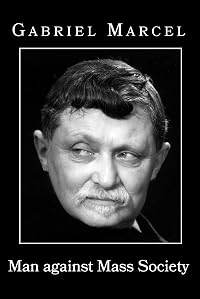
Man against Mass Society
by Gabriel Marcel
On This Page
Description
The central theme of this important book is that we are paying the price of an arrogance that refuses to recognize mystery. The author invites the reader to enter into the argument that he holds with himself on a great number of problems. Written in the early 1950s, Marcel's discussion of these topics are remarkably contemporary, e.g.: * Our crisis is a metaphysical, not merely social, one. * What a man is depends partly on what he thinks he is, and a materialistic philosophy turns men into show more things. * Can a man be free except in a free country? * Stoicism is no longer a workable philosophy because today pressure can be put on the mind as well as on the body. * Technical progress is not evil in itself, but a technique is a means that, regarded as an end, can become either an idol or an excuse for self-idolatry. State control of scientific research, leading to a concentration on new means of destruction, is a calamity. * Fanaticism is an opinion that refuses to argue, and so the fanatic is an enemy of truth. * The kind of unification that science is bringing about today is really an ironing out of differences, but the only valuable kind of unity is one that implies a respect for differences. * We must beware of thinking in terms of great numbers and so blinding ourselves to the reality of individual suffering. Our philosophical approach to being is made possible only by our practical approach to our neighbor. * We must encourage the spirit of fraternity and distrust the kind of egalitarianism that is based on envy and resentment. * No man however humble should feel that he cannot spread the light among his friends. No easy solution is offered, but the author conveys his own faith that ultimately love and intelligence will triumph. show lessTags
Recommendations
























Member Reviews
Members
- Recently Added By
Author Information

89+ Works 1,652 Members
Gabriel Marcel has been described as a theistic or Christian existentialist. Born in Paris of Protestant parents, he converted to Roman Catholicism in 1924. Prior to his conversion, he had immersed himself in idealism, as his first book, a study of Royce's metaphysics, reveals. Before Jaspers and Heidegger were known to French intellectuals, show more Marcel had written about themes central to existentialism, but with a religious twist. He had acknowledged concern for the vitality and pervasiveness of religious experience, and, like Martin Buber, he had pointed to the sociality of human experience, which bears witness to the presence of the Divine. For Marcel, Being involves participation. No one can be separated from the whole of Being to which he or she is related. Nor can a person be reduced to merely a facet of Being; for he or she is a concrete individual, with experience that is immediate, spontaneous, unpredictable. Though entranced by the mystery of existence, a person may illuminate it by means of philosophical reflection. (Bowker Author Biography) show less
Series
Belongs to Publisher Series
Common Knowledge
- Canonical title*
- De mensen contra het menselijke
- Original title
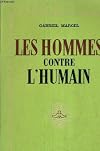
- Les hommes contre l'humain
*Some information comes from Common Knowledge in other languages. Click "Edit" for more information.
Classifications
Statistics
- Members
- 135
- Popularity
- 242,027
- Reviews
- 1
- Rating
- (3.21)
- Languages
- Dutch, English, French
- Media
- Paper, Ebook
- ISBNs
- 8
- ASINs
- 10