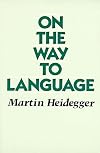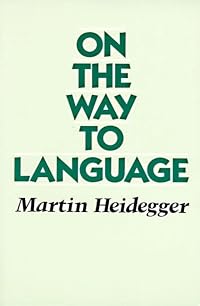
On the Way to Language
by Martin Heidegger
On This Page
Description
"In this volume Martin Heidegger confronts the philosophical problems of language and begins to unfold the meaning behind his famous and little understood phrase "Language is the House of Being." The "Dialogue on Language," between Heidegger and a Japanese friend, together with the four lectures that follow, present Heidegger's central ideas on the origin, nature, and significance of language. These essays reveal how one of the most profound philosophers of our century relates language to show more his earlier and continuing preoccupation with the nature of Being and human being. On the Way to Language enable readers to understand how central language became to Heidegger's analysis of the nature of Being. On the Way to Language demonstrates that an interest in the meaning of language is one of the strongest bonds between analytic philosophy and Heidegger. It is an ideal source for studying his sustained interest in the problems and possibilities of human language and brilliantly underscores the originality and range of his thinking."--Publisher description. show lessTags
Recommendations













Member Reviews
Members
- Recently Added By
Published Reviews
In this volume Martin Heidegger confronts the philosophical problems of language and begins to unfold the meaning begind his famous and little understood phrase "Language is the House of Being."
The "Dialogue on Language," between Heidegger and a Japanese friend, together with the four lectures that follow, present Heidegger's central ideas on the origin, nature, and significance of language. show more These essays reveal how one of the most profound philosophers of our century relates language to his earlier and continuing preoccupation with the nature of Being and himan being.
One the Way to Language enable readers to understand how central language became to Heidegger's analysis of the nature of Being. On the Way to Language demonstrates that an interest in the meaning of language is one of the strongest bonds between analytic philosophy and Heidegger. It is an ideal source for studying his sustained interest in the problems and possibilities of human language and brilliantly underscores the originality and range of his thinking. show less
The "Dialogue on Language," between Heidegger and a Japanese friend, together with the four lectures that follow, present Heidegger's central ideas on the origin, nature, and significance of language. show more These essays reveal how one of the most profound philosophers of our century relates language to his earlier and continuing preoccupation with the nature of Being and himan being.
One the Way to Language enable readers to understand how central language became to Heidegger's analysis of the nature of Being. On the Way to Language demonstrates that an interest in the meaning of language is one of the strongest bonds between analytic philosophy and Heidegger. It is an ideal source for studying his sustained interest in the problems and possibilities of human language and brilliantly underscores the originality and range of his thinking. show less
added by kirstenlund
Author Information

454+ Works 23,448 Members
Martin Heidegger was born in Messkirch, Baden, Germany on September 22, 1889. He studied Roman Catholic theology and philosophy at the University of Frieburg before joining the faculty at Frieburg as a teacher in 1915. Eight years later Heidegger took a teaching position at Marburg. He taught there until 1928 and then went back to Frieburg as a show more professor of philosophy. As a philosopher, Heidegger developed existential phenomenology. He is still widely regarded as one of the most original philosophers of the 20th century. Influenced by other philosophers of his time, Heidegger wrote the book, Being in Time, in 1927. In this work, which is considered one of the most important philosophical works of our time, Heidegger asks and answers the question "What is it, to be?" Other books written by Heidegger include Basic Writings, a collection of Heidegger's most popular writings; Nietzsche, an inquiry into the central issues of Friedrich Nietzsche's philosophy; On the Way to Language, Heidegger's central ideas on the origin, nature and significance of language; and What is Called Thinking, a systematic presentation of Heidegger's later philosophy. Since the 1960s, Heidegger's influence has spread beyond continental Europe and into a number of English-speaking countries. Heidegger died in Messkirch on May 26, 1976. (Bowker Author Biography) show less
Series
Belongs to Publisher Series
Common Knowledge
- Original title
- Unterwegs zur Sprache
- Original publication date
- Verlag Günther Neske Pfullingen, 1959 (original German) (original German); 1971 (English: Hertz) (English: Hertz); 1973, prima edizione italiana
- First words
- L'uomo parla.
Der Mensch spricht. - Original language
- Tedesco
Classifications
Statistics
- Members
- 527
- Popularity
- 56,456
- Reviews
- 1
- Rating
- (3.95)
- Languages
- 10 — Chinese, English, French, German, Hungarian, Italian, Polish, Portuguese, Spanish, Swedish
- Media
- Paper
- ISBNs
- 21
- ASINs
- 8