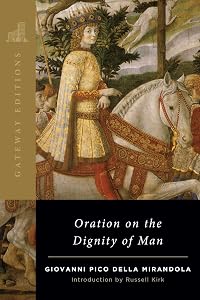
Oration on the Dignity of Man
by Giovanni Pico della Mirandola
On This Page
Description
This is a new translation of and commentary on Pico della Mirandola's most famous work, the Oration on the Dignity of Man. It is the first English edition to provide readers with substantial notes on the text, essays that address the work's historical, philosophical and theological context, and a survey of its reception. Often called the 'Manifesto of the Renaissance', this brief but complex text was originally composed in 1486 as the inaugural speech for an assembly of intellectuals, which show more could have produced one of the most exhaustive metaphysical, theological and psychological debates in history, had Pope Innocent VIII not forbidden it. This edition of the Oration reflects the spirit of the original text in bringing together experts in different fields. Not unlike the debate Pico optimistically anticipated, the resulting work is superior to the sum of its parts. show lessTags
Recommendations












Member Reviews
Delivered in Rome in 1486 by a twenty-four year old scholar before a platoon of erudite theologians and philosophers, Oration on the Dignity of Man is clearly the masterpiece of Renaissance humanism. Della Mirandola's oration fearlessly prepares the ground for debate around the 900 theses he proposed to such an audience, with which he sought to ignite passionate, intellectual discourses on every subject relevant to man.
The speech typifies the Renaissance mind and spirit, celebrating man's most precious gift from God – free will – and our divine potential for good. For della Mirandola, man was made unique in his capacity to choose between dwelling in the carnal, earthy world or to ascend into the heavenly spheres to reach a height show more that equals the cherubiums: “unable to yield to them” he calls, “and impatient of any second place, let us emulate their dignity and glory. And, if we will it, we shall be inferior to them in nothing” (13).
Yet this brilliant soul proves to be quite a mystic as well, as it becomes known in the last twenty pages -- by delicately deviating from Christian doctrine, della Mirandola veers off into the territory of esotericism and the occult, peppering his discourse with mentions of the Kabbalah and gnostic references. He goes as far as to propose a philosophy based upon “divine arithmetic”, which extends the works of Pythagoras, while also defining the two branches of "magic" – that of demonic evil, and that of "the highest realization of natural philosophy" (53). Of course, his esoteric references make certain parts of the oration very inaccessible, but for myself, it exposed me to thinkers and philosophies unheard of, which only delighted me. In a time in which many of the respected thinkers rejected intimate examinations of non-Christian texts and doctrines, this man daringly calls upon those of us yearning to initiate into the spiritual realms, to explore different paths of knowledge to become “a pure contemplator…wholly withdrawn into the inner chambers of the mind” (11).
If you want to read more of my reviews, check out my book blog! show less
The speech typifies the Renaissance mind and spirit, celebrating man's most precious gift from God – free will – and our divine potential for good. For della Mirandola, man was made unique in his capacity to choose between dwelling in the carnal, earthy world or to ascend into the heavenly spheres to reach a height show more that equals the cherubiums: “unable to yield to them” he calls, “and impatient of any second place, let us emulate their dignity and glory. And, if we will it, we shall be inferior to them in nothing” (13).
Yet this brilliant soul proves to be quite a mystic as well, as it becomes known in the last twenty pages -- by delicately deviating from Christian doctrine, della Mirandola veers off into the territory of esotericism and the occult, peppering his discourse with mentions of the Kabbalah and gnostic references. He goes as far as to propose a philosophy based upon “divine arithmetic”, which extends the works of Pythagoras, while also defining the two branches of "magic" – that of demonic evil, and that of "the highest realization of natural philosophy" (53). Of course, his esoteric references make certain parts of the oration very inaccessible, but for myself, it exposed me to thinkers and philosophies unheard of, which only delighted me. In a time in which many of the respected thinkers rejected intimate examinations of non-Christian texts and doctrines, this man daringly calls upon those of us yearning to initiate into the spiritual realms, to explore different paths of knowledge to become “a pure contemplator…wholly withdrawn into the inner chambers of the mind” (11).
If you want to read more of my reviews, check out my book blog! show less
The Oration on the Dignity of Man reads like an introduction to Pico Della Mirandola's 900 theses. If one is looking for a detailed exposition of occult philosophy you won't find it in this short treatise. However, what Pico Della Mirandola does achieve is a polemical call for a synthesis of the esoteric teaching of the ages. He doesn't declaim the exoteric but rather shows how exoteric mysticism and esoteric mysticism coalesce in a grand tradition going back to Hermes Trismegistus, Zoroaster, Jesus etc. On another level this text is of historical relevance for scholars of Rennaisance thought. Pico della Mirandola was precocious, it is amazing that he had done so much research into the esoteric arts, theology, philosophy all at the show more young age of 24. Sadly, he passed young and we don't get to see the full flowering of this erudite humanist thinker. show less
The Oration on the Dignity of Man reads like an introduction to Pico Della Mirandola's 900 theses. If one is looking for a detailed exposition of occult philosophy you won't find it in this short treatise. However, what Pico Della Mirandola does achieve is a polemical call for a synthesis of the esoteric teaching of the ages. He doesn't declaim the exoteric but rather shows how exoteric mysticism and esoteric mysticism coalesce in a grand tradition going back to Hermes Trismegistus, Zoroaster, Jesus etc. On another level this text is of historical relevance for scholars of Rennaisance thought. Pico della Mirandola was precocious, it is amazing that he had done so much research into the esoteric arts, theology, philosophy all at the show more young age of 24. Sadly, he passed young and we don't get to see the full flowering of this erudite humanist thinker. show less
The Renaissance was a time of reevaluation of philosophical and theological teachings in various forms and the results at times were interesting and strange. On the Dignity of Man contains three treatises by Giovanni Pico della Mirandola including the titular treatise has been called the “manifesto of the Renaissance”.
The “Oration on the Dignity of Man” is Pico’s justification of the importance of the human quest for knowledge within a Neoplatonic frame as well as an introduction to his unpublished 900 thesis in which he believed provided complete and sufficient basis for the discovery of all knowledge. The second treatise, “On Being and the One”, is an attempted reconciliation between Platonic and Aristotelian writings on show more the relative place of being and “the one” and a refutation of opposing arguments. The finale treatise, “Heptaplus”, is a mystic-allegorical exposition of the creation according to the seven Biblical senses, elaborates on his idea that different religions and traditions describe the same God.
The titular treatise of this collection is the best of the bunch as Pico is eloquent in his thoughts, justifications, and introducing his thesis. The other two treatise are a combination of Christian, pagan philosophy, and Jewish thought which ultimate stretches credibility even though Pico tries his best to bring forth his ideas. However even thought I’m not truly well read in Plato and Aristotle, even I know they do not agree while Pico tries his best to make them agree. Pico’s belief that all other traditions and religions were pale imitations of future Christianity and thus worthy to be combined with Scripture to bring forth quasi-theological ideas like St. Augustine.
On the Dignity of Man is a collection of treatise by Giovanni Pico in which the titular treatise is the best of the bunch while the other two are well written but utterly worthless due to Pico’s thinking. show less
The “Oration on the Dignity of Man” is Pico’s justification of the importance of the human quest for knowledge within a Neoplatonic frame as well as an introduction to his unpublished 900 thesis in which he believed provided complete and sufficient basis for the discovery of all knowledge. The second treatise, “On Being and the One”, is an attempted reconciliation between Platonic and Aristotelian writings on show more the relative place of being and “the one” and a refutation of opposing arguments. The finale treatise, “Heptaplus”, is a mystic-allegorical exposition of the creation according to the seven Biblical senses, elaborates on his idea that different religions and traditions describe the same God.
The titular treatise of this collection is the best of the bunch as Pico is eloquent in his thoughts, justifications, and introducing his thesis. The other two treatise are a combination of Christian, pagan philosophy, and Jewish thought which ultimate stretches credibility even though Pico tries his best to bring forth his ideas. However even thought I’m not truly well read in Plato and Aristotle, even I know they do not agree while Pico tries his best to make them agree. Pico’s belief that all other traditions and religions were pale imitations of future Christianity and thus worthy to be combined with Scripture to bring forth quasi-theological ideas like St. Augustine.
On the Dignity of Man is a collection of treatise by Giovanni Pico in which the titular treatise is the best of the bunch while the other two are well written but utterly worthless due to Pico’s thinking. show less
Për të gjithë tashmë (e tillë është gjendja fatkeqe ku ndodhemi) studimi i filozofisë sjell përbuzje dhe fyerje, në vend të nderit dhe lavdisë. Bindja vdekjeprurëse dhe monstruoze se filozofia nuk duhet të studiohet fare ose vetëm nga pak njerëz, ka pushtuar pothuajse të gjitha mendjet. Sikur këto çështje që kemi kërkuar me kujdesin më të madh: shkaqet pse ndodhin gjërat, mënyrat si vepron natyra, plani i university, këshillat e Zotit dhe misteret e qiellit dhe të tokës, të ishin diçka e pavlerë para syve dhe duarve tona, veçse nëse dikush me një njohuri të tillë do të përfitonte favore apo të ardhura për veten e tij. Kështu, kemi arritur në pikën ku, është e dhimbshme ta pranojmë, personat show more e vetëm të cilët quhen të mençur janë ata që ndjekjen e dijes e kanë degraduar në një tregti fitimprurëse. Dhe e përkora Pallas, që banon brenda nesh vetëm nga zemërgjerësia e Zotave, refuzohet, tallet, fërshëllehet me përbuzje, duke mos pasur askënd që ta dojë dhe t'i jetë mik. show less
A classic description of the "great chain of being," in which human beings are unique in their ability to change their ontological identities: descending lower than the beasts and/or ascending higher than the angels. Aren't we the lucky ones!
this is why we're arrogant sons of bitches...
Members
- Recently Added By
Lists

Renacimiento
24 works; 1 member

The ESOTERICA Library by Dr. Justin Sledge (Renaissance Magic)
10 works; 1 member
Author Information

Some Editions
Series
Belongs to Publisher Series
Work Relationships
Common Knowledge
- Canonical title*
- La dignità dell'uomo
- Original title
- Oratio de hominis dignitate
- Alternate titles*
- Over de menselijke waardigheid
- Original publication date
- 1486
- Blurbers
- Lewis, John
- Original language*
- Latijn
- Disambiguation notice
- Please do not combine the original Latin with translations ("Dead Language" / scholarship rule), or any editions including other Works. Thank you.
Please do not combine the original Latin with translations ("Dead Language" / scholarship rule), or with any edition not including all the same Works. Thank you.
Please do not combine the original Latin with translations ("Dead Language" / scholarship rule). Thank you.
*Some information comes from Common Knowledge in other languages. Click "Edit" for more information.
Classifications
Statistics
- Members
- 781
- Popularity
- 35,769
- Reviews
- 13
- Rating
- (3.34)
- Languages
- 13 — Catalan, Dutch, English, Finnish, French, German, Galician, Greek, Italian, Latin, Portuguese (Portugal), Spanish, Swedish
- Media
- Paper, Ebook
- ISBNs
- 64
- ASINs
- 17