On This Page
Description
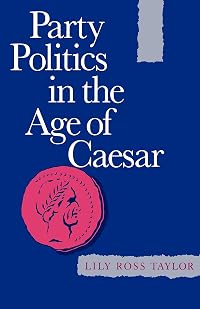
The advice given to Cicero by his astute, campaign-conscious brother to prepare him for the consular elections of 64 B.C., has a curiously modern ring: "Avoid taking a definite stand on great public issues either in the Senate or before the people. Bend your energies towards making friends of key-men in all classes of voters." Party Politics in the Age of Caesar is a shrewd commentary on this text, designed to clarify the true meaning in Roman political life of such terms as "party" and show more "faction." Taylor brilliantly explains the mechanics of Roman politics as she discusses the relations of nobles and their clients, the manipulation of the state religion for political expedience, and the practical means of delivering the vote. show lessTags
Recommendations














Member Reviews
Very informative, though rather outdated in approach and execrably written. And those two things are connected: Taylor's evidence is almost all textual, and I don't mean records and archival material, I mean Sallust and Cicero. And that has had an... interesting impact on her prose. Like a good Roman, Taylor is very keen to make sure a sentence's main verb comes as close to the end of the sentence as possible, which leads to huge amounts of this:
"Cicero, confident in the support of senate and knights, had the execution carried out."
"Although the good men, following Catulus, hailed Cicero as the father of his country, the real hero of the famous Nones of December was not Cicero but Cato."
Perhaps this worked when these pieces were show more delivered as lectures? Perhaps classicists in the forties and fifties just wrote like this? In any case, while reading this I happened to read a review of new classics books by the wonderful Peter Thonnemann. He cautioned us not to idealize the scholarship of the past, before it got all trendy. For example, one "cutting edge" volume of this time period featured nine chapters on individual poets, and one on Roman and Greek historians. Back then, classics was just the classic books. Taylor's book is okay, but very much a period piece. show less
"Cicero, confident in the support of senate and knights, had the execution carried out."
"Although the good men, following Catulus, hailed Cicero as the father of his country, the real hero of the famous Nones of December was not Cicero but Cato."
Perhaps this worked when these pieces were show more delivered as lectures? Perhaps classicists in the forties and fifties just wrote like this? In any case, while reading this I happened to read a review of new classics books by the wonderful Peter Thonnemann. He cautioned us not to idealize the scholarship of the past, before it got all trendy. For example, one "cutting edge" volume of this time period featured nine chapters on individual poets, and one on Roman and Greek historians. Back then, classics was just the classic books. Taylor's book is okay, but very much a period piece. show less
Edition: // Descr: viii, 255 p. 23.5 cm. // Series: Sather Classical Lectures : Volume 22 Call No. { 947 T21 copy #1 } Contains Notes and Index. // //
Edition: // Descr: viii, 255 p. 20.5 cm. // Series: Call No. { 947 T21 copy #2 } Contains Notes and Index. // //
Ratings
Members
- Recently Added By
Author Information

6 Works 311 Members
Series

Common Knowledge
- Canonical title
- Party Politics in the Age of Caesar
- People/Characters
- Julius Caesar; Marcus Tullius Cicero; Marcus Porcius Cato the Younger
- Important places
- Rome, Italy
Classifications
- Genres
- History, Nonfiction, General Nonfiction, Politics and Government
- DDC/MDS
- 930 — History & geography History of ancient world (to ca. 499) Ancient History: China, Egypt, Rome, Greece
- LCC
- DG81 .T38 — History of Europe, Asia, Africa and Oceania City History of Italy Ancient Italy. Rome to 476 Antiquities. Civilization. Culture. Ethnography
- BISAC
Statistics
- Members
- 234
- Popularity
- 139,991
- Reviews
- 4
- Rating
- (3.88)
- Languages
- English, French
- Media
- Paper, Ebook
- ISBNs
- 4
- ASINs
- 9