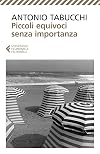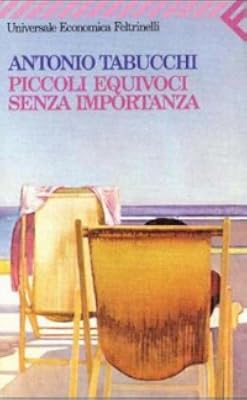
Little Misunderstandings of No Importance
by Antonio Tabucchi
On This Page
Description
The short story collection that launched Tabucchi to fame, reflecting on the uncertainties, memories, mistakes and mysteries of life Eleven short stories pivoting on life's ambiguities and the central question they pose in Tabucchi's fiction: is it choice, fate, accident, or even, occasionally, a kind of magic that plays a decisive role in the protagonists' lives? Set in Paris, Lisbon, Madras and New York and blended with the author's wonderfully intelligent imagination, Tabucchi reflects on show more the elemental aspects of the human experience, exploring grief, uncertainty, adventure, memory and love. 'One of the most admired Italian writers of his generation' The Times show lessTags
Recommendations
















Member Reviews
There are two stories here that make the collection memorable. Tabucchi stories take care and time - his narrator in Little Misunderstandings grapples with the trial of an old friend for some crime that might involve revolutionary politics. He recalls this friend on trial flirting with such ideas at university. Those days were free and open, ideas, relationships, came and went in a voyage of discovery. Our narrator searches for that elusive moment that might explain events of the present in the past. Why one friend he loved is having a mastectomy, why the trial of another is happening, why the judge in the trial is also from the same party of friends at the same university. This confluence happens like the overwhelming rush of memories show more and emotions we all suffer. The past has misunderstandings we take as minor and pass like time. Was the narrator himself responsible for the fate of his friend? In the future, the actions take on a wider scope. Regret that something could be done about it back then crashes against the inability of the present to influence the past. We are left with powerful emotions. It sounds a little Proust when I put it like that, but such things are significant in Tabucchi’s world as though each age needs to explain them over again.
The Trains that Go to Madras is memorable, especially since train journeys in India offer the narrator the experiences one can’t forget easily as he sets off for a few days to do some research on an early Christian martyr while in Madras.
(A little side note, the narrator goes by train using an unusual travel guide (mid 1980s) that recommends trains are better than planes in India, meaning that you will see the real India, though you might get there even a day late, the journey is worth it, unforgettable. The travel guide is of course Lonely Planet’s Survival Kit to India – a local travel book company that abandoned after decades the Survival Kit model for the sober guides and phrasebooks now. Once, these books were everyone’s go to for alternate travel experiences (a strange illusory thing that was never quite as expected). Perhaps they went a little PC. Now we know, travel is a bucket list phenomenon, a formulaic thing, and it’s easy enough to find quick, comfortable experiences everywhere.)
But the experiences in this story are unavailable to travellers except through the medium of literature and imagination. An encounter does guide the narrator to a leap of the imagination at the end. Similarly, India is illusive to the outsider. It is an imagined place. It’s best to accept that your European mind is always at work, seeking the exotic, the spectacular, the ready-made reality. In India it is inevitable to seek solace in what you already know. You discover quickly that you are full of reactions you hadn’t anticipated. Life’s rich pageant is all in your own mind.
The narrator gets a wonderful experience naturally, he did take the advice seriously to travel by train, but he got less an Indian experience than a truly mid-20thC European experience. His mysterious train cabin co-traveller is on a mission to see a Shiva statue in Madras. The co-traveller is full of historical and local recommendations so treats the narrator to another version of Indian experience. He tells also of a dark history in Europe during WW2. Like all Tabucchi stories, the threads lead to a confluence – in this case art and life meet and the possibilities of the imagination provide either the answer, or more possibility. Europeans can’t leave the past behind, they seem to take it with them wherever they go. And the train is not late, but arrives exactly on time as all air-conditioned class trains in India did back then. Stories are never quite as neat, or ironic. show less
The Trains that Go to Madras is memorable, especially since train journeys in India offer the narrator the experiences one can’t forget easily as he sets off for a few days to do some research on an early Christian martyr while in Madras.
(A little side note, the narrator goes by train using an unusual travel guide (mid 1980s) that recommends trains are better than planes in India, meaning that you will see the real India, though you might get there even a day late, the journey is worth it, unforgettable. The travel guide is of course Lonely Planet’s Survival Kit to India – a local travel book company that abandoned after decades the Survival Kit model for the sober guides and phrasebooks now. Once, these books were everyone’s go to for alternate travel experiences (a strange illusory thing that was never quite as expected). Perhaps they went a little PC. Now we know, travel is a bucket list phenomenon, a formulaic thing, and it’s easy enough to find quick, comfortable experiences everywhere.)
But the experiences in this story are unavailable to travellers except through the medium of literature and imagination. An encounter does guide the narrator to a leap of the imagination at the end. Similarly, India is illusive to the outsider. It is an imagined place. It’s best to accept that your European mind is always at work, seeking the exotic, the spectacular, the ready-made reality. In India it is inevitable to seek solace in what you already know. You discover quickly that you are full of reactions you hadn’t anticipated. Life’s rich pageant is all in your own mind.
The narrator gets a wonderful experience naturally, he did take the advice seriously to travel by train, but he got less an Indian experience than a truly mid-20thC European experience. His mysterious train cabin co-traveller is on a mission to see a Shiva statue in Madras. The co-traveller is full of historical and local recommendations so treats the narrator to another version of Indian experience. He tells also of a dark history in Europe during WW2. Like all Tabucchi stories, the threads lead to a confluence – in this case art and life meet and the possibilities of the imagination provide either the answer, or more possibility. Europeans can’t leave the past behind, they seem to take it with them wherever they go. And the train is not late, but arrives exactly on time as all air-conditioned class trains in India did back then. Stories are never quite as neat, or ironic. show less
“Tell me, dear heart, dear chilled heart, what would you say to going to live in Lisbon? It’s surely warm there and you’d revive like a lizard under the sun. The city’s at the water’s edge and they say it’s built of marble. You see it is a country after my own heart; a landscape made up of light and stone, and water to reflect them! And so you walk slowly through this marble city, between 18th-century buildings and arcades that witnessed the days of colonial trade, sailing ships, the bustle and the foggy dawns of anchors being weighted.”
In the short-story “Time is very strange” from the collection “Little Misunderstandings of No Importance” by Antonio Tabucchi, Frances Frenaye (translator)
I am glad authors are show more challenging the homogenisation that is so demanded by many readers. Too much fiction does not reflect real dialogue; I know it can be harder to follow, but it is good that some writing is articulated in that way. Perhaps short-stories are best for this as readers might be able to tolerate for a shorter time than throughout a novel. However, online reviewing is effectively channelling so much writing into narrow parameters which squeeze out interesting and/or innovative approaches. I have also been pleased in recent years to see more short-story collections being physically published, even from obscure writers like Tabucchi (does anyone still read him in this and age?). Ironically short stories and episodic novels are ideal for reading the way most people use e-readers. Yet, the sense that they are an illegitimate form of writing with people saying they are waiting for the ‘full’ novel of the story or feeling that, as if by accident, the author has only published a ‘fragment’ of the ‘proper’ story, is too common. When you read a Tabucchi short-story we don’t have this feeling of incompleteness.
If you’re into Lisbon, my city, read the rest of this review on my blog. show less
In the short-story “Time is very strange” from the collection “Little Misunderstandings of No Importance” by Antonio Tabucchi, Frances Frenaye (translator)
I am glad authors are show more challenging the homogenisation that is so demanded by many readers. Too much fiction does not reflect real dialogue; I know it can be harder to follow, but it is good that some writing is articulated in that way. Perhaps short-stories are best for this as readers might be able to tolerate for a shorter time than throughout a novel. However, online reviewing is effectively channelling so much writing into narrow parameters which squeeze out interesting and/or innovative approaches. I have also been pleased in recent years to see more short-story collections being physically published, even from obscure writers like Tabucchi (does anyone still read him in this and age?). Ironically short stories and episodic novels are ideal for reading the way most people use e-readers. Yet, the sense that they are an illegitimate form of writing with people saying they are waiting for the ‘full’ novel of the story or feeling that, as if by accident, the author has only published a ‘fragment’ of the ‘proper’ story, is too common. When you read a Tabucchi short-story we don’t have this feeling of incompleteness.
If you’re into Lisbon, my city, read the rest of this review on my blog. show less
se mai desiderassi scrivere, vorrei farlo come tabucchi.
Una Toscana segreta e stregata, una stazione della Riviera, una Lisbona baudelairiana, un rallye di automobili d'epoca, un persecutore implacabile dall'aria distinta in un treno da Bombay a Madras. I racconti di Tabucchi sembrano, a una prima lettura, avventure esistenziali, ritratti di viaggiatori ironici e disperati. Poi l'apparente sintonia fra il reale e il narrato diventa all'improvviso turbamento e sconcerto. Come degli obliqui "racconti filosofici", le storie di Tabucchi si trasformano in una riflessione intorno al caso e alla scelta, un tentativo di osservare gli interstizi che attraversano il tessuto dell'esistenza. Nelle pagine di Tabucchi aleggia un'inquietudine metafisica che evoca la migliore tradizione italiana da Piero show more della Francesca a De Chirico, a Pirandello. Ma questo scrittore, che ama i personaggi eccentrici e le vite sbagliate, carica i suoi enigmi di una luce strana; i suoi geroglifici "polizieschi" sono le ricerche di un investigatore che non cerca risposte, ma un messaggio, un segnale, un'apparizione. show less
Mar 18, 2020Italian
Riletta 30 anni dopo (almeno, forse anche 35) la prima raccolta di racconti di Tabucchi mostr pregi e difetti. Alcuni racconti non hanno una fine, o hanno troppi pochi riferimenti per immaginarsi una fine (o anche più fini), altri sono invece scritti benissimo, con finali molto chiari e belli, altri lasciano un po' così, senza infamia e senza lode. Insomma, non mi ha convinto moltissimo al di là della squisita scrittura di Tabucchi, che ha sempre il termine, la punteggiatura e la "metrica" giuste.
Mar 23, 2025Italian
Ratings
Members
- Recently Added By
Lists

Reading LIst
648 works; 1 member
Author Information

204+ Works 7,871 Members
Antonio Tabucchi was born in Pisa, Italy on September 24, 1943. He studied literature and philosophy at the city's university. He was a writer and academic. He was professor of Portuguese literature at the University of Siena and the Italian Cultural Institute in Lisbon. His works include Piazza d'Italia, Piccoli Equivoci Senza Importanza (Little show more Misunderstandings of No Importance), Requiem, uma Alucinaçaõ (Requiem: A Hallucination), Tristano Muore (Tristan Is Dying), and Racconti con Figure. Many of his works were adapted into films including Sostiene Pereira (Pereira Maintains) and Notturno Indiano (Indian Nocturne). In addition to his fictional writing, he translated works by Fernando Pessoa and other Portuguese writers into Italian. He received numerous literary prizes including the Chevalier des Arts et des Lettres in France. In 1993, he was one of the founder members of the International Parliament of Writers and contributed articles to its journal, Autodafé. He died of cancer on March 25, 2012 at the age of 68. (Bowker Author Biography) show less
Some Editions
Awards and Honors
Notable Lists
Series
Belongs to Publisher Series
El brot (40)
Keltainen kirjasto (225)
Gallimard, Folio (4609)
Common Knowledge
- Canonical title
- Little Misunderstandings of No Importance
- Original title
- Piccoli equivoci senza importanza
- Alternate titles*
- Petits malentendus sans importance
- Original publication date
- 1985
- Important places*
- Pisa, Toscane, Italië; Toscane, Italië
- First words
- The clerk called the court to order and there was a brief silence as the nearly white-haired Frederick, in his judge’s robe, led the little procession through the side door into the courtroom.
- Original language*
- Italiaans
*Some information comes from Common Knowledge in other languages. Click "Edit" for more information.
Classifications
- Genres
- Fiction and Literature, General Fiction
- DDC/MDS
- 853.914 — Literature & rhetoric Italian, Romanian & related literatures Italian fiction 1900- 20th Century 1945-1999
- LCC
- PQ4880 .A24 .P53 — Language and Literature French, Italian, Spanish and Portuguese literatures Italian literature Individual authors, 1961-2000
- BISAC
Statistics
- Members
- 376
- Popularity
- 83,022
- Reviews
- 5
- Rating
- (3.47)
- Languages
- 12 — Catalan, Danish, Dutch, English, Finnish, French, German, Italian, Portuguese, Spanish, Swedish, Turkish
- Media
- Paper, Ebook
- ISBNs
- 27
- ASINs
- 4