Repetition: An Essay in Experimental Psychology
by Søren Kierkegaard
On This Page
Tags
Recommendations































Member Reviews
She is the boundary of his being
Kierkegaard met Regine Olsen in Copenhagen in 1837, and, by all appearances, there was a deep attraction between the two. They were engaged in 1840, but Kierkegaard immediately broke off the engagement the following year. Regina married her old tutor in 1847, and the couple left Copenhagen for the Danish West Indies in March 1855. Kierkegaard died in November that same year, having remained a celibate bachelor all his life.
These facts about Kierkegaard's life can be gathered from Wikipedia, and all the rest from his own writings. I first encountered Kierkegaard three years ago when I read Fear and Trembling. I knew nothing about him except his reputation as a Christian philosopher with a keen intellect. show more By the time I finished the book, however, I had learned about his affair with Regina and his innermost thoughts about their relationship. Kierkegaard would not divulge his secrets to any living person, yet he pours his heart out in his books, and Regina is in almost every one of them.
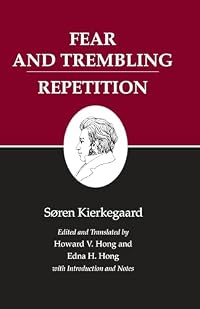
Repetition is a companion and prequel to "Fear and Trembling". A couple of times during reading, I had to keep back sentimental tears from staining the pages (for I borrowed the book from the local library). Kierkegaard wrote that Regina was "the boundary of his being". I suppose he wasn't exaggerating, since he died --became completely dissolved as it were, when she left the city where they both lived.
Can an existentialist love?
Heraclitus says that all things are in motion and nothing at rest, and that you cannot go into the same river twice. Plato counters by arguing that if that is the case, knowledge and love would be impossible. "There will be no one to know and nothing to be known"; in the same vein, there would be no one to love and be loved.
The existentialists seem to subscribe to Heraclitus' view, which makes me wonder whether they can have a normal relationship. If they themselves and the ones they are supposed to love are constantly in the process of becoming, how can they remain in love? As far as I can gather, Nietzsche never had a romantic relationship with woman. ("Suppose truth is a woman, what then?" Then you don't have it, period.)
I cannot say whether Kierkegaard's struggles with love also arise from his existentialist view, which leads the Young Man to proclaim, "I stick my finger into existence -- it smells of nothing." He seems to have progressed from the aesthetic sphere to the religious (in the spirit if not in the flesh), when [b:Works of Love|83324|Works of Love (Kierkegaard's Writings, Volume 16)|Søren Kierkegaard|https://d.gr-assets.com/books/1388373530s/83324.jpg|80455] was published, fours years after Repetition. In that book, he contrasts the worldly conception of love, as sublimated by the poets, with the Christian ideal. show less
Kierkegaard met Regine Olsen in Copenhagen in 1837, and, by all appearances, there was a deep attraction between the two. They were engaged in 1840, but Kierkegaard immediately broke off the engagement the following year. Regina married her old tutor in 1847, and the couple left Copenhagen for the Danish West Indies in March 1855. Kierkegaard died in November that same year, having remained a celibate bachelor all his life.
These facts about Kierkegaard's life can be gathered from Wikipedia, and all the rest from his own writings. I first encountered Kierkegaard three years ago when I read Fear and Trembling. I knew nothing about him except his reputation as a Christian philosopher with a keen intellect. show more By the time I finished the book, however, I had learned about his affair with Regina and his innermost thoughts about their relationship. Kierkegaard would not divulge his secrets to any living person, yet he pours his heart out in his books, and Regina is in almost every one of them.
Repetition is a companion and prequel to "Fear and Trembling". A couple of times during reading, I had to keep back sentimental tears from staining the pages (for I borrowed the book from the local library). Kierkegaard wrote that Regina was "the boundary of his being". I suppose he wasn't exaggerating, since he died --became completely dissolved as it were, when she left the city where they both lived.
Can an existentialist love?
Heraclitus says that all things are in motion and nothing at rest, and that you cannot go into the same river twice. Plato counters by arguing that if that is the case, knowledge and love would be impossible. "There will be no one to know and nothing to be known"; in the same vein, there would be no one to love and be loved.
The existentialists seem to subscribe to Heraclitus' view, which makes me wonder whether they can have a normal relationship. If they themselves and the ones they are supposed to love are constantly in the process of becoming, how can they remain in love? As far as I can gather, Nietzsche never had a romantic relationship with woman. ("Suppose truth is a woman, what then?" Then you don't have it, period.)
I cannot say whether Kierkegaard's struggles with love also arise from his existentialist view, which leads the Young Man to proclaim, "I stick my finger into existence -- it smells of nothing." He seems to have progressed from the aesthetic sphere to the religious (in the spirit if not in the flesh), when [b:Works of Love|83324|Works of Love (Kierkegaard's Writings, Volume 16)|Søren Kierkegaard|https://d.gr-assets.com/books/1388373530s/83324.jpg|80455] was published, fours years after Repetition. In that book, he contrasts the worldly conception of love, as sublimated by the poets, with the Christian ideal. show less
""
Sep 2, 2015French
Ratings
Members
- Recently Added By
Author Information

624+ Works 33,020 Members
Born in Copenhagen, Denmark, Søren Kierkegaard was the son of a wealthy middle-class merchant. He lived all his life on his inheritance, using it to finance his literary career. He studied theology at the University of Copenhagen, completing a master's thesis in 1841 on the topic of irony in Socrates. At about this time, he became engaged to a show more woman he loved, but he broke the engagement when he decided that God had destined him not to marry. The years 1841 to 1846 were a period of intense literary activity for Kierkegaard, in which he produced his "authorship," a series of writings of varying forms published under a series of fantastic pseudonyms. Parallel to these, he wrote a series of shorter Edifying Discourses, quasi-sermons published under his own name. As he later interpreted it in the posthumously published Point of View for My Work as an Author, the authorship was a systematic attempt to raise the question of what it means to be a Christian. Kierkegaard was persuaded that in his time people took the meaning of the Christian life for granted, allowing all kinds of worldly and pagan ways of thinking and living to pass for Christian. He applied this analysis especially to the speculative philosophy of German idealism. After 1846, Kierkegaard continued to write, publishing most works under his own name. Within Denmark he was isolated and often despised, a man whose writings had little impact in his own day or for a long time afterward. They were translated into German early in the twentieth century and have had an enormous influence since then, on both Christian theology and the existentialist tradition in philosophy. (Bowker Author Biography) show less
Series
Belongs to Publisher Series
Kierkegaard Werke (II)
Textos filosòfics (63)
Common Knowledge
- Original title
- Gjentagelsen
- Original publication date
- 1843
Classifications
Statistics
- Members
- 185
- Popularity
- 176,114
- Reviews
- 2
- Rating
- (3.44)
- Languages
- 15 — Catalan, Czech, Danish, Dutch, English, Finnish, French, German, Italian, Norwegian (Bokmål), Portuguese, Russian, Serbian, Spanish, Swedish
- Media
- Paper, Ebook
- ISBNs
- 24
- ASINs
- 7