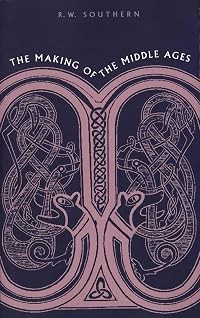
The Making of the Middle Ages
by R. W. Southern
On This Page
Description
A study of the chief personalities and forces which brought Western Europe to preeminence as a center for political experimentation, economic expansion, and intellectual discovery.Tags
Recommendations















Member Recommendations

Member Reviews
After this brief appearance he vanished from history, and the whole incident might be dismissed as one of those inexplicable approaches of worlds moving in different orbits and disturbing for a moment the even tenor tenor of their course, were it not for what followed.
My reading progression was routinely distracted last week. This is customary, hardly an aberration. A return to Chinese literature was a possibility. The killings at Charlie Hebdo changed that. I really appreciate Dr. Southern's work. I'm sure there have been successive waves of disputation and engagement since its publication. This remains a brilliant portrait of an age. The 11th and 12th Centuries were brazen efforts at stability. Augustine, Anselm and Boethius appear show more to be the heroes in this text. I also appreciated Southern's characterization of the opposition between Byzantines and the Latin West: the obscure rituals of the former appearing to the latter like a visit to the Kremlin. There is a subsequent explanation of the Fourth Crusade which appears to be an attempted justification of the sacking of Constantinople. That aside this is a wonderful text. show less
My reading progression was routinely distracted last week. This is customary, hardly an aberration. A return to Chinese literature was a possibility. The killings at Charlie Hebdo changed that. I really appreciate Dr. Southern's work. I'm sure there have been successive waves of disputation and engagement since its publication. This remains a brilliant portrait of an age. The 11th and 12th Centuries were brazen efforts at stability. Augustine, Anselm and Boethius appear show more to be the heroes in this text. I also appreciated Southern's characterization of the opposition between Byzantines and the Latin West: the obscure rituals of the former appearing to the latter like a visit to the Kremlin. There is a subsequent explanation of the Fourth Crusade which appears to be an attempted justification of the sacking of Constantinople. That aside this is a wonderful text. show less
Southern explores a transitional period in the 11th and 12th centuries that led to high medieval culture. Southern's writing is always lucid and enjoyable, and this book is no exception. He discusses the consolidation of political power, and how that resulted in a culture of chivalry. He covers the Crusades, and Europe's increasing engagement with other cultures and awareness of the larger world. Southern's main passion is intellectual culture, and this really comes out in the final chapters that explore education in and out of the monasteries, and the shift from a totally rational culture to a much more emotional culture - this emotional engagement, particularly in religion, is one of the hallmarks of late medieval culture.
This book is show more considered one of the big must-reads for anyone interested in medieval history, and it deserves that reputation. However, I often see it recommended for beginners or people who are just starting to learn about medieval history, and I don't think that is a good audience for this book. For starters, Southern never really explains what he means by "the Middle Ages" - a lot of people are used to thinking of "the Middle Ages" as the period from 400 to 1500, but Southern is using it more specifically to mean the period beginning around 1200. The whole book is about how the culture of the Middle Ages developed, but Southern doesn't tell you at the beginning what that culture is: for this book to truly be useful for beginners, it would be helpful to have a chapter explaining what the world was like at the beginning of the period and what it was like at the end, so that readers would understand what transition he is exploring. This is by no means a criticism of Southern's work: he did not intend this book to be read by people unfamiliar with the period. This is a warning to anyone who thinks this book might be a good introduction to the Middle Ages. show less
This book is show more considered one of the big must-reads for anyone interested in medieval history, and it deserves that reputation. However, I often see it recommended for beginners or people who are just starting to learn about medieval history, and I don't think that is a good audience for this book. For starters, Southern never really explains what he means by "the Middle Ages" - a lot of people are used to thinking of "the Middle Ages" as the period from 400 to 1500, but Southern is using it more specifically to mean the period beginning around 1200. The whole book is about how the culture of the Middle Ages developed, but Southern doesn't tell you at the beginning what that culture is: for this book to truly be useful for beginners, it would be helpful to have a chapter explaining what the world was like at the beginning of the period and what it was like at the end, so that readers would understand what transition he is exploring. This is by no means a criticism of Southern's work: he did not intend this book to be read by people unfamiliar with the period. This is a warning to anyone who thinks this book might be a good introduction to the Middle Ages. show less
As said by other reviewers, this is not an easy book. It is very erudite, and there is a lot of learning to be gained. The big picture is mixed with concrete details of certain places and families. I think it does show its age by its biography, but still very worth the effort. Should be read in conjunction with Wickham and "Framing of the Middle ages".
2161 The Making of the Middle Ages, by R. W. Southern (read 4 Sep 1988) This book by an Oxonian was first published in 1953. It is a very erudite book, and hence not too easy to read. It covers the period from 972 to 1204, and discusses "Latin Christendom and its Neighbors," "The Bonds of Society," "The Ordering of the Christian Life," and "The Tradition of Thought." The tone is very favorable to the age, and I found it a good book: The author is a real student, and there is nothing popularizing about the book.
Points of interest:
Long depopulation gave the soil of tenth century Anjou great fertility
Important distinction between lands of Germanic and Romance speech: latter responsible for Cluny, Citeaux, crusades, growth of learning.
lack of understanding between West and Byzantium becoming worse
Men of Verdun in tenth century exported slaves - probably from Eastern marches - to Spain
In 1141 the Abbot of Cluny organised the translation of fundamental Muslim works: at one stroke this multiplied the means of understanding Islam
Latin world had silver coinage; Greek and Moslem worlds had gold. Former an area of little commerce, the latter of much
St Anselm and St Peter Damian cared little for the idea of a Crusade
Haimo in his Life of Abbo of Fleury show more dates the origin of the Jerusalem pilgrimage as mid-tenth century
The origin of Arab influence on Western culture can be traced with some confidence to the very end of the tenth century
When William Longchamp's enemies accused him of desire for aggrandizement, they called him a "Prester John"
Early Middle Ages a time of great agricultural improvement - by thirteenth century the peasant was in much the same position as he was to be on eve of agrarian revolution
Down to 1215 custom of Church forbade marriage within the 7th degree [how far was this enforced?]
In the high religious view serfdom was not necessarily wicked, but public opinion thought it degrading
"Freedom was not a status like serfdom; it was a quality which was attached to the status of all who were not serfs... It was only when the quality of freedom was articulated by being attached to the status of knight, burgess or baron that it could be observed, analysed and measured."
Rome had 300+ churches by end of twelfth century, and probably not much fewer 200 years earlier
In early eleventh century Pope was, as Duchesne says, "the high-priest of the Roman pilgrimage, the dispenser of benedictions and of privileges and of anathemas." Canute was the last English King to make a pilgrimage to Rome
Gregory VII, alone of rulers of his time, kept copies of important letters
Twelfth century produced some very violent satire against the Curia
Book II of Cassiodorus, Divine and Secular Learning, was a good summary of secular learning in sixth-eleventh centuries
Gerbert the first scholar to lecture on Boethius' Logic. Boethius was to eleventh century what Aristotle was to twelfth and thirteenth.
Gerbert revived use of abacus
We find eleventh century scholars who had no idea what Boethius meant by the interior angles of a triangle
Peter of Blois' letters were a best-seller till seventeenth century
The twelfth century schools made the Bible more familiar than ever before
A very clear account of the pre-Anselmian theology of the Redemption is on pp 234-5 [no evidence of how universal it was]
Chanson de Roland represents pre-Hildebrandine religion" eg it takes for granted that an Archbishop would fight; heroes call on St Michael or St Denis, never on the Virgin. Also "they think more of their lands than of their loves".
Mioracle stories of Our Lady start appearing in large numbers towards the end of eleventh century. Different from earlier miracle stories - powers exercised not to protect this or that church, but for salvation of souls; much vaguer about time and place; concerned with individuals; often indifferent to ordinary morality.
Miracles of Thomas a Becket were most numerous in Middle Ages - but different in kind from those of Our Lady
In early Church there was a prejudice against moving relics of Saints, but eagerness of northern peoples for a share started a large-scale migration of them in ninth century which continued on after the end of this book, and was indeed fed by the fall of Constantinople in 1204, when eg the Holy Rood of Bromholm and the Holy Blood of Westminster came west.
The period covere by this book is 972-1204. The fundamental shifts of emphasis of the period are:
i) Moslem and Greek Orthodox attitudes are real problems.
ii) Scholars are now at grips with Greek and Arab thought.
iii) There is more internationalism and at the same time more individualism.
iv) The study of logic has progressed from almost nil to "undisputed pre-eminence".
v) Life is looked on less as an exercise in endurance and more as a quest.
This would not be an easy book for the non-historian to read: it assumes eg a knowledge of who Gregory VII, Anselm, Bernard were. Nor does it deal with all the changes of this period; eg there is little about trade and nothing about warfare, castle-building, or the development of civil services. But within its limits it is extremely good, and fully deserves the exceptionally favourable reviews it has received.
(notes written 1954) show less
Long depopulation gave the soil of tenth century Anjou great fertility
Important distinction between lands of Germanic and Romance speech: latter responsible for Cluny, Citeaux, crusades, growth of learning.
lack of understanding between West and Byzantium becoming worse
Men of Verdun in tenth century exported slaves - probably from Eastern marches - to Spain
In 1141 the Abbot of Cluny organised the translation of fundamental Muslim works: at one stroke this multiplied the means of understanding Islam
Latin world had silver coinage; Greek and Moslem worlds had gold. Former an area of little commerce, the latter of much
St Anselm and St Peter Damian cared little for the idea of a Crusade
Haimo in his Life of Abbo of Fleury show more dates the origin of the Jerusalem pilgrimage as mid-tenth century
The origin of Arab influence on Western culture can be traced with some confidence to the very end of the tenth century
When William Longchamp's enemies accused him of desire for aggrandizement, they called him a "Prester John"
Early Middle Ages a time of great agricultural improvement - by thirteenth century the peasant was in much the same position as he was to be on eve of agrarian revolution
Down to 1215 custom of Church forbade marriage within the 7th degree [how far was this enforced?]
In the high religious view serfdom was not necessarily wicked, but public opinion thought it degrading
"Freedom was not a status like serfdom; it was a quality which was attached to the status of all who were not serfs... It was only when the quality of freedom was articulated by being attached to the status of knight, burgess or baron that it could be observed, analysed and measured."
Rome had 300+ churches by end of twelfth century, and probably not much fewer 200 years earlier
In early eleventh century Pope was, as Duchesne says, "the high-priest of the Roman pilgrimage, the dispenser of benedictions and of privileges and of anathemas." Canute was the last English King to make a pilgrimage to Rome
Gregory VII, alone of rulers of his time, kept copies of important letters
Twelfth century produced some very violent satire against the Curia
Book II of Cassiodorus, Divine and Secular Learning, was a good summary of secular learning in sixth-eleventh centuries
Gerbert the first scholar to lecture on Boethius' Logic. Boethius was to eleventh century what Aristotle was to twelfth and thirteenth.
Gerbert revived use of abacus
We find eleventh century scholars who had no idea what Boethius meant by the interior angles of a triangle
Peter of Blois' letters were a best-seller till seventeenth century
The twelfth century schools made the Bible more familiar than ever before
A very clear account of the pre-Anselmian theology of the Redemption is on pp 234-5 [no evidence of how universal it was]
Chanson de Roland represents pre-Hildebrandine religion" eg it takes for granted that an Archbishop would fight; heroes call on St Michael or St Denis, never on the Virgin. Also "they think more of their lands than of their loves".
Mioracle stories of Our Lady start appearing in large numbers towards the end of eleventh century. Different from earlier miracle stories - powers exercised not to protect this or that church, but for salvation of souls; much vaguer about time and place; concerned with individuals; often indifferent to ordinary morality.
Miracles of Thomas a Becket were most numerous in Middle Ages - but different in kind from those of Our Lady
In early Church there was a prejudice against moving relics of Saints, but eagerness of northern peoples for a share started a large-scale migration of them in ninth century which continued on after the end of this book, and was indeed fed by the fall of Constantinople in 1204, when eg the Holy Rood of Bromholm and the Holy Blood of Westminster came west.
The period covere by this book is 972-1204. The fundamental shifts of emphasis of the period are:
i) Moslem and Greek Orthodox attitudes are real problems.
ii) Scholars are now at grips with Greek and Arab thought.
iii) There is more internationalism and at the same time more individualism.
iv) The study of logic has progressed from almost nil to "undisputed pre-eminence".
v) Life is looked on less as an exercise in endurance and more as a quest.
This would not be an easy book for the non-historian to read: it assumes eg a knowledge of who Gregory VII, Anselm, Bernard were. Nor does it deal with all the changes of this period; eg there is little about trade and nothing about warfare, castle-building, or the development of civil services. But within its limits it is extremely good, and fully deserves the exceptionally favourable reviews it has received.
(notes written 1954) show less
Dr. Hill History 1980
Members
- Recently Added By
Lists

Folio Society
831 works; 53 members

r/History Recommended Reading List
603 works; 12 members

r/AskHistorians' Recommended Books
1,068 works; 19 members

Books You Read For University
184 works; 3 members

Works cited in The New Science of the Enchanted Universe by Marshall Sahlin
141 works; 1 member
Author Information

20+ Works 3,058 Members
R. W. Southern was a Fellow of Balliol College from 1937 to 1961, Chichele Professor of History at Oxford from 1961 to 1969, and President of St. John's College, Oxford from 1969 to 1981.
Some Editions
Awards and Honors
Distinctions
Notable Lists
Series
Belongs to Publisher Series
Work Relationships
Common Knowledge
- Original publication date
- 1953
- People/Characters
- Anselm of Canterbury (1033-1109); Bernard of Clairvaux; Gregory VII, Pope (c.1015/1020-1085); Agnes of Poitou; Peter Lombard (1100-1160); Peter of Blois (show all 14); Fulk Nerra; Liudprand, Bishop of Cremona; Peter the Venerable; Chrétien of Troyes; Gerbert of Aurillac; Fulbert of Chartres (960-1028); Boethius; Peter Abelard (1079-1142)
- Important places
- Europe
- First words
- The formation of western Europe from the late tenth to the early thirteenth century is the subject of this book. (Introduction)
It is easy to forget that the idea of the unity of Western civilization with which we are familiar arises from a radical simplification of the past. (Chapter I)
Classifications
Statistics
- Members
- 1,227
- Popularity
- 20,269
- Reviews
- 10
- Rating
- (4.03)
- Languages
- 5 — Danish, Dutch, English, German, Spanish
- Media
- Paper
- ISBNs
- 11
- ASINs
- 24