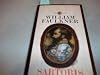
Sartoris
by William Faulkner
On This Page
Description
First published in 1929 by Harcourt, Brace and Company, New York, now public domain in the US and Canada, William Faulkner's ''Sartoris'' portrays the decay of the Mississippi aristocracy following the social upheaval of the American Civil War. It also deals with the decay of an aristocratic southern family just after the end of World War I. The novel begins with the return of young Bayard Sartoris from the First World War. Bayard and his twin brother John, who was killed in action, were show more fighter pilots. Young Bayard is haunted by the death of his brother. That and the family disposition for foolhardy acts push him into a pattern of self-destructive behavior, especially reckless driving in a recently purchased automobile and crashing it. During convalescence, he meets Narcissa Benbow, but will marriage curb his self-destructive behavior? show lessTags
Recommendations














































Member Recommendations

Cecrow The 1929 edition of Sartoris is an abridged version of Faulkner's original work. The full text was published in 1973 as Flags in the Dust.
Member Reviews
This book is full of humor, despair, confusing interpersonal interactions, the casually accepted racism of the early-20th-century South, and really vigorous, gorgeous (if sometimes kind of adjectival and adverby) prose. The Sartoris men are insufferable (and cyclically so), Miss Jenny a hoot, Narcissa and Horace mostly puzzling, and Simon and family caricaturish and problematically delightful. Favorite bits include Old Bayard's trip to the Memphis doctor for his wen, Thanksgiving with Loosh, and the gut-punch of young Bayard's visit to the MacCallums. The Snopes side plot is kind of weird and seems like maybe it should have been cut along with the other stuff that was cut as this book transformed from the unpublishable Flags in the Dust show more into Sartoris. On the whole a really enjoyable read thanks to some of the memorable characters and the way the words are strung together. show less
Sartoris is the first novel Faulkner located in Yoknapatawpha County where he would go on to set fourteen more novels. In it he introduces the Sartoris family but the Snopes are also present in this early novel. It seems that he began to find his own voice in this novel, improving over his two earlier offerings (Soldiers' Pay and Mosquitoes).
He tells the story of a Southern family of the 'romantic' type, exhibiting chivalry and courage in a haughty and sometimes vain style. Bayard the younger, his grandfather is also a Bayard, comes home after the Great War and succeeds in demonstrating a recklessness that is more in tune with the times than traditional Sartoris family life is comfortable with. Thus there is the tension between show more tradition and modernity that permeates the novel. Faulkner's inimitable prose style is beginning to emerge and there are paragraphs of pure poetry in prose. Though not so many as would appear in works following. The combination of story and soul, action and intimations of the future provides a satisfying introduction to the South as seen from a porch in Yoknapatawpha County. show less
He tells the story of a Southern family of the 'romantic' type, exhibiting chivalry and courage in a haughty and sometimes vain style. Bayard the younger, his grandfather is also a Bayard, comes home after the Great War and succeeds in demonstrating a recklessness that is more in tune with the times than traditional Sartoris family life is comfortable with. Thus there is the tension between show more tradition and modernity that permeates the novel. Faulkner's inimitable prose style is beginning to emerge and there are paragraphs of pure poetry in prose. Though not so many as would appear in works following. The combination of story and soul, action and intimations of the future provides a satisfying introduction to the South as seen from a porch in Yoknapatawpha County. show less
En Sartoris, Faulkner disecciona una clase social en decadencia a partir de una familia heredera de las tradiciones aristocráticas del Sur, a la que sólo le queda la retórica romántica, el orgullo y la autocompasión para enfrentarse a un mundo en el que ya no encuentra su sitio.
Jul 25, 2013 (Edited)Spanish
OB-4
Dec 14, 2020Catalan
Ratings
Members
- Recently Added By
Lists

20th Century Literature
1,161 works; 55 members
Author Information

460+ Works 98,912 Members
Born in an old Mississippi family, William Faulkner made his home in Oxford, seat of the University of Mississippi. After the fifth grade he went to school only off and on-lived, read, and wrote much as he pleased. In 1918, refusing to enlist with the "Yankees," he joined the Canadian Air Force, and was transferred to the British Royal Air Force. show more After the war he studied a little at the University, did house painting, worked as a night superintendent at a power plant, went to New Orleans and became a friend of Sherwood Anderson, then to Europe and back home to Oxford. By this time he had written two novels. The Sound and the Fury followed in 1929. Financial success came with Sanctuary in 1931, which he assisted in filming. Faulkner 's novels are intense in their character portrayals of disintegrating Southern aristocrats, poor whites, and African Americans. A complex stream-of-consciousness rhetoric often involves Faulkner in lengthy sentences of anguished power. Most of his tales are set in the mythical Yoknapatawpha County, Mississippi, and are characterized by the use of many recurring characters from families of different social levels spanning more than a century. His best subjects are the old, dying South and the newer materialistic South. As I Lay Dying (1930), is a grotesquely tragicomic story about a family of poor southern whites. With Absalom, Absalom! (1936); the difficult parts of his famous short novel "The Bear" (published in Go Down, Moses, 1942); and the allegorical A Fable (1954), a non-Yoknapatawpha novel set in France during World War I; Faulkner returned to an innovative and difficult style that most readers have trouble with. Yet, interspersed among such works are collections of easily read stories originally published in popular magazines. There seems to be a growing sentiment among critics that the Snopes trilogy-The Hamlet (1940), The Town (1957), and The Mansion (1959)-for the most part an example of Faulkner's "moderate" style, could well be among his most important works. Faulkner was awarded the 1949 Nobel Prize for literature "for his powerful and artistically independent contribution to the new American novel," but it would appear now that he also deserved to win that honor for his contribution to world literature. When reporting his death, the Boston Globe quoted Faulkner's having once told an interviewer: "Since man is mortal, the only immortality for him is to leave something behind him that is immortal since it will always move. That is the artist's way of scribbling "Kilroy was here" on the wall of the final and irrevocable oblivion through which he must some day pass." In addition to the Nobel Prize, Faulkner received the Howells Medal of the American Academy of Arts and Letters in 1950, and in 1951 he was given the National Book Award for his Collected Stories Collected Stories. For his novel A Fable he received the National Book Award for the second time, as well as the Pulitzer Prize in 1955. The Reivers (1962) was awarded the Pulitzer Prize in 1963. In 1957 and 1958, he was the University of Virginia's first writer-in-residence, and in January 1959 he accepted an appointment as consultant on contemporary literature to the Alderman Library of that university. Although Faulkner was not without honors in his lifetime and has received world recognition since then, it is surprising to learn that, when Malcolm Cowley edited The Portable Faulkner in 1946, he found that almost all of Faulkner's books were out of print. By arranging selections from the works to form a continuous chronicle, Cowley deserves much of the credit for making readers aware of the way in which Faulkner was creating a fictive world on a scale grander than that of any novelist since Balzac. William Faulkner died in Oxford, Mississippi, in 1962. (Bowker Author Biography) show less
Some Editions
Awards and Honors
Series
Belongs to Publisher Series
Work Relationships
Is contained in
Is an abridged version of
Common Knowledge
- Canonical title*
- Sartoris
- Original publication date
- 1929
- People/Characters
- Nathan Bedford Forrest; John Sartoris; Bayard Sartoris; J. E. B. Stuart
- Important places
- Yoknapatawpha County, Mississippi, USA; Mississippi, USA
- Dedication
- To Sherwood Anderson
through whose kindness
I was first published, with the belief
that this book will give him no reason
to regret that fact - First words
- As usual, old man Falls had brought John Sartoris into the room with him, had walked the three miles in from the county Poor Farm, fetching, like an odor, like the clean dusty smell of his faded overalls, the spirit of the de... (show all)ad man into that room where the dead man's son sat..."
- Last words
- (Click to show. Warning: May contain spoilers.)Beyond Miss Jenny's trim, fading head the maroon curtains hung motionless; beyond the window evening was a windless lilac dream, foster dam of quietude and peace.
*Some information comes from Common Knowledge in other languages. Click "Edit" for more information.
Classifications
Statistics
- Members
- 690
- Popularity
- 41,229
- Reviews
- 4
- Rating
- (3.69)
- Languages
- 9 — English, Estonian, French, German, Hungarian, Italian, Portuguese, Romanian, Spanish
- Media
- Paper, Audiobook, Ebook
- ISBNs
- 39
- ASINs
- 20