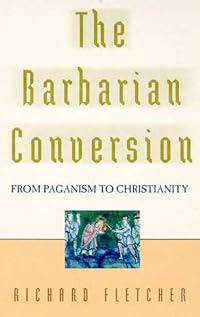
The Barbarian Conversion: From Paganism to Christianity
by Richard Fletcher
On This Page
Description
"An investigation of the process by which large parts of Europe accepted the Christian faith between the fourth and the fourteenth centuries and of some of the cultural consequences that flowed therefrom." In a work of splendid scholarship that reflects both a firm mastery of difficult sources and a keen intuition, one of Britain's foremost medievalists tells the story of the Christianization of Europe. It is a very large story, for conversion encompassed much more than religious belief. show more With it came enormous cultural change: Latin literacy and books, Roman notions of law and property, and the concept of town life, as well as new tastes in food, drink, and dress. Whether from faith or by force, from self-interest or by revelation, conversion had an immense impact that is with us even today. It is Richard Fletcher's achievement in this superb work that he makes that impact both felt and understood. - Publisher. show lessTags
Recommendations


















Member Reviews
Richard Fletcher's liberal-minded account of the christianisation of Europe from just before the fall of the Western Roman Empire (if it could be said to have fallen at all, given the continuing role of the Church of Rome) to the end of Lithuanian paganism is well worth reading.
It is classic narrative history starting at the beginning and ending at the end with a couple of analytical chapters in the middle and end to give us some sense of what it may all have 'meant'. He writes fluently even if some readers are going to be boondoggled by the flow of obscure names.
His judgements are generally wise ones although he almost lost a star with an excessively (almost sneering, quite unlike him) dismissal of Marxist cynicism. There are good show more reasons to be cynical about the motives behind the process of christianisation.
He redeems himself somewhat by giving us sufficient evidence of the variety of political, social and economic motives for becoming at least ritualistically christian to allow us to make up our own minds while confirming that the churchmen involved were 'true believers'.
There is no incompatibility involved in class interests aligning themselves with activist faith-based imagined worlds - after all, we are going through a similar phase of mixed faith and cynicism in the alignment of government and business with the green agenda of St. Greta of Thunberg,
Historians, like philosophers, must be prepared to accept that it is possible for many impossible things not only to be thought before breakfast but subsequently aligned so that they appear to be coherent and logical in order to meet the practical needs of all sides. People are very clever.
Fletcher's weakness perhaps is only in accepting this process as more good than it was insofar as the 'victims' of both activist faith-bringers and warrior and then kingly elites were always going to be the poor bloody sods who had to till the fields and do the dirty work.
I found it heartening in his final chapter that so many of these poor sods still held onto their peasant magical thinking in preference to the magical thinking of intellectuals given that non-magical thinking (our own preferred mode of thinking) was still centuries away.
Was this conversion process benign or malign? Neither probably, much as imperialism, whether Roman or British, cannot be simplified into good or evil. There are benefits of order and relief of poverty in having kings and monasteries. There are disbenefits of exploitation and social control.
Certainly the character of the Church follows an age-old pattern repeated in many societies including ours today. The good tends to get shunted aside in favour of the bad as any form of possible alternative or dissent disappears.
Fletcher is good on the early emergence of the Adelskirche (church as nobility) as warrior societies dumped their war band pseudo-egalitarianism in favour of anointings and fixed land-holding. Clever romanised bosses and intelligent warrior kings could use the church for their own ends.
This is not to claim that the Church was ever just the creature of the aristocracy. This was a partnership that might even break down periodically. The Church had a lot going for it - soft power dominance, heirdom to Roman prestige, a core intellectual consistency, expertise.
The 1,000 year process of turning Western Europe into Western Christendom is shown to have had its logic in this book. As Fletcher wisely points out, the point was that the christians were simply more organised than the pagans to the point where you end up feeling sorry for the latter.
Christendom starts to turn nasty to the degree that its power becomes concentrated. The first major sign of what this may mean (although it was always implicit in Augustine's vicious attitude towards the Donatists) was the brutal treatment of the Saxon pagans by Charlemagne.
However, this arose from the frustrations of power politics. As so often, the battered Saxons became more christian than the christians who worried about their treatment when it came to battering the Wends and other Slavs, a Germanic neurosis that would last in some form until 1945.
The turn to evil (and that is what it must be called) takes place somewhere around the end of the tenth and beginning of the eleventh centuries with the generalisation of a crusading impulse that turned Christian warriors into precisely the same sort of thugs as pagan warlords.
It is a well-worn observation that children who are battered tend to batter their children and the behaviour of the Germans might be considered evidence in favour of that maxim when the evils of crusader ideology came home to roost in the Baltic.
What is interesting about this process is the unthinking role of some fanatic Churchmen, very different in character from earlier generations, not so much fanatic as enthusiastic, who had constructed a missionary ideal in stages during the early middle ages.
By the end of the book (the last half of the fourteenth century), we see a powerful and organised pagan kingdom in Lithuania, last man standing but too late to resist Christianity, undertaking highly skilled negotiations to ensure its political success by adopting the incoming religion.
In essence, Christianity was the soft power survival of the massively prestigious and organised (superior even in collapse) world of 'Romanitas', the vehicle of both order and human exploitation in the interests of collaborating elites but also constraining those elites into right behaviour.
By adopting the 'right behaviour' of a modified christian 'Romanitas', elites got prestige, social control (through family members) and rights to human exploitation in return for modifying their behaviours to maintain some semblance of order and reduce the effects of their inhuman instincts.
So, neither entirely good not entirely bad, the christianisation process was simply how one set of humans in one part of the world managed themselves in a time of limited resources, controlling greed for plunder and employing the emotional and intellectual talents of a class of scribblers.
It was progress of a kind for land owners, merchants and intellectuals though it simply shuffled the cards for the rest of humanity (the bulk of it) as they remained under the control of collaborating plunderers of land and souls.
Older traditions and certainties and a lot of personal autonomy went out of the window although it is true that the Church would provide (at its best) relief from poverty and restraints on lordly behaviour (when it chose to exercise moral authority). As we say, neither good nor bad.
From the point of view of many ordinary folk, the early middle ages under Roman christianity might seem like a golden age sandwiched between an age of predatory enslaving pirates and warlords and the utter lunacy of the Church Reformers, Reformation and Counter-Reformation.
A well ordered and mostly sensitive and kind book with none of my sourness towards the utter absurdity of religious magical thinking, this is well worth reading if only because of its complete honesty in laying out the facts on which we can have our own opinion. show less
It is classic narrative history starting at the beginning and ending at the end with a couple of analytical chapters in the middle and end to give us some sense of what it may all have 'meant'. He writes fluently even if some readers are going to be boondoggled by the flow of obscure names.
His judgements are generally wise ones although he almost lost a star with an excessively (almost sneering, quite unlike him) dismissal of Marxist cynicism. There are good show more reasons to be cynical about the motives behind the process of christianisation.
He redeems himself somewhat by giving us sufficient evidence of the variety of political, social and economic motives for becoming at least ritualistically christian to allow us to make up our own minds while confirming that the churchmen involved were 'true believers'.
There is no incompatibility involved in class interests aligning themselves with activist faith-based imagined worlds - after all, we are going through a similar phase of mixed faith and cynicism in the alignment of government and business with the green agenda of St. Greta of Thunberg,
Historians, like philosophers, must be prepared to accept that it is possible for many impossible things not only to be thought before breakfast but subsequently aligned so that they appear to be coherent and logical in order to meet the practical needs of all sides. People are very clever.
Fletcher's weakness perhaps is only in accepting this process as more good than it was insofar as the 'victims' of both activist faith-bringers and warrior and then kingly elites were always going to be the poor bloody sods who had to till the fields and do the dirty work.
I found it heartening in his final chapter that so many of these poor sods still held onto their peasant magical thinking in preference to the magical thinking of intellectuals given that non-magical thinking (our own preferred mode of thinking) was still centuries away.
Was this conversion process benign or malign? Neither probably, much as imperialism, whether Roman or British, cannot be simplified into good or evil. There are benefits of order and relief of poverty in having kings and monasteries. There are disbenefits of exploitation and social control.
Certainly the character of the Church follows an age-old pattern repeated in many societies including ours today. The good tends to get shunted aside in favour of the bad as any form of possible alternative or dissent disappears.
Fletcher is good on the early emergence of the Adelskirche (church as nobility) as warrior societies dumped their war band pseudo-egalitarianism in favour of anointings and fixed land-holding. Clever romanised bosses and intelligent warrior kings could use the church for their own ends.
This is not to claim that the Church was ever just the creature of the aristocracy. This was a partnership that might even break down periodically. The Church had a lot going for it - soft power dominance, heirdom to Roman prestige, a core intellectual consistency, expertise.
The 1,000 year process of turning Western Europe into Western Christendom is shown to have had its logic in this book. As Fletcher wisely points out, the point was that the christians were simply more organised than the pagans to the point where you end up feeling sorry for the latter.
Christendom starts to turn nasty to the degree that its power becomes concentrated. The first major sign of what this may mean (although it was always implicit in Augustine's vicious attitude towards the Donatists) was the brutal treatment of the Saxon pagans by Charlemagne.
However, this arose from the frustrations of power politics. As so often, the battered Saxons became more christian than the christians who worried about their treatment when it came to battering the Wends and other Slavs, a Germanic neurosis that would last in some form until 1945.
The turn to evil (and that is what it must be called) takes place somewhere around the end of the tenth and beginning of the eleventh centuries with the generalisation of a crusading impulse that turned Christian warriors into precisely the same sort of thugs as pagan warlords.
It is a well-worn observation that children who are battered tend to batter their children and the behaviour of the Germans might be considered evidence in favour of that maxim when the evils of crusader ideology came home to roost in the Baltic.
What is interesting about this process is the unthinking role of some fanatic Churchmen, very different in character from earlier generations, not so much fanatic as enthusiastic, who had constructed a missionary ideal in stages during the early middle ages.
By the end of the book (the last half of the fourteenth century), we see a powerful and organised pagan kingdom in Lithuania, last man standing but too late to resist Christianity, undertaking highly skilled negotiations to ensure its political success by adopting the incoming religion.
In essence, Christianity was the soft power survival of the massively prestigious and organised (superior even in collapse) world of 'Romanitas', the vehicle of both order and human exploitation in the interests of collaborating elites but also constraining those elites into right behaviour.
By adopting the 'right behaviour' of a modified christian 'Romanitas', elites got prestige, social control (through family members) and rights to human exploitation in return for modifying their behaviours to maintain some semblance of order and reduce the effects of their inhuman instincts.
So, neither entirely good not entirely bad, the christianisation process was simply how one set of humans in one part of the world managed themselves in a time of limited resources, controlling greed for plunder and employing the emotional and intellectual talents of a class of scribblers.
It was progress of a kind for land owners, merchants and intellectuals though it simply shuffled the cards for the rest of humanity (the bulk of it) as they remained under the control of collaborating plunderers of land and souls.
Older traditions and certainties and a lot of personal autonomy went out of the window although it is true that the Church would provide (at its best) relief from poverty and restraints on lordly behaviour (when it chose to exercise moral authority). As we say, neither good nor bad.
From the point of view of many ordinary folk, the early middle ages under Roman christianity might seem like a golden age sandwiched between an age of predatory enslaving pirates and warlords and the utter lunacy of the Church Reformers, Reformation and Counter-Reformation.
A well ordered and mostly sensitive and kind book with none of my sourness towards the utter absurdity of religious magical thinking, this is well worth reading if only because of its complete honesty in laying out the facts on which we can have our own opinion. show less
This is a fantastic history covering a critical episode shaping Europe and, through that, the world. Although the scholarly writing could have been pedantic, the author writes in an easy style and his love of history clearly shows.
One of the key aspects I enjoyed also demonstrated the sheer depth of Mr. Fletcher's knowledge of the subject. He often cites conflicting accounts and views and the problems and benefits with each. Additionally, he isn't afraid to show how much he doesn't know and how much of what is written is based on assumption, perspective, or inference.
Rather than approach the topic as Christian vs pagan or a conflict theory perspective, Fletcher approaches the topic from the unique conditions, motivations, and show more traditions inherent in the mission fields. He discusses the commonalities as well as specifics to each time, place, and people. Why were missionaries unsuccessful at one time period, but successful in others?
I appreciated his discussions of the evolution of the church. This is easily illustrated in the use of vernacular vs "sacred" languages controversies. The early manuscripts in Hebrew, Koine Greek, and Aramaic were the common languages of their day. Translating them to Latin was a big deal, not because Latin was holy, but because it was the common language. Cyril and Methodius translated the Greek rites and rituals into the local vernacular (Old Slavonic) so that the Christian message could reach more people. This caused controversy at the time because some felt the language of rites should be Latin, Greek or Hebrew - none of which were the vernacular of the mission fields. Part of the Russian Orthodox schism stemmed from the departure of Old Slavonic hundreds of years later (in addition to 2 vs 3 fingered crosses or 2 or 3 allelujahs). Fast forward to the 20th century controversies of the Second Vatican with its allowance of vernacular rites and liturgy or the fringe Protestant insistence that the King James Bible is the only true Bible. These vernacular vs sacred controversies have been ongoing for 1700 years, more or less, and are generally indicative of those with evangelistic Great Commission vs those tied to man's traditions.
Although I understood how monasteries worked at the edges of society to reclaim marginal lands for productive use, how the Orders worked as banking institutions and furthered the Western model of popular education, but I didn't understand their critical role in evangelizing Europe. There is still a considerable amount of uncharitable veneer from Reformers and Protestants toward shaping the conception of monks and monasteries, nuns and abbeys, as dried husks chanting ancient monotones, hoarding their spiritual gifts rather than following the Great Commission. In their time, monasteries were the vehicles of knowledge, missionary activity, and pastoral care.
Although scholarly, The COnversion of Europe is easily approachable and fills in many gaps that other histories of Europe leave out. This is essential reading to understanding European history as well as the evolution of the church. show less
One of the key aspects I enjoyed also demonstrated the sheer depth of Mr. Fletcher's knowledge of the subject. He often cites conflicting accounts and views and the problems and benefits with each. Additionally, he isn't afraid to show how much he doesn't know and how much of what is written is based on assumption, perspective, or inference.
Rather than approach the topic as Christian vs pagan or a conflict theory perspective, Fletcher approaches the topic from the unique conditions, motivations, and show more traditions inherent in the mission fields. He discusses the commonalities as well as specifics to each time, place, and people. Why were missionaries unsuccessful at one time period, but successful in others?
I appreciated his discussions of the evolution of the church. This is easily illustrated in the use of vernacular vs "sacred" languages controversies. The early manuscripts in Hebrew, Koine Greek, and Aramaic were the common languages of their day. Translating them to Latin was a big deal, not because Latin was holy, but because it was the common language. Cyril and Methodius translated the Greek rites and rituals into the local vernacular (Old Slavonic) so that the Christian message could reach more people. This caused controversy at the time because some felt the language of rites should be Latin, Greek or Hebrew - none of which were the vernacular of the mission fields. Part of the Russian Orthodox schism stemmed from the departure of Old Slavonic hundreds of years later (in addition to 2 vs 3 fingered crosses or 2 or 3 allelujahs). Fast forward to the 20th century controversies of the Second Vatican with its allowance of vernacular rites and liturgy or the fringe Protestant insistence that the King James Bible is the only true Bible. These vernacular vs sacred controversies have been ongoing for 1700 years, more or less, and are generally indicative of those with evangelistic Great Commission vs those tied to man's traditions.
Although I understood how monasteries worked at the edges of society to reclaim marginal lands for productive use, how the Orders worked as banking institutions and furthered the Western model of popular education, but I didn't understand their critical role in evangelizing Europe. There is still a considerable amount of uncharitable veneer from Reformers and Protestants toward shaping the conception of monks and monasteries, nuns and abbeys, as dried husks chanting ancient monotones, hoarding their spiritual gifts rather than following the Great Commission. In their time, monasteries were the vehicles of knowledge, missionary activity, and pastoral care.
Although scholarly, The COnversion of Europe is easily approachable and fills in many gaps that other histories of Europe leave out. This is essential reading to understanding European history as well as the evolution of the church. show less
This author annoyed me with his obvious biases and slant on scant historical information. There is little to no writing about paganism in this book, but the author does not let that stop him from implying in the title that we might actually get some understanding about paganism. Nope. As it does not advance the author's Christian bias, it gets no coverage. For example, on page 55, he relates a story about a young man who "had a violent fit of trembling and then fell down in a coma." His people *interpreted* this as "the work of the Devil" according to the *Christian* who is relating this story. Yet his people called in a shaman or witch or healer (read: pagan. The author is intentionally vague about what the person is called) who show more performed the duties of a modern day *doctor*. The "doctor" could not do much for the boy (Just as modern day doctors cannot sometimes heal someone in a coma, but does the author point that out? No.) and then the young man's family take him to a shrine of a Christian and he is "miraculously" cured. Absolutely no mention is made as to why pagan people would call this epileptic seizure the work of the "Devil", as they don't use that language and further, if they were Christians, why would they go to a shaman/witch in the first place? Additionally, no mention is made of the fact that we know that people come out of comas on their own, and that perhaps, just perhaps, this young man came out of his coma after being jostled everywhere and then people attributed it to a shrine. If his family had stopped by a nearby old tree and the young man had awakened, would the tree then bring about miraculous cures? I think not. This book is filled with example after example of things like that, with no effort on the author's part to be logical or realistic or interpret events in a more feasible and likely manner.
Further, when the author writes about people whom we would call *schizophrenic* today (People who hear voices and then do what they say are locked up *for a reason*) he states, "No one can doubt the authenticity of the experience" (p.85). Um, yeah, we can. And I do. People did not perform miracles. People did not stand on ledges for 37 *years*. People did not dry up a lake by striking it with a stick. People who hear voices need psychiatric help, not encouragement of their mental disease.
Lastly, the author seems to have no comprehension of irony. When a woman is described as "converting" her pagan husband to Christianity, then she is lauded - she is *wonderful*, a paragon of virtue, her name will be written down and remembered. When a nameless pagan woman "converts" her husband to paganism, she "seduces him... and perverts him from the sincerity of his faith." The author makes no comment on how the two women, doing the *same exact thing*, are written about in wholly different manners. Argh! This book is chock full of examples like that, where if it advances the author's Christian worldview, then it is good, if it does not, it is to be degraded.
I do not recommend this book. show less
Further, when the author writes about people whom we would call *schizophrenic* today (People who hear voices and then do what they say are locked up *for a reason*) he states, "No one can doubt the authenticity of the experience" (p.85). Um, yeah, we can. And I do. People did not perform miracles. People did not stand on ledges for 37 *years*. People did not dry up a lake by striking it with a stick. People who hear voices need psychiatric help, not encouragement of their mental disease.
Lastly, the author seems to have no comprehension of irony. When a woman is described as "converting" her pagan husband to Christianity, then she is lauded - she is *wonderful*, a paragon of virtue, her name will be written down and remembered. When a nameless pagan woman "converts" her husband to paganism, she "seduces him... and perverts him from the sincerity of his faith." The author makes no comment on how the two women, doing the *same exact thing*, are written about in wholly different manners. Argh! This book is chock full of examples like that, where if it advances the author's Christian worldview, then it is good, if it does not, it is to be degraded.
I do not recommend this book. show less
Everyone knows Christianity started as a small sect in the Roman Empire and ended up as the religion of all Europe. This book fills in the gaps (or at least gaps for non-Europeans) about how exactly the religion got from point A to point B. It's a look at the spread of Christianity from a predominantly urban religion to the Roman peasantry to the barbarian tribes who replaced Roman rule in Europe, then to the periphery where the legions had never marched. I'm glad to have this hole in my history filled in, though the book was rather dense, full of names and places quickly forgotten. Still, I was particularly impressed with how the author handled the miracle stories and hagiographies so dominant in contemporary accounts of early show more Christianity — neither overly skeptical nor credulous, Fletcher recounts the stories of saints performing miracles with more of a concern for what the people of the time believed than how modern readers would view them. show less
The Barbarian Conversion: From Paganism to Christianity covers about a thousand years of Christian History – a period running from about the third century to the middle of the thirteenth century. By ‘barbarian’ Fletcher, of course, uses the term in the way the Christian religious of this time used it – anyone not a Christian was a barbarian.
The book follows, primarily and in minute detail, the progression of the conversion of the barbarians of Europe and the men who spent their lives in pursuit of task of capturing the world for Christ. There is some effort made by these missionaries of Christianity to take on the conversion of the Jews and the Muslims, but they had barely any success. The success which they did have was show more accomplish mainly at the point of a sword, on the rack or by using the kind of logic that worked with these people – mainly the Northmen, Goths, Celts, Slavs, Huns and their descendants. If their gods were better than Christ why did they live in such cold and/or inhospitable places and why did the Christian peoples seem to have all the material things worth having, things the barbarians fiercely coveted if the Christian god was not the correct and true god? In most cases, this was stunning logic to these people. Barbarians apparently were also highly susceptible to the missionizing of their women – their Christian wives or the female Christian slaves they took to their beds. Many a powerful king, warrior or chieftain was persuaded to give up the gods of his ancestors for the new religion. The marriages were arranged with an eye to conversion and the subsequent political and monetary benefits to the Church. For myself, a non-Christian, I could not but dislike the tactics and the compulsion of the men who made conversion their mission in life. However, I do understand that it all took place a very long time ago, in a world that was certainly a very, very different one from mine.
I was intrigued to learn that there were some cases of Christians converting to Judaism and Islam, but these conversions not being – obviously – the object of this book, Fletcher only mentions them fleetingly.
To me, a non-academic, it seems as though Fletcher covered his subject thoroughly and accurately, but I could, of course be quite wrong. It is really for those better versed in the subject to draw conclusions concerning his success. (And of course, if I’d not taken so very long to finish the book, my review might be a little more coherent and better written.) show less
The book follows, primarily and in minute detail, the progression of the conversion of the barbarians of Europe and the men who spent their lives in pursuit of task of capturing the world for Christ. There is some effort made by these missionaries of Christianity to take on the conversion of the Jews and the Muslims, but they had barely any success. The success which they did have was show more accomplish mainly at the point of a sword, on the rack or by using the kind of logic that worked with these people – mainly the Northmen, Goths, Celts, Slavs, Huns and their descendants. If their gods were better than Christ why did they live in such cold and/or inhospitable places and why did the Christian peoples seem to have all the material things worth having, things the barbarians fiercely coveted if the Christian god was not the correct and true god? In most cases, this was stunning logic to these people. Barbarians apparently were also highly susceptible to the missionizing of their women – their Christian wives or the female Christian slaves they took to their beds. Many a powerful king, warrior or chieftain was persuaded to give up the gods of his ancestors for the new religion. The marriages were arranged with an eye to conversion and the subsequent political and monetary benefits to the Church. For myself, a non-Christian, I could not but dislike the tactics and the compulsion of the men who made conversion their mission in life. However, I do understand that it all took place a very long time ago, in a world that was certainly a very, very different one from mine.
I was intrigued to learn that there were some cases of Christians converting to Judaism and Islam, but these conversions not being – obviously – the object of this book, Fletcher only mentions them fleetingly.
To me, a non-academic, it seems as though Fletcher covered his subject thoroughly and accurately, but I could, of course be quite wrong. It is really for those better versed in the subject to draw conclusions concerning his success. (And of course, if I’d not taken so very long to finish the book, my review might be a little more coherent and better written.) show less
Heavyweight read, but oh so brilliant. The subtitle is 'From Paganism to Christianity 371-1386AD' and it really does that - gives you a picture of 1000 years with a framework to interpret it.
The unique method of this historian is that he narrates events using the worldview of the participants that includes the supernatural! His goal is to understand, and the historian must enter the world of the sources in order to understand motives, etc. In some respects it is a treatise on missiology, because they were facing many of the same issues that the modern missionary faces.
Members
- Recently Added By
Author Information

5+ Works 1,982 Members
Common Knowledge
- Original title
- Conversion of Europe
- Alternate titles
- Barbarian Conversion
- Original publication date
- 1997
Classifications
Statistics
- Members
- 765
- Popularity
- 36,478
- Reviews
- 11
- Rating
- (3.87)
- Languages
- English, Italian
- Media
- Paper, Ebook
- ISBNs
- 8
- ASINs
- 8