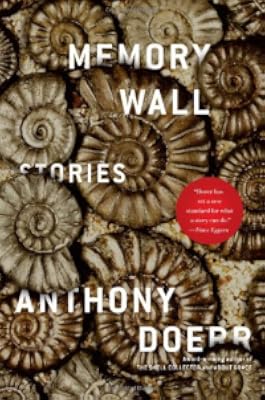
Memory Wall: Stories
by Anthony Doerr
On This Page
Description
Set on four continents, stories about memory.Tags
Recommendations








Member Reviews
One of the elusive pleasures of reading is discovering an author that has somehow slipped through your own personal cracks, an author that once found, seems to have been writing just for you all along, you were just too busy or preoccupied to notice. The best part of finally finding each other, even if unbeknownst to the other party, is much the same as in any new relationship; there are stories to be told, histories to be learned—the literary equivalent of a new continent to be explored.
In Anthony Doerr’s case, the quest covers the entire globe—poking into corners of the world you may have missed. Doerr’s latest collection of short stories, Memory Wall, wanders from South Africa to Wyoming, from a Korean no man’s land to a show more soon-to-be flooded Chinese village, and from post-Soviet Lithuania to the horror of World War II Germany, yet there remains a common human thread that keeps the far-flung places from seeming alien, or even so very different from home.
The collection is bookended by two novellas dealing with two very different women at the end of their respective lives. The title piece carefully extends a toe into the realm of science fiction, showing a white suburban Cape Town woman who is suffering from Alzheimer’s desperately trying to hang on to her memories by having them recorded on discs to be played back at will. The memory wall is both the disorganized map-cum-art project that she constructs in an attempt to make sense of a life that is quickly becoming a series of digitized vignettes as well as the rock cliffs that her late amateur paleontologist husband prowled searching for proof of a deeper permanence.
The story takes an unexpected turn when two men break into the woman’s house to play through her memories looking for clues to a major find that her husband may have made right before he died. The men soon figure out that it’s pretty easy to burglarize someone who isn’t going to remember that you were there, and the subtext of the cultural power imbalance comes glaringly apparent as the younger of the two men experiences the woman’s memories, disconnected episode by episode. We soon learn that she wasn’t all that nice of a person, which was an interesting way for Doerr to go since up until then, we were feeling quite sorry for the woman. At that point, loyalties realign, and the young man becomes the hero/sacrificial lamb to root for.
The final story, Afterworld, is a ghost story of sorts and deals with a Holocaust survivor whose epileptic fits have given her a window into another world that has both sustained and haunted her throughout her life. A Jewish orphan in Hamburg at the worst time possible to be either of those things, Esther Gramm’s out-of-body experiences afford her insights that the other orphan girls don’t fully appreciate until it is much too late.
While having a fit, she has a vision of the bleak future and brings back an explanation of how other people’s memories keep us tethered to this world, “In another world, folded inside the living world, we wait. We wait until everyone who knew us as children has died. And when the last one of them dies, we finally die our third death.”
Not everything is grim, however, Esther also catches a glimpse of those ready to move on, an encampment of pilgrims in tents on the edge of a great forest, and sharing this vision ultimately saves her life. Of course, since she remains living, the other girls who were murdered by the Nazis are stuck waiting around in a bombed-out limbo, trying in vain to contact her.
Alone with the aged Esther, her nephew Robert gets her to share her memories of the war for a thesis project he is supposed to be working on, and finally becomes a hero in his own right at the end of the story and Esther’s life. Memory is the thread that connects all of the stories in Doerr’s book in much the same way it connects everyone in real life. Whether you cherish them, are losing them, or are haunted by them, memories are what make us who we are as well as what makes the world itself.
“Every hour, Robert thinks, all over the globe, an infinite number of memories disappear, whole glowing atlases dragged into graves. But during that same hour children are moving about, surveying territory that seems to them entirely new. They push back the darkness; they scatter memories behind them like bread crumbs. The world is remade.”
Poetry. show less
In Anthony Doerr’s case, the quest covers the entire globe—poking into corners of the world you may have missed. Doerr’s latest collection of short stories, Memory Wall, wanders from South Africa to Wyoming, from a Korean no man’s land to a show more soon-to-be flooded Chinese village, and from post-Soviet Lithuania to the horror of World War II Germany, yet there remains a common human thread that keeps the far-flung places from seeming alien, or even so very different from home.
The collection is bookended by two novellas dealing with two very different women at the end of their respective lives. The title piece carefully extends a toe into the realm of science fiction, showing a white suburban Cape Town woman who is suffering from Alzheimer’s desperately trying to hang on to her memories by having them recorded on discs to be played back at will. The memory wall is both the disorganized map-cum-art project that she constructs in an attempt to make sense of a life that is quickly becoming a series of digitized vignettes as well as the rock cliffs that her late amateur paleontologist husband prowled searching for proof of a deeper permanence.
The story takes an unexpected turn when two men break into the woman’s house to play through her memories looking for clues to a major find that her husband may have made right before he died. The men soon figure out that it’s pretty easy to burglarize someone who isn’t going to remember that you were there, and the subtext of the cultural power imbalance comes glaringly apparent as the younger of the two men experiences the woman’s memories, disconnected episode by episode. We soon learn that she wasn’t all that nice of a person, which was an interesting way for Doerr to go since up until then, we were feeling quite sorry for the woman. At that point, loyalties realign, and the young man becomes the hero/sacrificial lamb to root for.
The final story, Afterworld, is a ghost story of sorts and deals with a Holocaust survivor whose epileptic fits have given her a window into another world that has both sustained and haunted her throughout her life. A Jewish orphan in Hamburg at the worst time possible to be either of those things, Esther Gramm’s out-of-body experiences afford her insights that the other orphan girls don’t fully appreciate until it is much too late.
While having a fit, she has a vision of the bleak future and brings back an explanation of how other people’s memories keep us tethered to this world, “In another world, folded inside the living world, we wait. We wait until everyone who knew us as children has died. And when the last one of them dies, we finally die our third death.”
Not everything is grim, however, Esther also catches a glimpse of those ready to move on, an encampment of pilgrims in tents on the edge of a great forest, and sharing this vision ultimately saves her life. Of course, since she remains living, the other girls who were murdered by the Nazis are stuck waiting around in a bombed-out limbo, trying in vain to contact her.
Alone with the aged Esther, her nephew Robert gets her to share her memories of the war for a thesis project he is supposed to be working on, and finally becomes a hero in his own right at the end of the story and Esther’s life. Memory is the thread that connects all of the stories in Doerr’s book in much the same way it connects everyone in real life. Whether you cherish them, are losing them, or are haunted by them, memories are what make us who we are as well as what makes the world itself.
“Every hour, Robert thinks, all over the globe, an infinite number of memories disappear, whole glowing atlases dragged into graves. But during that same hour children are moving about, surveying territory that seems to them entirely new. They push back the darkness; they scatter memories behind them like bread crumbs. The world is remade.”
Poetry. show less
After discovering Anthony Doerr in one of the Best American Short Stories Anthologies, I immediately ordered his collections...and I'm so glad that I did. In this collection, Doerr develops themes involving memory and loss in particular, evolving worlds and characters that present themselves as being both totally unique and perfectly believable. Each story explores characters who can't help but be fascinating, and no story treads on already discovered territory. And, beyond his originality, Doerr is also an exceptional writer--the prose here is worth savoring, as energetic as it is graceful. Simply: Doerr is my new favorite contemporary short story writer. These stories stand up to the best out there, and I absolutely recommend the show more collection. show less
Anthony Doerr's collection of short stories, two of which have apeared in Dave Eggers' McSweeney's anthologies, follows various people while examining the function their memories serve in understanding the past, however strenuous, often forming the catalyst that allows for meaningful catharsis. In the story Village 113, a seed keeper reflects on having lived her entire life in a small Chinese village right before the government forces everyone off the land to construct a giant dam. The book's closing piece, Afterworld, depicts a jewish woman close to death as she recounts her haunting childhood at an orphanage in Germany near the onset of the Holocaust.
Perhaps the most vividly written is the title story, presenting a future where show more memories can be bought, sold or traded as cartridges for visual consumption. Alma, a seventy-one year old woman living in Cape Town with her servent relives her past at every waking moment, possibly counteracting an oncoming dementia. She soon becomes targeted for a specific memory, one which details the final minutes of her late husband, shortly before discovering the remains of an ancient, priceless fossil.
Doerr's language often drifts into the ethereal, whereas light and the meterological are consistenly mined for metaphors. However, contemporary themes abound in every selection, whether its race relations in South Africa, Chinese governmental authority, or American marital issues. show less
Perhaps the most vividly written is the title story, presenting a future where show more memories can be bought, sold or traded as cartridges for visual consumption. Alma, a seventy-one year old woman living in Cape Town with her servent relives her past at every waking moment, possibly counteracting an oncoming dementia. She soon becomes targeted for a specific memory, one which details the final minutes of her late husband, shortly before discovering the remains of an ancient, priceless fossil.
Doerr's language often drifts into the ethereal, whereas light and the meterological are consistenly mined for metaphors. However, contemporary themes abound in every selection, whether its race relations in South Africa, Chinese governmental authority, or American marital issues. show less
Six stories, widely different in setting and characters, give a kaleidoscopic view of memory.
“Memory Wall” - in a future South Africa, an old woman with dementia goes to a memory clinic and has her memories put on cartridges so that she can relive parts of her life. She is visited by a man, who is attempting to find something for his own purposes. Along the way, the reader discovers that perhaps her life and the marriage with her late husband is more complicated than the simple, happy memories she focuses on.
“Procerate, Generate” tells the story of a couple attempting to have a child and the heartbreak of their infertility.
“The Demilitarized Zone” - A man’s son sends back letters detailing the war in which he is taking show more part, not realizing that his parents’ marriage has fallen apart while he was away.
“Village 113” - A seed keeper navigates the changes to her village in Asia when a project, worked on in part by her son, means a dam will go up and flood the village.
“The River Nemunas” - A 15-year-old girl moves to Lithuania after her parents die, living with her grandfather and meeting a neighbor woman with Alzheimer’s. Ally’s memories of her parents, and her grandfather and the neighbor knowing her mother as a child, as well as memories of the river and the past when sturgeon could be fished from it, come to the surface as Ally and the neighbor take boating excursions each day.
“Afterworld” - Esther has had seizures since she was a child growing up in an orphanage in Germany; as an old woman in Ohio, she bodily declines but starts to relive some of those memories of the other girls she knew.
While Doerr is known for his best-selling novels All the Light We Cannot See and Cloud Cuckoo Land, he is skillful in the short form as well, drawing complex characters, compelling stories, and astute observations. show less
“Memory Wall” - in a future South Africa, an old woman with dementia goes to a memory clinic and has her memories put on cartridges so that she can relive parts of her life. She is visited by a man, who is attempting to find something for his own purposes. Along the way, the reader discovers that perhaps her life and the marriage with her late husband is more complicated than the simple, happy memories she focuses on.
“Procerate, Generate” tells the story of a couple attempting to have a child and the heartbreak of their infertility.
“The Demilitarized Zone” - A man’s son sends back letters detailing the war in which he is taking show more part, not realizing that his parents’ marriage has fallen apart while he was away.
“Village 113” - A seed keeper navigates the changes to her village in Asia when a project, worked on in part by her son, means a dam will go up and flood the village.
“The River Nemunas” - A 15-year-old girl moves to Lithuania after her parents die, living with her grandfather and meeting a neighbor woman with Alzheimer’s. Ally’s memories of her parents, and her grandfather and the neighbor knowing her mother as a child, as well as memories of the river and the past when sturgeon could be fished from it, come to the surface as Ally and the neighbor take boating excursions each day.
“Afterworld” - Esther has had seizures since she was a child growing up in an orphanage in Germany; as an old woman in Ohio, she bodily declines but starts to relive some of those memories of the other girls she knew.
While Doerr is known for his best-selling novels All the Light We Cannot See and Cloud Cuckoo Land, he is skillful in the short form as well, drawing complex characters, compelling stories, and astute observations. show less
I was impressed at first by the originality of imagination of the author but as I read more of his stories his style became more and more annoying. Short sentences, packed with detailed observations that real persons would never experience in that way. This creates a distance and makes it difficult to identify with the main character. It is all too artificial.
*Received from Goodreads' First Reads program*
In its short existence, there have been many masters of the short story. Flannery O'Connor. Anton Chekhov. Raymond Carver. Jorge Luis Borges. Some of them were writers of larger works, but we tend to remember them best for their short pieces. Ambrose Bierce. Stephen Crane. Zora Neale Hurston. Eudora Welty. John Cheever. Many of these writers belonged to a different era, a time when short stories were appreciated, even revered. Guy de Maupassant. Edgar Allan Poe. O. Henry. But some have continued to captivate our interests in recent years. Alice Munro. Amy Hempel. Anthony Doerr.
Is it perhaps a bit premature to add Anthony Doerr's name to this list of greats? Perhaps. But I have little doubt show more that given a little perseverance by the author, and time, Doerr will be one of those writers we think of when we consider the short story. He is a true talent, with writing that is natural and a voice that is rich.
Each story in Memory Wall is unique. Doerr is able to transport the reader from a semi-dystopian South Africa to an aquarium in 1914 Detroit without a hiccup in skill. Along the way, the reader visits contemporary China, a magical, yet dilapidated village in Lithuania, WWII era Germany, as well as Wyoming and Korea. No matter the setting, it is as if Doerr has entered his story and walked around in it, observing every important detail. He has such a great sense of space that the settings come to life.
Fortunately, Doerr's talent does not end with place. His stories and characters are just as vibrant as the worlds they are dropped into. Every one of these stories is tangible, empathetic, and moving—almost literally moving; often it felt as though the page had a rhythm, in and out, swaying gently in the fabric of the author's carefully woven tales.
Anthony Doerr's Memory Wall is nearly a perfect collection. It is a real spectacle and well worth the time it takes to read, not just once, but over and again.
Favorites: “Procreate, Generate”, “Afterworld”, “Memory Wall”, “The Deep”
Note: The paperback edition includes a seventh story not included in the original publication. While in many short story collections, stories that are added in later editions are often “throw aways”, this is not the case with this one. “The Deep” is wonderful and worth owning. It felt as if it belonged in this collection; it was just a little late showing up. show less
In its short existence, there have been many masters of the short story. Flannery O'Connor. Anton Chekhov. Raymond Carver. Jorge Luis Borges. Some of them were writers of larger works, but we tend to remember them best for their short pieces. Ambrose Bierce. Stephen Crane. Zora Neale Hurston. Eudora Welty. John Cheever. Many of these writers belonged to a different era, a time when short stories were appreciated, even revered. Guy de Maupassant. Edgar Allan Poe. O. Henry. But some have continued to captivate our interests in recent years. Alice Munro. Amy Hempel. Anthony Doerr.
Is it perhaps a bit premature to add Anthony Doerr's name to this list of greats? Perhaps. But I have little doubt show more that given a little perseverance by the author, and time, Doerr will be one of those writers we think of when we consider the short story. He is a true talent, with writing that is natural and a voice that is rich.
Each story in Memory Wall is unique. Doerr is able to transport the reader from a semi-dystopian South Africa to an aquarium in 1914 Detroit without a hiccup in skill. Along the way, the reader visits contemporary China, a magical, yet dilapidated village in Lithuania, WWII era Germany, as well as Wyoming and Korea. No matter the setting, it is as if Doerr has entered his story and walked around in it, observing every important detail. He has such a great sense of space that the settings come to life.
Fortunately, Doerr's talent does not end with place. His stories and characters are just as vibrant as the worlds they are dropped into. Every one of these stories is tangible, empathetic, and moving—almost literally moving; often it felt as though the page had a rhythm, in and out, swaying gently in the fabric of the author's carefully woven tales.
Anthony Doerr's Memory Wall is nearly a perfect collection. It is a real spectacle and well worth the time it takes to read, not just once, but over and again.
Favorites: “Procreate, Generate”, “Afterworld”, “Memory Wall”, “The Deep”
Note: The paperback edition includes a seventh story not included in the original publication. While in many short story collections, stories that are added in later editions are often “throw aways”, this is not the case with this one. “The Deep” is wonderful and worth owning. It felt as if it belonged in this collection; it was just a little late showing up. show less
I read this for a face to face book group that took place last night at my local independent bookshop Five Leaves. It is not a book I would have been likely to choose for myself but it certainly made for a lively and interesting discussion. I have never read Doerr before.
This book is a collection of a novella and five stories, set in several continents at various times in recent history, linked by a theme of memory, how it works, how it shapes lives and what happens when it is lost. The prose often seems plain and direct, but has a poetic precision.
The title novella which opens the collection is set in South Africa. Alma, A widow lives alone in a gated house with her loyal "house boy" Pheko. She is suffering from Alzheimer's, and is show more participating in a form of therapy (here we enter the realm of sci-fi) in which her memories are captured on cartridges, which she arranges on a wall. Her late husband was a fossil enthusiast, whose death from a heart attack was due to a spectacular find on the "Karoo". An unscrupulous collector breaks into the house with a young street boy looking to harvest the memories to discover the location of the lost fossil.
The other stories that impressed me most were The River Nemunas, in which a 15 year old orphan girl from the mid West goes to live with her grandfather in Lithuania, and Afterworld, in which a dying holocaust escapee and epileptic remembers her war experiences in a Hamburg orphanage while being cared for by her American grandson.
Doerr is strong on characterisation and descriptions of places. My main reservations were that some of his plot contrivances were either a little too visible or just defied belief. Overall I found it an enjoyable read. show less
This book is a collection of a novella and five stories, set in several continents at various times in recent history, linked by a theme of memory, how it works, how it shapes lives and what happens when it is lost. The prose often seems plain and direct, but has a poetic precision.
The title novella which opens the collection is set in South Africa. Alma, A widow lives alone in a gated house with her loyal "house boy" Pheko. She is suffering from Alzheimer's, and is show more participating in a form of therapy (here we enter the realm of sci-fi) in which her memories are captured on cartridges, which she arranges on a wall. Her late husband was a fossil enthusiast, whose death from a heart attack was due to a spectacular find on the "Karoo". An unscrupulous collector breaks into the house with a young street boy looking to harvest the memories to discover the location of the lost fossil.
The other stories that impressed me most were The River Nemunas, in which a 15 year old orphan girl from the mid West goes to live with her grandfather in Lithuania, and Afterworld, in which a dying holocaust escapee and epileptic remembers her war experiences in a Hamburg orphanage while being cared for by her American grandson.
Doerr is strong on characterisation and descriptions of places. My main reservations were that some of his plot contrivances were either a little too visible or just defied belief. Overall I found it an enjoyable read. show less
Members
- Recently Added By
Lists

Recommend the 20 best books you've read in the last five years
2,168 works; 602 members

Favorite Short Fiction
228 works; 99 members

Top Five Books of 2016
795 works; 229 members

Books Read in 2022
5,226 works; 115 members
Author Information

Anthony Doerr was born on October 27, 1973 in Cleveland, Ohio. He is the author of The Shell Collector, About Grace, Four Seasons in Rome, Memory Wall, and All the Light We Cannot See. His fiction has won four O. Henry Prizes and has been anthologized in several anthologies. He has won the Barnes and Noble Discover Prize, the Rome Prize, the New show more York Public Library's Young Lions Award, the National Magazine Award for Fiction, three Pushcart Prizes, two Pacific Northwest Book Award, three Ohioana Book Awards, the 2010 Story Prize, which is considered the most prestigious prize in the U.S. for a collection of short stories, and the Sunday Times EFG Short Story Award, which is the largest prize in the world for a single short story. His novel, All the Light We Cannot See, won the Adult Fiction Award for the Indies Choice Book Awards in 2015, the International Book of the Year at the ABIA Awards and the Pulitzer Prizes for Fiction in 2015. Anthony Doerr also won the 2015 Andrew Carnegie Medal for Excellence in Fiction for this same title. (Bowker Author Biography) show less
Some Editions
Awards and Honors
Awards
Series
Belongs to Publisher Series
Work Relationships
Common Knowledge
- Canonical title*
- Le mur de mémoire
- Original title
- Memory wall
- Original publication date
- 2010
- Important events
- Holocaust
- Epigraph
- You have to begin to lose your memory, if only in bits and pieces, to realize that memory is what makes our lives. Life without memory is no life at all, just as intelligence without the possibility of expression is not real... (show all)ly an intelligence. Our memory is our coherence, our reason, our feeling, even our action. Without it, we are nothing.
-- Luis Buñuel, My Last Sigh - Dedication
- For Shauna
- First words
- Seventy-four-year-old Alma Konachek lives in Vredehoek, a suburb above Cape Town: a place of warm rains, big-windowed lofts, and silent, predatory automobiles.
- Last words
- (Click to show. Warning: May contain spoilers.)And then Tom sits, hands in his lap, alive for one more day.
- Blurbers
- Eggers, Dave; Meloy, Maile; Shepard, Jim
- Original language*
- English
*Some information comes from Common Knowledge in other languages. Click "Edit" for more information.
Classifications
Statistics
- Members
- 712
- Popularity
- 39,966
- Reviews
- 22
- Rating
- (4.09)
- Languages
- 7 — Czech, Dutch, English, French, German, Japanese, Spanish
- Media
- Paper, Audiobook, Ebook
- ISBNs
- 21
- ASINs
- 7