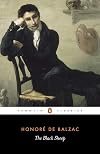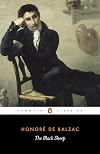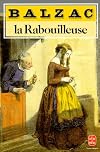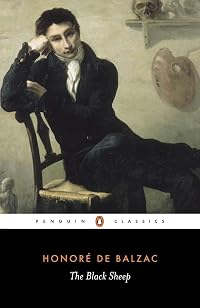
The Black Sheep
by Honoré de Balzac
Scenes from Provincial Life (6), The Human Comedy (Études de Moeurs - Scènes de la vie de province II | 29), Studies of Manners (33)
On This Page
Description
Brothers Philippe and Joseph Bridau couldn't be more different. One is a cruel man who puts his ruthlessness to good use in a military career, while the other is a kind-hearted, sensitive soul who grows up to be a penniless artist. When the family's fortune is at risk, the two diametrically opposed siblings wage an all-out war..
Tags
Recommendations















Member Reviews
A typical- and utterly gripping- Balzac tale of greed and self-sacrifice, fiendish plots and unrewarded virtue.
Mme Bridau is a widowed mother of two. Handsome charmer Philippe has her heart, but his younger artist brother Joseph is the ever-unappreciated hero. There is much family history and many machinations, but as wastrel Philippe brings his doting mother to penury, she and Joseph are forced to seek the assistance of wealthy Uncle Rouget. And here a second strand comes into play: poor, timorous Uncle is enamoured of an unscrupulous housekeeper. And she, in turn, is being seduced by local "gang leader" Maxence, who has plans for appropriating Uncle's money...
One of my favourite authors.
Mme Bridau is a widowed mother of two. Handsome charmer Philippe has her heart, but his younger artist brother Joseph is the ever-unappreciated hero. There is much family history and many machinations, but as wastrel Philippe brings his doting mother to penury, she and Joseph are forced to seek the assistance of wealthy Uncle Rouget. And here a second strand comes into play: poor, timorous Uncle is enamoured of an unscrupulous housekeeper. And she, in turn, is being seduced by local "gang leader" Maxence, who has plans for appropriating Uncle's money...
One of my favourite authors.
The Black Sheep, by Honoré de Balzac is a riveting and melodramayic tale about rank and how it goes about defining reality. Balzac uses stock characters: hero, villain, heroine, aged parents, and servants. All engaged in a sensational plot of love, murder and betrayal. I like the way he so transparently weaves this tale and nudges us into thought so lightly as he takes the reader into his confidence and comments on the action. He often uses lists as ordering devices for this commentary, a widow has two tasks… p.36, In Paris, there are in fact three classes of pauperdom p.120, There are two kinds of timidity: p.171, …three infallible ways of killing a woman p.331.
I couldn’t help but feel confident of his perspicacity…
This layered story finds significance in the layering. Much could be written about the way finances are expressed and assessed as measures of expectation, greed and worth. The Knights of Idleness appear to spring from a provincial morality play. The source and most of the action happens at Issoudun, as Balzac explains, a place where Isis, a goddess who (ironically) protects women and is associated with marital devotion, was once worshipped in a temple. This layering is almost painterly where motifs of the spectre of death hang of over innocent beauty; nowhere more evident in the progression of Flore from budding flower to wilted carcass.
Despite intelligence and capability, women fare badly in The Black Sheep. They are devoted hostages to emotion. Perhaps a sign of the times, perhaps some provocative misogyny?
Historical context is another layer. One of the main characters (Phillipe) had been an aide-de-camp to Napoleon and much of the story is set in a France that yearns for Napoleon (he is in exile on Elba). I have long been interested in how it was that France (immediately post-revolution) was in such a need of a leader that they installed an Emperor. Perhaps it’s because I have grown a cutting from the willow that grew on Napoleon's grave in Elba. The Black Sheep has led me to my next read: a massive (900 page) biography Napoleon: A Life by Andrew Roberts. show less
I couldn’t help but feel confident of his perspicacity…
Theshow more
significance of this scene is that calculation enters much further into the heart when it is concealed beneath an expression of feeling; then it can even overcome the most genuine grief. p.310
This layered story finds significance in the layering. Much could be written about the way finances are expressed and assessed as measures of expectation, greed and worth. The Knights of Idleness appear to spring from a provincial morality play. The source and most of the action happens at Issoudun, as Balzac explains, a place where Isis, a goddess who (ironically) protects women and is associated with marital devotion, was once worshipped in a temple. This layering is almost painterly where motifs of the spectre of death hang of over innocent beauty; nowhere more evident in the progression of Flore from budding flower to wilted carcass.
Perhaps my readers will accuse me of painting too crude a picture; perhaps they will say that Flore’s outbursts are so close to the truth of human nature that the painter should leave them in the shadow? p.197
Despite intelligence and capability, women fare badly in The Black Sheep. They are devoted hostages to emotion. Perhaps a sign of the times, perhaps some provocative misogyny?
Women are like naughty children. They are inferior animals to men, and you must make them afraid of you, for the worst plight that can befall us is to be governed by the brutes!
Historical context is another layer. One of the main characters (Phillipe) had been an aide-de-camp to Napoleon and much of the story is set in a France that yearns for Napoleon (he is in exile on Elba). I have long been interested in how it was that France (immediately post-revolution) was in such a need of a leader that they installed an Emperor. Perhaps it’s because I have grown a cutting from the willow that grew on Napoleon's grave in Elba. The Black Sheep has led me to my next read: a massive (900 page) biography Napoleon: A Life by Andrew Roberts. show less
This is quite the tale of greed, selfishness, gambling, thievery, corruption, plot and counterplot -- and art. Balzac tells the story of a good and a bad brother (said to be based somewhat on his brother and himself, although there is no way his brother could have been as evil as Philippe), their widowed mother Agathe, and various relatives and hangers-on, including his mother's brother who has received the entire inheritance of their father because he erroneously believed that Agathe was not his child.
The story starts in Paris: after their father's death, Joseph (the good brother) and Philippe received educations because their father, a high-level clerk, had been a big supporter of Napoleon. Philippe served brilliantly in the army show more under Napoleon, but refused to serve under the Bourbons after Napoleon's defeat, and is at loose ends, not able to hold down a job because of his drinking, womanizing, general carousing, and gambling. Joseph, on the other hand, is becoming an artist, having first become entranced by the art students at a local school. Agathe loves Philippe the most, because of his glorious military career and because he is handsome; she doesn't understand the world of art that so attracts Joseph and finds him unattractive (he is described as being ugly). Soon, Philippe runs out of money and so steals from his mother and brother, neither of whom have very much to begin with, and from their aunt who basically lives with the family. As the first part ends, the aunt has died from the shock of the theft and Agathe has for once turned against Philippe; Philippe is basically homeless and in the gutter when he is arrested as a participant in a plot against the king.
The scene shifts in the second part, as Agathe and Joseph travel to the provinces where the uncle with the money lives. Staying with Agathe's godmother, who lives in the house next door, they learn that the uncle, Jean-Jacques, has come under the influence of his housekeeper-mistress, Flore, who rules the household with an iron hand, even to the point of allowing her lover, Max, to live with them. Of course, they are trying to fleece him of his money. Max is the head of a secret group of young men, called the Knights of Idleness, that wreaks havoc in the town of Issoudun through their nightly "pranks"; like Philippe, he is a former army officer from the Napoleonic era and, also like Philippe, he is a man who is only out for himself. Agathe and Joseph prove to be no match for Max and Flore, and return to Paris without the inheritance and after some horrifying episodes. In the last part, Philippe is paroled to Issoudun, where needless to say he worms his way into the Jean-Jacques household, setting off an inevitable clash between the two evil geniuses of this novel (or three, including Flore). I will not reveal the end result, so as to avoid spoilers, but I will say that as a reader I had to suspend disbelief about the change in Philippe from a weak man at the mercy of his vices to a disciplined plotter. But thoroughly no good throughout!
This was an all-around fun read, although it dragged in a few places (for example, the detailed description of the history and geography of Issoudun). Balzac created some truly evil characters and let them try to outwit each other, with much opportunity for treachery and dastardly deeds. And some of the other characters, like a lawyer friend of Joseph's and the miserly husband of Agathe's godmother, are also well drawn. Along the way, the book provides insight into the politics and economics of post-Napoleonic France, the pitiless attitude towards poor people, the struggle of artists, the role of lawyers, the mutual disdain of Parisians and people living in the provinces, and the everyone-knows-everything atmosphere of small towns. I first heard about this novel here on LT, and I'm glad I read it.
ETA My edition could really have benefited from end notes, as I was driven to Wikipedia frequently to look up historical and literary references; Penguin editions often have them, but this one didn't. show less
The story starts in Paris: after their father's death, Joseph (the good brother) and Philippe received educations because their father, a high-level clerk, had been a big supporter of Napoleon. Philippe served brilliantly in the army show more under Napoleon, but refused to serve under the Bourbons after Napoleon's defeat, and is at loose ends, not able to hold down a job because of his drinking, womanizing, general carousing, and gambling. Joseph, on the other hand, is becoming an artist, having first become entranced by the art students at a local school. Agathe loves Philippe the most, because of his glorious military career and because he is handsome; she doesn't understand the world of art that so attracts Joseph and finds him unattractive (he is described as being ugly). Soon, Philippe runs out of money and so steals from his mother and brother, neither of whom have very much to begin with, and from their aunt who basically lives with the family. As the first part ends, the aunt has died from the shock of the theft and Agathe has for once turned against Philippe; Philippe is basically homeless and in the gutter when he is arrested as a participant in a plot against the king.
The scene shifts in the second part, as Agathe and Joseph travel to the provinces where the uncle with the money lives. Staying with Agathe's godmother, who lives in the house next door, they learn that the uncle, Jean-Jacques, has come under the influence of his housekeeper-mistress, Flore, who rules the household with an iron hand, even to the point of allowing her lover, Max, to live with them. Of course, they are trying to fleece him of his money. Max is the head of a secret group of young men, called the Knights of Idleness, that wreaks havoc in the town of Issoudun through their nightly "pranks"; like Philippe, he is a former army officer from the Napoleonic era and, also like Philippe, he is a man who is only out for himself. Agathe and Joseph prove to be no match for Max and Flore, and return to Paris without the inheritance and after some horrifying episodes. In the last part, Philippe is paroled to Issoudun, where needless to say he worms his way into the Jean-Jacques household, setting off an inevitable clash between the two evil geniuses of this novel (or three, including Flore). I will not reveal the end result, so as to avoid spoilers, but I will say that as a reader I had to suspend disbelief about the change in Philippe from a weak man at the mercy of his vices to a disciplined plotter. But thoroughly no good throughout!
This was an all-around fun read, although it dragged in a few places (for example, the detailed description of the history and geography of Issoudun). Balzac created some truly evil characters and let them try to outwit each other, with much opportunity for treachery and dastardly deeds. And some of the other characters, like a lawyer friend of Joseph's and the miserly husband of Agathe's godmother, are also well drawn. Along the way, the book provides insight into the politics and economics of post-Napoleonic France, the pitiless attitude towards poor people, the struggle of artists, the role of lawyers, the mutual disdain of Parisians and people living in the provinces, and the everyone-knows-everything atmosphere of small towns. I first heard about this novel here on LT, and I'm glad I read it.
ETA My edition could really have benefited from end notes, as I was driven to Wikipedia frequently to look up historical and literary references; Penguin editions often have them, but this one didn't. show less
Although full of action and entertaining, "The Black Sheep" is something more. This is a story of two brothers and a mother, very similar to my own family situation, and apparently like Balzac's home life as well - speaking from personal experience, the novel has a good deal of verisimilitude: the competition for the affection of the mother, the changing fortunes of the brothers - one plodding slowly along, the other a bright but erratic star - the physical prowess and weakness of each - these are not just fictional devices. Balzac speaks broadly to the reality of life, all the while set in the delightful atmosphere of early 19th century France, it really is a treat.
[The Black Sheep] tells the story of two brothers living in Paris at the beginning of the 19th century, at the end of the Napoleonic wars. One, Joseph, is a gifted painter of good heart and upright character. The other, Phillipe, is a one-time soldier and all-around scoundrel. It is Phillipe who is the mother Agathe’s favourite, however, despite his drinking and gambling habits dragging his family into ruin. Phillipe’s depredations are the subject of the first part of the book; in the second part Joseph and his mother leave Paris for the small town of Issoudun in an attempt to claim the inheritance that rightfully belongs to Agathe, but which her brother is in danger of leaving to his housekeeper-mistress Flore and her lover Max, show more another thoroughly rotten character. Joseph and Agathe prove too naïve and straightforward to contend with the machinations of Flore and Max, but when Phillipe appears, Max may have finally met his match…
Treachery and double-crossing abound in this novel, and there is an exciting duel at the end as well. Villainy ultimately meets with vengeance, but virtue is by no means always rewarded. Balzac is not entirely cynical but he does paint a cruel picture of a world dominated by greed and social schemers.
This is the first book I’ve ever read by Balzac. I enjoyed it although it was a tiny bit heavy-going at times and felt very much like a period novel. According to the introduction, Balzac considered himself at least as much a historian as a novelist, and though the action moves along rapidly the author provides exhaustive details about battles and Bourbons, geography of the provinces, and, most of all, financial arrangements from the Parisian lottery to the fine points of inheritance law. Expect to see an awful lot of calculations in francs. This will appeal most to readers interested in the historical setting of post-Napoleonic France. show less
Treachery and double-crossing abound in this novel, and there is an exciting duel at the end as well. Villainy ultimately meets with vengeance, but virtue is by no means always rewarded. Balzac is not entirely cynical but he does paint a cruel picture of a world dominated by greed and social schemers.
This is the first book I’ve ever read by Balzac. I enjoyed it although it was a tiny bit heavy-going at times and felt very much like a period novel. According to the introduction, Balzac considered himself at least as much a historian as a novelist, and though the action moves along rapidly the author provides exhaustive details about battles and Bourbons, geography of the provinces, and, most of all, financial arrangements from the Parisian lottery to the fine points of inheritance law. Expect to see an awful lot of calculations in francs. This will appeal most to readers interested in the historical setting of post-Napoleonic France. show less
It's Balzac, and it's reasonably short, so you know it's pretty powerful. The only interesting thing I have to say about this is stolen from the introduction to the Penguin edition; the translator points out that in this book, unlike many of Balzac's writing, the historical asides are actually relevant and important for the plot, so it's far more unified than the others. Great point. Also, Balzac got the whole 'show you someone who's horrible, then show you someone even worse so that you'll sympathize with the horrible shit' move down pat. George Martin's an amateur by comparison.
On the other hand, not sure it's one of the greatest novels of all time, as some poll or other suggested.
On the other hand, not sure it's one of the greatest novels of all time, as some poll or other suggested.
Enjoyable read, not one of his best, but an average Balzac is so much better than most.
Members
- Recently Added By
Lists

The Guardian's 100 greatest novels of all time
100 works; 16 members

French Fiction of the 18th and 19th Centuries in English Translation
169 works; 3 members

la comédie humaine
47 works; 1 member

.
396 works; 1 member
Author Information

Born on May 20, 1799, Honore de Balzac is considered one of the greatest French writers of all time. Balzac studied in Paris and worked as a law clerk while pursuing an unsuccessful career as an author. He soon accumulated enormous debts that haunted him most of his life. A prolific writer, Balzac would often write for 14 to-16 hours at a time. show more His writing is marked by realistic portrayals of ordinary, but exaggerated characters and intricate detail. In 1834, Balzac began organizing his works into a collection called The Human Comedy, an attempt to group his novels to present a complete social history of France. Characters in this project reappeared throughout various volumes, which ultimately consisted of approximately 90 works. Some of his works include Cesar Birotteau, Le Cousin Pons, Seraphita, and Le Cousine Bette. Balzac wed his lifelong love, Eveline Hanska in March 1850 although he was gravely ill at the time. Balzac died in August of that year. (Bowker Author Biography) show less
Some Editions
Awards and Honors
Notable Lists
Series

Scenes from Provincial Life
8 works (6)

The Human Comedy
86 works (Études de Moeurs - Scènes de la vie de province II | 29)

Studies of Manners
60 works (33)
Belongs to Publisher Series
Work Relationships
Common Knowledge
- Canonical title
- The Black Sheep
- Original title
- La Rabouilleuse
- Alternate titles
- A Bachelor's Establishment; The Two Brothers
- Original publication date
- 1842
- People/Characters
- Joseph Bridau; Philippe Bridau; Agathe Bridau (nee Rouget); Maxence Gilet; Flore Brazier; Monsieur Hochon (show all 8); Madame Descoings; Jean-Jacques Rouget
- Important places
- Issoudun
- First words
- In the year 1792 the townsfolk of Issoudun were fortunate enough to have a doctor of the name of Rouget, who had the reputation of being an extremely wily man.
- Last words
- (Click to show. Warning: May contain spoilers.)"You can always count on wealthy friends," replies his frienc Leon de Lora, who, despite his fame as a landscapist, has not given up his old habit of twisting proverbs, and who, prompted by the modesty with which Joseph received these favors showered upon him by fate, reminds his friends that, "A man's appetite grows as he paints."
- Original language
- French
Classifications
Statistics
- Members
- 734
- Popularity
- 38,580
- Reviews
- 13
- Rating
- (3.87)
- Languages
- 7 — English, French, German, Hungarian, Italian, Russian, Turkish
- Media
- Paper, Audiobook, Ebook
- ISBNs
- 53
- ASINs
- 36