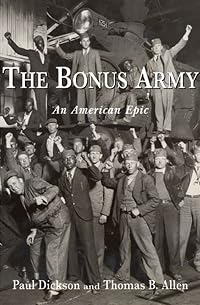
The Bonus Army : An American Epic
by Paul Dickson, Thomas B. Allen
On This Page
Description
In the Depression summer of 1932, some 45,000 veterans of World War I descended on Washington to demand the bonus promised them eight years earlier for their wartime service. They lived in shantytowns, white and black together, protested and rallied for their cause. Roy Wilkins saw the model for racial integration here; J. Edgar Hoover built his reputation against the radicals. President Hoover, Army Chief of Staff Douglas MacArthur, and others feared the protesters would turn violent after show more the Senate defeated the "bonus bill" that the House had passed. On July 28, tanks rolled as troops evicted the marchers. Newspapers and newsreels showed graphic images of American soldiers driving out their former comrades in arms. Democratic candidate Franklin Roosevelt said to an adviser, "This will elect me," though bonus armies would plague him as well. The march inspired Congress to pass the G.I. Bill of Rights in 1944.--From publisher description. show lessTags
Recommendations











Member Reviews
As this is not my best period in American history, I'm reluctant to wax too authoritative about this work. However, Dickson & Allen are at their best in giving the flavor of what it was like to be a participant in this great mass protest, and how the rank and file tried to maintain their dignity while at the same time doing their level best to prevent those in authority from ignoring their plight. What particularly stands out is that this was an integrated protest, and how the main body of protestors themselves worked to keep Communist agitators at arms-length (not that Douglas MacArthur and the Army's Military Intelligence Division noticed).
Perhaps one anecdote sums up the book best, as when a new bonus army arrived in Washington, DC show more in 1933, FDR's response was to treat the protestors as constituents (no matter his unwillingness to privilege their demands), instead of as a threat, as Hoover did. The observation from one participant being that: "Hoover sent the army. Roosevelt sent his wife."
From there the work winds down as the authors work through the immediate aftermath of the veterans' protests, of how the ghastly disaster of work camps filled with veterans being obliterated in Key West during the Labor Day Hurricane of 1935 finally paved the way for the bonus to be paid, to the creation of the GI Bill, and ending with the continuing tradition of mass protest descending on Washington in the spirit of petition. show less
Perhaps one anecdote sums up the book best, as when a new bonus army arrived in Washington, DC show more in 1933, FDR's response was to treat the protestors as constituents (no matter his unwillingness to privilege their demands), instead of as a threat, as Hoover did. The observation from one participant being that: "Hoover sent the army. Roosevelt sent his wife."
From there the work winds down as the authors work through the immediate aftermath of the veterans' protests, of how the ghastly disaster of work camps filled with veterans being obliterated in Key West during the Labor Day Hurricane of 1935 finally paved the way for the bonus to be paid, to the creation of the GI Bill, and ending with the continuing tradition of mass protest descending on Washington in the spirit of petition. show less
The Bonus Army is a term created for the WWI veterans marching on Washington to demand the bonuses they were promised for serving in WWI. Interesting study! They were treated in some cases well by people helping them get to Washington. Then poorly by the politicians and the military. A lot of research went into this book. If you are interested in post WWI, the depressian era and the administrations of Hoover and FDR this would be good read. Recommended.
I signed them to speak to the Friends of the Library and what neat and fascinating people. The book is pretty good too. Mine is signed.
Ratings
Members
- Recently Added By
Author Information

63+ Works 3,094 Members
Paul Dickson is the author of more than sixty nonfiction books, including Sputnik: The Shock of the Century and The Bonus Army: An American Epic (with Thomas B. Allen), and books on electronic warfare and war slang. He concentrates on writing about the American language, baseball, and 20th century history. He lives in Garrett Park, Maryland.

50+ Works 4,791 Members
Thomas B. Allen is the author of numerous history books, including George Washington, Spy-master and Remember Valley Forge. A frequent contributor to Smithsonian Magazine, National Geographic, Military History Quarterly, Military History, Naval History, the U.S. Naval Institute's Proceedings magazine, and other publications, he lives in Bethesda, show more Maryland. show less
Common Knowledge
- Dedication
- To Nancy Dickson and Scottie Allen for their total support and belief in this book.
- First words
- One night toward the end of May 1932, Pelham Glassford, the police chief of Washington, D.C., was driving south from New York City through New Jersey when suddenly in his headlights appeared what he later described as "a bedr... (show all)aggled group of seventy-five or one hundred men marching cheerily along, singing and waving at the passing traffic."
- Last words
- (Click to show. Warning: May contain spoilers.)Millions of Americans have since peacefully marched on Washington in support of various causes, their way paved by the veterans of 1932.
Classifications
- Genres
- History, Nonfiction, General Nonfiction
- DDC/MDS
- 973.916 — History & geography History of North America United States 1901- World Wars and Depression Era (1901-1953) Herbert Hoover (1929-1933) Great Depression, Wall Street Crash of 1929,
- LCC
- F199 .D55 — Local History of the United States, Canada and Latin America United States local history District of Columbia. Washington
- BISAC
Statistics
- Members
- 180
- Popularity
- 182,328
- Reviews
- 3
- Rating
- (4.07)
- Languages
- English
- Media
- Paper, Ebook
- ISBNs
- 5
- UPCs
- 1
- ASINs
- 6