
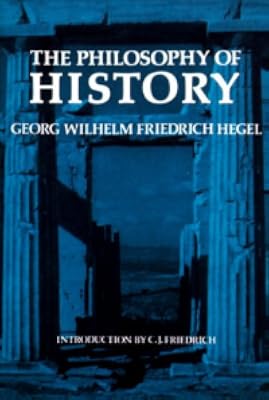
The Philosophy of History
by Georg Wilhelm Friedrich Hegel
On This Page
Description
Hegel wrote this classic as an introduction to a series of lectures on the "philosophy of history." With this work, he created the history of philosophy as a scientific study. He reveals philosophical theory as neither an accident nor an artificial construct, but as an exemplar of its age.Tags
Recommendations













Member Reviews
Portentous as fuck. The number-one thing I got out of this book was a timely reminder that it's not just the poststructuralists, dude, and a certain strain of continental philosophy has always equated obscurity with depth.
Other than that? Well, the parts where he spends half a page explaining why we call(ed) the Orient the Orient and the West the West even though the Earth is a ball, and why we call the New World new (hint: it's NOT ACTUALLY ANY NEWER) are fun, but let's face it: at, not with.
The abstract castlebuilding on God and "Spirit" I read with great inattention and in some cases only notionally, and it still got through to me by the end because he managed to spend FOUR HUNDRED PAGES stentoring it at me (like getting hit with a show more pillow for aeons and aeons . . .), and in the end it was worth about four sentences and even those weren't really worth enough for me to try to sketch/parse them here. I'll give you one word, and it won't surprise you to hear that it's "theodicy."
Some of the stuff about the Greeks and the Romans and the good ol' dialectical contradictions that brought them down was interesting and new, no doubt. And the stuff about China and India and the "German World" (including France and Spain, in Hegel's estimation) was interesting in a "the way we were" kind of way. Aaand his concept as a whole, world-historical peoples and the development of Spirit and passing of the torch is kind of aesthetically, or no, ergonomically pleasing, as long as you don't ask there to be any reality to it whatsoever.
But dude, if I could coin one term to describe whatever the term is for a unity of imagined author with experienced text (and please don't ask me to coin a term for that too) for this book, it would be . . .
"Anti-fresh air." Schopenhauer called Hegel's philosophy (and this was selected by me and Heidi from a wealth of similar statements by many dudes) ". . . a colossal piece of mystification which will yet provide posterity with an inexhaustible theme for laughter at our times, that it is a pseudo-philosophy paralyzing all mental powers, stifling all real thinking, and, by the most outrageous misuse of language, putting in its place the hollowest, most senseless, thoughtless, and, as is confirmed by its success, most stupefying verbiage..." He was basically right. show less
Other than that? Well, the parts where he spends half a page explaining why we call(ed) the Orient the Orient and the West the West even though the Earth is a ball, and why we call the New World new (hint: it's NOT ACTUALLY ANY NEWER) are fun, but let's face it: at, not with.
The abstract castlebuilding on God and "Spirit" I read with great inattention and in some cases only notionally, and it still got through to me by the end because he managed to spend FOUR HUNDRED PAGES stentoring it at me (like getting hit with a show more pillow for aeons and aeons . . .), and in the end it was worth about four sentences and even those weren't really worth enough for me to try to sketch/parse them here. I'll give you one word, and it won't surprise you to hear that it's "theodicy."
Some of the stuff about the Greeks and the Romans and the good ol' dialectical contradictions that brought them down was interesting and new, no doubt. And the stuff about China and India and the "German World" (including France and Spain, in Hegel's estimation) was interesting in a "the way we were" kind of way. Aaand his concept as a whole, world-historical peoples and the development of Spirit and passing of the torch is kind of aesthetically, or no, ergonomically pleasing, as long as you don't ask there to be any reality to it whatsoever.
But dude, if I could coin one term to describe whatever the term is for a unity of imagined author with experienced text (and please don't ask me to coin a term for that too) for this book, it would be . . .
"Anti-fresh air." Schopenhauer called Hegel's philosophy (and this was selected by me and Heidi from a wealth of similar statements by many dudes) ". . . a colossal piece of mystification which will yet provide posterity with an inexhaustible theme for laughter at our times, that it is a pseudo-philosophy paralyzing all mental powers, stifling all real thinking, and, by the most outrageous misuse of language, putting in its place the hollowest, most senseless, thoughtless, and, as is confirmed by its success, most stupefying verbiage..." He was basically right. show less
The whole of Hegel’s Lectures on the Philosophy of History is rarely read. The Introduction is widely read and respected as a key text for understanding Hegel’s philosophy of history, and also his political philosophy. This edition includes the entire contents of the lectures, translated by Ruben Alvarado (although based on the Sibree translation from 1857). It is important to remember that this is not a text published by Hegel himself, but was originally compiled and published from his and his students' lecture notes after his death.
The Introduction, about one quarter of the entirety in this edition, lays out the basics — what history is to Hegel, how it fits into his broader system, the roles of individual agents within history, show more and some very interesting remarks on historical change and the importance of making sense of history as something more than just a massive sequence of events.
The remainder, the bulk of this edition, presents Hegel’s understanding of history in detail, beginning with “The Oriental World” and culminating in “The Germanic World” of his own time.
Hegel is a rationalist, certainly in the sense that he draws from early Greek philosophy — that there is a way of making rational sense of the world. And he credits Anaxagoras with this fundamental insight, that nature can be understood in rational terms — that it has a logos.
But nature, while understood rationally, doesn’t do what human history does — history doesn’t just follow a rational course. In human history, reason is enacted in the rational wills, actions, institutions, and practices of people.
History starts when reason begins to enact itself, in Hegel’s terms, when the consciousness of freedom begins to develop itself. For Hegel, that enactment of reason requires a “state”. His use of the term “state” is misleading in our own context, where the “state” is identified with a “government”. His conception is much broader and includes not only the political structures of a people, but their culture and practices in general — their art, science, religion, civic, and even the structures of personal life. All of these are aspects of the “determination” that a people gives to itself — the specific structures, practices, etc. they both construct and live within historically.
The first true states in Hegel’s account are those of “The Oriental World”. What is distinctive about this stage of history is the emergence of “freedom” — where “freedom” is exactly this ability of a rational agent to enact itself in the world. As Hegel progresses through the stages of history, from this initial stage through the Greek and Roman Worlds, and finally to what he calls “The Germanic World”, freedom progresses. In the initial stages, freedom is not universal — in fact, in his account of China, freedom is the freedom of only one person, a ruler. For the rest, the state, and the rules by which to live, are external — an imposition.
Parenthetically, I have to say that Hegel’s knowledge of what he calls “The Oriental World, seems rudimentary and shallow. Hegel writes at a time when Asia, like Africa, South America, and parts of North America were still remote. They still carry an exotic air, but, because of their remoteness, even someone like Hegel appears to have been vulnerable to gross misapprehensions. It would have been difficult for anyone to have first-hand knowledge of those continents, and most, probably including Hegel, relied on third or fourth hand accounts, with abundant generalities and inaccuracies.
As we progress through the other stages, freedom becomes universal — the state becomes the expression of the rational will of all its people.
This is not a story of western democracy (in fact, the political theory put forward here by Hegel is monarchical). One thing that comes out more clearly than in others of Hegel’s works is the Kantian nature of his concepts of freedom and the state. For Kant, freedom is the activity of a rational will, as opposed to a will determined by nature ("inclination" for Kant). Reason supplies us with the ability to affect reality freely rather than as compelled by nature.
Hegel criticizes the liberal conception of freedom as essentially non-Kantian (although not in so many words) — the freedom of liberal states is the freedom to follow natural inclinations, particular interests, desires, and aims. Kantian freedom, to the contrary, is the freedom of rational activity — pursuit of universal goals and laws.
And freedom, the full playing out of “subjective” and “objective” freedom, in the consciousness of people and in their concrete lives, institutions, and laws is what world history achieves — “. . . world history is nothing but the development of the idea of freedom.”
The contrast is important. Achieving a just state, for Hegel, is not a matter of constructing a fair playing ground for individuals to pursue their separate and particular interests. It is an arena in which reason, again in the Kantian sense, makes itself real in institutions, practices, and laws. This is an importantly different conception of the role of the state in the life of individuals, drawn from a different conception of freedom. Freedom, for Hegel as it was for Kant, is the ability to act rationally, generating our actions from universal principles of reason. In its favored light, it is the freedom to act rationally and produce a world mirroring human reason.
None of this is to say that freedom actually implies the suppression of the aims and goals of individuals. Hegel argues, going beyond Kant certainly on this point, that the opposition between reason and inclination is resolved in the evolution of a state that, in its very rational character, provides for the fulfillment of the particular aims and goals of individuals.
Hegel’s philosophy of history neatly complements both his Phenomenology of Spirit, as the concrete historical settings for the evolution of knowledge and consciousness in the Phenomenology, and his Philosophy of Right, his most focused work on political philosophy.
Given the central importance of history in Hegel's thought, it's great to see this newer, revised translation. I'm not in a position to make a scholarly judgment on the translation, and I have no specific criticisms. Alvarado bases his translation on the original (and only other complete) translation by Sibree from 1857. I'd love to see a fresh translation from scratch, but I do recommend Alvarado's translation as a much needed update. show less
The Introduction, about one quarter of the entirety in this edition, lays out the basics — what history is to Hegel, how it fits into his broader system, the roles of individual agents within history, show more and some very interesting remarks on historical change and the importance of making sense of history as something more than just a massive sequence of events.
The remainder, the bulk of this edition, presents Hegel’s understanding of history in detail, beginning with “The Oriental World” and culminating in “The Germanic World” of his own time.
Hegel is a rationalist, certainly in the sense that he draws from early Greek philosophy — that there is a way of making rational sense of the world. And he credits Anaxagoras with this fundamental insight, that nature can be understood in rational terms — that it has a logos.
But nature, while understood rationally, doesn’t do what human history does — history doesn’t just follow a rational course. In human history, reason is enacted in the rational wills, actions, institutions, and practices of people.
History starts when reason begins to enact itself, in Hegel’s terms, when the consciousness of freedom begins to develop itself. For Hegel, that enactment of reason requires a “state”. His use of the term “state” is misleading in our own context, where the “state” is identified with a “government”. His conception is much broader and includes not only the political structures of a people, but their culture and practices in general — their art, science, religion, civic, and even the structures of personal life. All of these are aspects of the “determination” that a people gives to itself — the specific structures, practices, etc. they both construct and live within historically.
The first true states in Hegel’s account are those of “The Oriental World”. What is distinctive about this stage of history is the emergence of “freedom” — where “freedom” is exactly this ability of a rational agent to enact itself in the world. As Hegel progresses through the stages of history, from this initial stage through the Greek and Roman Worlds, and finally to what he calls “The Germanic World”, freedom progresses. In the initial stages, freedom is not universal — in fact, in his account of China, freedom is the freedom of only one person, a ruler. For the rest, the state, and the rules by which to live, are external — an imposition.
Parenthetically, I have to say that Hegel’s knowledge of what he calls “The Oriental World, seems rudimentary and shallow. Hegel writes at a time when Asia, like Africa, South America, and parts of North America were still remote. They still carry an exotic air, but, because of their remoteness, even someone like Hegel appears to have been vulnerable to gross misapprehensions. It would have been difficult for anyone to have first-hand knowledge of those continents, and most, probably including Hegel, relied on third or fourth hand accounts, with abundant generalities and inaccuracies.
As we progress through the other stages, freedom becomes universal — the state becomes the expression of the rational will of all its people.
This is not a story of western democracy (in fact, the political theory put forward here by Hegel is monarchical). One thing that comes out more clearly than in others of Hegel’s works is the Kantian nature of his concepts of freedom and the state. For Kant, freedom is the activity of a rational will, as opposed to a will determined by nature ("inclination" for Kant). Reason supplies us with the ability to affect reality freely rather than as compelled by nature.
Hegel criticizes the liberal conception of freedom as essentially non-Kantian (although not in so many words) — the freedom of liberal states is the freedom to follow natural inclinations, particular interests, desires, and aims. Kantian freedom, to the contrary, is the freedom of rational activity — pursuit of universal goals and laws.
And freedom, the full playing out of “subjective” and “objective” freedom, in the consciousness of people and in their concrete lives, institutions, and laws is what world history achieves — “. . . world history is nothing but the development of the idea of freedom.”
The contrast is important. Achieving a just state, for Hegel, is not a matter of constructing a fair playing ground for individuals to pursue their separate and particular interests. It is an arena in which reason, again in the Kantian sense, makes itself real in institutions, practices, and laws. This is an importantly different conception of the role of the state in the life of individuals, drawn from a different conception of freedom. Freedom, for Hegel as it was for Kant, is the ability to act rationally, generating our actions from universal principles of reason. In its favored light, it is the freedom to act rationally and produce a world mirroring human reason.
None of this is to say that freedom actually implies the suppression of the aims and goals of individuals. Hegel argues, going beyond Kant certainly on this point, that the opposition between reason and inclination is resolved in the evolution of a state that, in its very rational character, provides for the fulfillment of the particular aims and goals of individuals.
Hegel’s philosophy of history neatly complements both his Phenomenology of Spirit, as the concrete historical settings for the evolution of knowledge and consciousness in the Phenomenology, and his Philosophy of Right, his most focused work on political philosophy.
Given the central importance of history in Hegel's thought, it's great to see this newer, revised translation. I'm not in a position to make a scholarly judgment on the translation, and I have no specific criticisms. Alvarado bases his translation on the original (and only other complete) translation by Sibree from 1857. I'd love to see a fresh translation from scratch, but I do recommend Alvarado's translation as a much needed update. show less
While I have another 100 pages or so to go, this book has not seemed particularly informative or even well written. Hegel's entire view of history is premised on history being completely teleological, with each stage leading towards some grand goal. Conveniently, this goal seems to be a modern, Christian German state. Can't imagine how Hegel got to that conclusion.
This teleological view falls apart pretty quickly if you don't believe in some sort of deity guiding the process, an objection Hegel never once seems to have considered, or at least never seems worthy of addressing.
My main issue with this book is that Hegel is some vague with defining this goal, "realizing the underlying principle of history," to paraphrase. This principle is show more variously referred to as obtaining subjective unity, the realization of the Spirit, fully obtaining Freedom and many other equally meaningless phrases. The term Spirit itself is thrown around frequently with no explanation as though the reader ought to inherently know what is being referred to by it. It later receives multiple definitions, none of which do much to explain it or how we know it exists, including: the underlying animate material, inherent vital movement, pure Identity and even used as an explanation of the link between man and God in Hegel's system. Freedom seems only to mean having reflected upon things and deciding for yourself to submit to the rules laid out by the Christian God of your own free will, under the realization that they are the best for you rather than out of fear or under force.
The history itself is incredibly bad, with Hegel naïvely relating obvious myths and rumors about the history and people of China and India. Meanwhile he writes off vast parts of the world as being essentially unable to have any historical significance based on Hegel's farcical geographical analysis.
I picked this up hoping for an interesting introduction to Hegel and his much referenced dialectical, but was fairly disappointed in all aspects. The Hegelian dialectical is treated as a fait accompli, even though his ideas on the synthesis between an idea and its antithesis seem to form the crux of his historical analysis. In addition to his poorly explained theory, you get double servings of bad history mixed with Hegel's intermittent forays into theology.
I'll check out some of his other works to try and get a better understanding of his system, particularly the dialectic, but overall am quite disappointed, especially as this book was recommended as a good introduction to Hegelian thought. Absolutely do not understand the praise given to this book. show less
This teleological view falls apart pretty quickly if you don't believe in some sort of deity guiding the process, an objection Hegel never once seems to have considered, or at least never seems worthy of addressing.
My main issue with this book is that Hegel is some vague with defining this goal, "realizing the underlying principle of history," to paraphrase. This principle is show more variously referred to as obtaining subjective unity, the realization of the Spirit, fully obtaining Freedom and many other equally meaningless phrases. The term Spirit itself is thrown around frequently with no explanation as though the reader ought to inherently know what is being referred to by it. It later receives multiple definitions, none of which do much to explain it or how we know it exists, including: the underlying animate material, inherent vital movement, pure Identity and even used as an explanation of the link between man and God in Hegel's system. Freedom seems only to mean having reflected upon things and deciding for yourself to submit to the rules laid out by the Christian God of your own free will, under the realization that they are the best for you rather than out of fear or under force.
The history itself is incredibly bad, with Hegel naïvely relating obvious myths and rumors about the history and people of China and India. Meanwhile he writes off vast parts of the world as being essentially unable to have any historical significance based on Hegel's farcical geographical analysis.
I picked this up hoping for an interesting introduction to Hegel and his much referenced dialectical, but was fairly disappointed in all aspects. The Hegelian dialectical is treated as a fait accompli, even though his ideas on the synthesis between an idea and its antithesis seem to form the crux of his historical analysis. In addition to his poorly explained theory, you get double servings of bad history mixed with Hegel's intermittent forays into theology.
I'll check out some of his other works to try and get a better understanding of his system, particularly the dialectic, but overall am quite disappointed, especially as this book was recommended as a good introduction to Hegelian thought. Absolutely do not understand the praise given to this book. show less
to be truly Hegelian, I should write this review in terminology which especially in translation, will be a fertile field for further analysis by other hands :-) ..This translation has been received text for over a century now, and is mentally, Hegel in the English speaking world.
He makes some gnomic statements that dog us yet, and some insights which are not yet shorn of relevance for the practitioner of historical works. It is also to be remembered that Hegel had experience of the German states prior to, during, and after, the Napoleonic irruption, and thus is a good guide to the minds of the early and middle nineteenth century. Thus a quite readable book, and a handy source for quotes. i do not recommend the Britannica's Great Books show more edition due to its lack of competent indexing. show less
He makes some gnomic statements that dog us yet, and some insights which are not yet shorn of relevance for the practitioner of historical works. It is also to be remembered that Hegel had experience of the German states prior to, during, and after, the Napoleonic irruption, and thus is a good guide to the minds of the early and middle nineteenth century. Thus a quite readable book, and a handy source for quotes. i do not recommend the Britannica's Great Books show more edition due to its lack of competent indexing. show less
How on earth can I 'review' this beast of an author, much less give his works a star rating? I'll try anyway.
This is one of his more accessible works, thankfully. If you have to read him, start here.
To take the shorter way out of this, I'll say that Hegel views History as Freedom. Some of his conceptions of the history of non-European states are incredibly misinformed, but that's just something that you have to take in mind.
The Introduction and Preface are astounding - German idealism, etched in stone tablets and given from the Mount of Sinai. Interesting ideas about Spirit and the Dialectic and The Meaning of History and other things. I need to reread a huge chunk of my philosophy section, now that I've actually read Hegel and not just show more summaries of him in order to get a background.
The preface and introduction are necessary for students of history and philosophy, regardless of orientation. The rest is up to you. show less
This is one of his more accessible works, thankfully. If you have to read him, start here.
To take the shorter way out of this, I'll say that Hegel views History as Freedom. Some of his conceptions of the history of non-European states are incredibly misinformed, but that's just something that you have to take in mind.
The Introduction and Preface are astounding - German idealism, etched in stone tablets and given from the Mount of Sinai. Interesting ideas about Spirit and the Dialectic and The Meaning of History and other things. I need to reread a huge chunk of my philosophy section, now that I've actually read Hegel and not just show more summaries of him in order to get a background.
The preface and introduction are necessary for students of history and philosophy, regardless of orientation. The rest is up to you. show less
One of Hegel's more straight-forward works. "The Philosophy of History" was created out of a series of lectures given by Hegel on the subject of progress and history. Beginning with Africa, a continent with no history, Hegel outlines the pros and cons of the major empires throughout history. The bureaucratic nature of the Chinese empire and the barbarousness of the Romans are highlighted of reasons for their eventual collapse. Naturally, Hegel chooses Germany as the nation that will eventually "end" history as such and he will be its final historian and philosopher.
Though the prose is often difficult (though easy by Hegelian standards), I think that this is a worthwhile read for those interested in contemporary philosophical debates show more surrounding history as well as those interested in Marxist theory. "The Philosophy of History" is an interesting case of history as narrative. The progressive agenda behind this book may help those understand the foundations of Marxist historiography. A difficult, though worthwhile read. show less
Though the prose is often difficult (though easy by Hegelian standards), I think that this is a worthwhile read for those interested in contemporary philosophical debates show more surrounding history as well as those interested in Marxist theory. "The Philosophy of History" is an interesting case of history as narrative. The progressive agenda behind this book may help those understand the foundations of Marxist historiography. A difficult, though worthwhile read. show less
Not a work written by Hegel but assembled from students' notes of some of his lectures. Well done in that respect.
Mostly the usual inconsequential word-play typical of too much of philosophy, leavened with a few insights now long incorporated into the historico-philosophical wisdom.
Skip this unless you are especially interested not in the philosophy of history, but rather in the history of philosophy.
Mostly the usual inconsequential word-play typical of too much of philosophy, leavened with a few insights now long incorporated into the historico-philosophical wisdom.
Skip this unless you are especially interested not in the philosophy of history, but rather in the history of philosophy.
Members
- Recently Added By
Lists

Filosofía - Clásicos
217 works; 1 member

How to Read a Book's Recommended Reading List
309 works; 10 members

Greatest Books, allegedly
484 works; 9 members

Books Referenced by Izetbegovic's Islam Between East and West
233 works; 2 members

Philosophy, Politics and Economics
61 works; 1 member

In Our Time books
4,934 works; 2 members
Author Information

Born the son of a government clerk in Stuttgart, Germany, George Wilhelm Friedrich Hegel received his education at Tubingen in theology. Arguably the most influential philosopher of the nineteenth century, Hegel's lectures---most notably at the University of Berlin from 1818 to his death---deeply influenced not only philosophers and historians but show more generations of political activists of both the Right and Left, champions of the all-powerful nation-state on the one hand and Karl Marx on the other. His lectures at Berlin were the platform from which he set forth the system elaborated in his writings. At the heart of Hegel's philosophy is his philosophy of history. In his view, history works in a series of dialectical steps---thesis, antithesis, synthesis. His whole system is founded on the great triad---the Idea as thesis, Nature as antithesis, and the Spirit as synthesis. The Idea is God's will; Nature is the material world, including man; Spirit is man's self-consciousness of the Idea, his coming to an understanding of God's will. The formation over time of this consciousness is History. Spirit does not exist in the abstract for Hegel, but is comprehended in "peoples," cultures, or civilizations, in practice states. Hegelian Freedom is only possible in organized states, where a National Spirit can be realized. This National Spirit, a part of the World Spirit, is realized in History largely through the actions of World Historical Individuals, heroes such as Napoleon, who embody that Spirit. A profound misunderstanding of this doctrine led many German intellectuals to subvert it into a narrow, authoritarian nationalism that glorified the "state" as an end in itself. Although Hegel saw his philosophy as universal, applicable throughout the world, the focus and inspiration of his thought was European. And in his own even smaller world, he was content to support and work for the Prussian state, which he believed to be the highest development of history up to that time. (Bowker Author Biography) show less
Some Editions
Series
Belongs to Publisher Series
Work Relationships
Common Knowledge
- Canonical title
- The Philosophy of History
- Original title
- Vorlesungen über die Philosophie der Geschichte
- Original publication date
- 1837
- Epigraph
- "The history of the world is not intelligible apart from a Government of the world."—W. V. HUMBOLDT
- First words
- The subject of this course of Lectures is the Philosophical History of the World.
- Last words
- (Click to show. Warning: May contain spoilers.)Only this insight can reconcile Spirit with the History of the World—viz., that what has happened, and is happening every day, is not only not "without God," but is essentially His work.
- Original language
- German
- Disambiguation notice
- This work is the complete edition of Hegel's lectures on the Philosophy of History. Do not confuse with the History of Philosophy, or with editions that contain only the introduction to the lectures on the Philosophy of Histo... (show all)ry.
Classifications
Statistics
- Members
- 1,467
- Popularity
- 15,868
- Reviews
- 14
- Rating
- (3.58)
- Languages
- 9 — Chinese, Czech, Danish, English, French, German, Italian, Portuguese, Spanish
- Media
- Paper, Ebook
- ISBNs
- 43
- UPCs
- 1
- ASINs
- 32