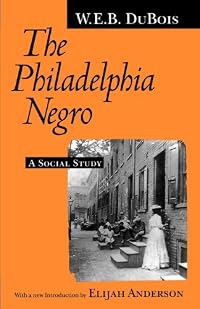
The Philadelphia Negro: A Social Study
by W. E. B. Du Bois
On This Page
Description
In 1897 the promising young sociologist William Edward Burghardt Du Bois (1868–1963) was given a temporary post as Assistant in Sociology at the University of Pennsylvania in order to conduct a systematic investigation of social conditions in the seventh ward of Philadelphia. The product of those studies was the first great empirical book on the Negro in American society.More than one hundred years after its original publication by the University of Pennsylvania Press, The Philadelphia show more Negro remains a classic work. It is the first, and perhaps still the finest, example of engaged sociological scholarship—the kind of work that, in contemplating social reality, helps to change it.In his introduction, Elijah Anderson examines how the neighborhood studied by Du Bois has changed over the years and compares the status of blacks today with their status when the book was initially published. show lessTags
Recommendations

























Member Reviews
Very quantitative, crisply objective, protective of the fragile evolving black middle class; anticipating civil rights attitudes of the 1960, but also somewhat subservient to bourgeois attitudes.
The Philadelphia Negro is the first, as still perhaps the finest, example of engaged sociological scholarship – the kind of work that, in contemplating social reality, helps to change it. It was first published in 1899.
Ratings
Members
- Recently Added By
Author Information

185+ Works 12,933 Members
Civil rights leader and author, William Edward Burghardt Du Bois was born in Great Barrington, Massachusetts on February 23, 1868. He earned a B.A. from both Harvard and Fisk universities, an M.A. and Ph.D. from Harvard, and studied at the University of Berlin. He taught briefly at Wilberforce University before he came professor of history and show more economics at Atlanta University in Ohio (1896-1910). There, he wrote The Souls of Black Folk (1903), in which he pointed out that it was up to whites and blacks jointly to solve the problems created by the denial of civil rights to blacks. In 1905, Du Bois became a major figure in the Niagara Movement, a crusading effort to end discrimination. The organization collapsed, but it prepared the way for the founding of the National Association for the Advancement of Colored People (NAACP), in which Du Bois played a major role. In 1910, he became editor of the NAACP magazine, a position he held for more than 20 years. Du Bois returned to Atlanta University in 1932 and tried to implement a plan to make the Negro Land Grant Colleges centers of black power. Atlanta approved of his idea, but later retracted its support. When Du Bois tried to return to NAACP, it rejected him too. Active in several Pan-African Congresses, Du Bois came to know Fwame Nkrumah, the first president of Ghana, and Jono Kenyatta the president of Kenya. In 1961, the same year Du Bois joined the Communist party, Nkrumah invited him to Ghana as a director of an Encyclopedia Africana project. He died there on August 27, 1963, after becoming a citizen of that country. (Bowker Author Biography) show less
Some Editions
Common Knowledge
- Canonical title*
- Les Noirs de Philadelphie. Une étude sociale
- Original title
- The Philadelphia Negro. A social study
- Original publication date
- 1899-1915
- Important places
- Philadelphia, Pennsylvania, USA; Pennsylvania, USA
- Epigraph*
- /
- Dedication*
- /
- First words*
- Remerciements de Nicolas Martin-Breteau
Entamée pour le cent cinquantième anniversaire de la naissance de W. E. B. Du Bois en 2018, cette traduction des Noirs de Philadelphie n’aurait pu voir le jour aux Éditions ... (show all)La Découverte sans l’enthousiasme et la confiance de Rémy Toulouse. [...]
Introduction
Les Noirs de Philadelphie : un classique pour les sciences sociales
Nicolas Martin-Breteau
En 1899, William Edward Burghardt Du Bois (1868-1963) faisait paraître ce qui est désormais considéré co... (show all)mme un « classique » de la sociologie, The Philadelphia Negro : A Social Study. Publié à la même époque que Le Suicide. Étude de sociologie d’Émile Durkheim (1897), l’ouvrage de Du Bois est contemporain de la structuration de la sociologie à l’échelle internationale, faisant ainsi de son auteur l’un des fondateurs de cette discipline. [...] - Original language
- English
*Some information comes from Common Knowledge in other languages. Click "Edit" for more information.
Classifications
- Genres
- Sociology, Nonfiction, History, General Nonfiction
- DDC/MDS
- 974.8 — History & geography History of North America Northeastern United States (New England and Middle Atlantic states) Pennsylvania
- LCC
- F158.9 .N4 .D8 — Local History of the United States, Canada and Latin America United States local history Pennsylvania
- BISAC
Statistics
- Members
- 176
- Popularity
- 185,403
- Reviews
- 2
- Rating
- (4.43)
- Languages
- English, French
- Media
- Paper, Ebook
- ISBNs
- 24
- ASINs
- 8