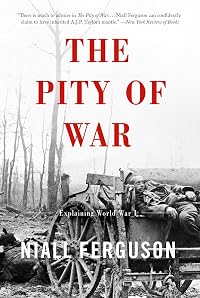
The Pity of War: Explaining World War I
by Niall Ferguson
On This Page
Description
From a bestselling historian, a daringly revisionist history of World War I "The Pity of War" makes a simple and provocative argument: the human atrocity known as the Great War was entirely England's fault. According to Niall Ferguson, England entered into war based on naive assumptions of German aims, thereby transforming a Continental conflict into a world war, which it then badly mishandled, necessitating American involvement. The war was not inevitable, Ferguson argues, but rather was show more the result of the mistaken decisions of individuals who would later claim to have been in the grip of huge impersonal forces. That the war was wicked, horrific, and inhuman is memorialized in part by the poetry of men like Wilfred Owen and Siegfried Sassoon, but also by cold statistics. Indeed, more British soldiers were killed in the first day of the Battle of the Somme than Americans in the Vietnam War. And yet, as Ferguson writes, while the war itself was a disastrous folly, the great majority of men who fought it did so with little reluctance and with some enthusiasm. For anyone wanting to understand why wars are fought, why men are willing to fight them and why the world is as it is today, there is no sharper or more stimulating guide than Niall Ferguson's "The Pity of War". show lessTags
Recommendations






Member Recommendations
Member Reviews
World War I was the greatest mistake of modern time. Ferguson makes the case better than I could that the war was not inevitable, that without British intervention it would have been a relatively quick German victory, and that the results of a quick German victory would have been better for everyone (including the French and British).
Ferguson downplayed the extent that WW1 essentially ruined Europe permanently (particularly if you combine WW1 with WW2), and didn't particularly describe the horrible impact it had on the US (and states generally) by making them all much more centralized and interventionist.
Ferguson downplayed the extent that WW1 essentially ruined Europe permanently (particularly if you combine WW1 with WW2), and didn't particularly describe the horrible impact it had on the US (and states generally) by making them all much more centralized and interventionist.
Ferguson thinks World War I is not given the respect it deserves. The Civil War and World War II are more widely written about than World War I. His book, The Pity of War, sets out to explain the war in detail by answering ten questions about the war:
1. Why didn't the Germans win the war?
2. What kept the men fighting through terrible conditions?
3. What made the men finally stop fighting?
4. Who really won the peace?
5. Was World War I inevitable?
6. Why did Germany start the war?
7. Why did Britain get involved?
8. Did the war keep going due to well placed propaganda?
9. Was the war popular on the home front?
10. Why didn't the British Empire defeat the Central Powers?
In truth, I felt that there was a sort of pissing contest going on about the show more different wars: which one lost the most men, which country financed which war more, how bloody was each battle...needless to say, they were all pretty horrible.
The table of International Alignments from 1815 to 1917 was pretty helpful. It is hard to believe that in the beginning there was Anglo-German cooperation surrounding finance. Ferguson describes the moments leading up to war minute by minute. Britain went to war at 11pm on August 14th, 1914. Can we learn from history? Few soldiers knew why they were fighting. they blames their involvement solely on the assassination of the Archduke and his wife. Here are other influences, the brilliant marketing of the Parlimentary Recruiting Committee: speeches, letters, posters, leaflets, surging military bands, and news articles. Psychological pressures of wives wanting brave husbands, the peer pressure of friends, the economy, national pride, ignorance of war, and sheer impulse to "try it." Ferguson goes on to examine why soldiers stayed in the war even though it was sheer hell. He questions the positive effects of war and the adittance that some soldiers actually enjoyed the fight.
Ferguson's Pity of War is chock full of detailed statistics like food consumption and the fact that Hitler did not approve of holiday cease-fire truces, such as Christmas Day. show less
1. Why didn't the Germans win the war?
2. What kept the men fighting through terrible conditions?
3. What made the men finally stop fighting?
4. Who really won the peace?
5. Was World War I inevitable?
6. Why did Germany start the war?
7. Why did Britain get involved?
8. Did the war keep going due to well placed propaganda?
9. Was the war popular on the home front?
10. Why didn't the British Empire defeat the Central Powers?
In truth, I felt that there was a sort of pissing contest going on about the show more different wars: which one lost the most men, which country financed which war more, how bloody was each battle...needless to say, they were all pretty horrible.
The table of International Alignments from 1815 to 1917 was pretty helpful. It is hard to believe that in the beginning there was Anglo-German cooperation surrounding finance. Ferguson describes the moments leading up to war minute by minute. Britain went to war at 11pm on August 14th, 1914. Can we learn from history? Few soldiers knew why they were fighting. they blames their involvement solely on the assassination of the Archduke and his wife. Here are other influences, the brilliant marketing of the Parlimentary Recruiting Committee: speeches, letters, posters, leaflets, surging military bands, and news articles. Psychological pressures of wives wanting brave husbands, the peer pressure of friends, the economy, national pride, ignorance of war, and sheer impulse to "try it." Ferguson goes on to examine why soldiers stayed in the war even though it was sheer hell. He questions the positive effects of war and the adittance that some soldiers actually enjoyed the fight.
Ferguson's Pity of War is chock full of detailed statistics like food consumption and the fact that Hitler did not approve of holiday cease-fire truces, such as Christmas Day. show less
An interesting take on WWI, and counter to the usualy historical line. He makes a case that it would have been beter if Britain had stood aside, leading to a much shorter and elss desctuctive war and a probably German victory. The result being a Europe much like we have today, but without the intervening Hitler and Stalin dictatorships. This book is massive, pack with a lot of statistics in the middle, making for slow going at times.
It would be best to read the final chapter 'Conclusion: Alternatives to Armageddon' so you understand where the author is leading as you read the rest of the book.
It would be best to read the final chapter 'Conclusion: Alternatives to Armageddon' so you understand where the author is leading as you read the rest of the book.
This is an interesting book but also a very opinionated one. In his dry academic way, Niall Ferguson is being irritating, sufficiently so that the reader becomes inclined to give him less credit than is due to him. And that’s a pity (no pun intended) because this is a valuable effort, worth reading despite its undeniable flaws.
It is hard to judge because the author presents us with a fragmented, splintered view of the war, as if we are looking at it in a shattered mirror. The problem, I think, is that Ferguson is so fond of adopting extreme positions and contrarian views, that he pursues them all over the place. The result is that this book reads as if the chapters of it have been written a long time apart, or even by different show more people who fundamentally disagree. The impression of incoherence is reinforced if you consider the book in the context of the many other excellent histories that have been written about the Great War. But much of its incoherence is internal to it.
For example, when discussing the causes of the war, Ferguson relies heavily on the cold logic of explanations founded in economic and industrial history. His investigation of why Germany decides to go to war in July 1914 focuses on the shifting balances of economic power, military power, and mobilisation time tables. In this context he discounts the cultural and personal factors, arguing (with some justification) that Wilhelmine Germany was not as militaristic as later propagandists portrayed it to be. Indeed he argues that militarism was not a great factor in the outbreak of the war at all. Yet in a later chapter, when he discusses the motivation of soldiers to fight, Ferguson does see the need to consider psychological and personal factors. He then cites (with approval) Van Creveld’s view that wars are fought because many men (and women) enjoy fighting. And he even argues that a primordial lust for combat and killing was an important factor in continuing the war. Note that this psychological argument is at least one-sided and possibly amounts to cherry picking the evidence, as Ferguson entirely ignores S.L.A. Marshall’s also important observation (controversial, but generally confirmed by later studies) that the majority of soldiers have no wish to kill and do not use their weapons purposefully. The author probably is on much safer ground when writing about economics than when writing about psychology, as his effort in the latter relies too heavily on literary and anecdotal evidence.
But Ferguson thus present us in one book with two radically different views on war, albeit separated by a substantial number of pages. He makes no attempt to reconcile them. Certainly this it is possible to attempt this, as inevitably psychology, culture and politics determined how people interpreted the economic and industrial factors, and how willing they were to wage war because of them. But that would involve seeking a middle ground, and as said, Ferguson seems fond of adopting extreme positions.
In his preface, the author admits that his indulgence in what-ifs is not to everyone’s taste. I find that he places himself in a long series of British conservatives who have argued that Britain would have been better off if it had stayed out of the continental wars, usually based on sparse arguments but plentiful wishful thinking. A standard element of this reasoning is that Britain might not have lost its Empire - or in Ferguson’s words, “the massive contraction in British overseas power” might not have occurred. This is unrealistic, because ultimately the Empire expired not because Britain was too weak to hold on to it, but because the people over which it ruled rejected it as an unjust and exploitative system, and the English people in majority had to accept the truth of that accusation. As Ferguson acknowledges, the Great War in reality resulted in a significant expansion of the Empire, not in its contraction. The same had been true for the Napoleonic Wars, which had left Britain even deeper in debt. But these gains would be short-lived, not because Britain lacked money, but because it was not remotely sustainable to treat hundreds of millions of people as second-class citizens in their own country.
Ferguson’s attempt at alternative history lacks credibility. To build a case that Britain could have stayed out of the Great War, Ferguson first argues that the issue of Belgian neutrality was moot because Britain was not willing to defend Belgian neutrality in all cases and at any cost, and that British politicians also saw disadvantages in the maintenance of Belgian neutrality. He has to concede that Britain could not tolerate a German occupation of the Belgian coast and the port of Antwerp. (Treaty obligations aside, seeing to it that the Belgian coast was not in unfriendly hands had been a priority for English and British politicians since at least the 100 Years War.) The cold fact that Belgian neutrality was a means to an end, not the end itself, did not make it unimportant. Many pages later, Ferguson does have to mention that Germany intended to annex significant parts of Belgium and France and that this repeatedly caused the failure of attempts to negotiate peace. But he still wishes that in 1914, Britain would have accepted “German guarantees of Belgian territorial integrity and neutrality”. One can question what these would have been worth, but that is almost beside the point. For Britain, the existence of this neutral state on the North Sea coast was not a goal in itself, but the expression of a continental balance of power that denied each of the great powers the possession of this strategic crossroads. With French power destroyed and Belgium at the mercy of a German empire that had already broken its word once, Bethmann’s assurances of Belgian neutrality would have been valueless to Britain.
Ferguson concedes that Britain could not accept a German military dominance of the continent (and it is implausible to even imagine that the defeat of both France and Russia could have resulted in anything else) but he suggests that it would have been possible for Britain to accept German economic and political dominance over it: A case that may sound vaguely plausible from a distance, but would have blown out of the water if anyone had floated it in 1914. And it is more than a little mischievous to absolve Wilhelm II from Napoleonic ambitions, while suggesting that Britain could have allowed his government to organise, in effect, a new Continental System. The writer is indeed being rather unfair to Napoleon, whose goal was not to rule the whole of Europe single-handedly, but to create a network of friendly states under French control. In any case, rhetorically comparing the concept of a post-1914 German-dominated Europe with the reality of the EU today amounts to a bizarre sleight of hand. The modern EU is not an organisation under German control; it could be more fairly described as a means to create and maintain a balancing force to Germany's power. After all, the fundamental axis on which it rotates runs from Paris to Berlin. A total German victory in 1914 would not have produced another EU, but another Warsaw Pact.
Ferguson believes that without British intervention Germany stood a good chance of winning the war, arguing that the German war economy was competitive despite its disadvantages, and that the German way of waging war was considerably more efficient in its use of manpower, money and industrial resources than that of the Entente powers. When it comes to military operations, Ferguson argues that Germany pursued a flawed strategy but had the tactical edge in WWI for fundamentally the same factor that played such an important role in WWII: A flexible tactical system that stressed operations by small units and that trained and trusted common soldiers, NCOs and junior officers to take the initiative and exploit opportunities. This is a very interesting observation. Yet the book suffers, not unexpectedly for a British historian, from focusing too much on the competing British and German economies, with occasional mention of France. France was, despite the loss of the industrial regions of the north, a major contributor to Entente industry, which for example found the means to supply the American expeditionary force (and also other allies) with artillery, tanks and aircraft. To neglect her so much is to tell an incomplete story.
One the whole then, this book provides a collection of interesting perspectives on the Great War, food for thought and debate. But they don’t amount to a coherent or credible thesis as a whole. The author is at his best when dealing with the economic history of the war, and these chapters feel thoroughly professional, although he indulges rather a lot in sniping at Keynes. But elsewhere - well, fools go where angels fear to thread. show less
It is hard to judge because the author presents us with a fragmented, splintered view of the war, as if we are looking at it in a shattered mirror. The problem, I think, is that Ferguson is so fond of adopting extreme positions and contrarian views, that he pursues them all over the place. The result is that this book reads as if the chapters of it have been written a long time apart, or even by different show more people who fundamentally disagree. The impression of incoherence is reinforced if you consider the book in the context of the many other excellent histories that have been written about the Great War. But much of its incoherence is internal to it.
For example, when discussing the causes of the war, Ferguson relies heavily on the cold logic of explanations founded in economic and industrial history. His investigation of why Germany decides to go to war in July 1914 focuses on the shifting balances of economic power, military power, and mobilisation time tables. In this context he discounts the cultural and personal factors, arguing (with some justification) that Wilhelmine Germany was not as militaristic as later propagandists portrayed it to be. Indeed he argues that militarism was not a great factor in the outbreak of the war at all. Yet in a later chapter, when he discusses the motivation of soldiers to fight, Ferguson does see the need to consider psychological and personal factors. He then cites (with approval) Van Creveld’s view that wars are fought because many men (and women) enjoy fighting. And he even argues that a primordial lust for combat and killing was an important factor in continuing the war. Note that this psychological argument is at least one-sided and possibly amounts to cherry picking the evidence, as Ferguson entirely ignores S.L.A. Marshall’s also important observation (controversial, but generally confirmed by later studies) that the majority of soldiers have no wish to kill and do not use their weapons purposefully. The author probably is on much safer ground when writing about economics than when writing about psychology, as his effort in the latter relies too heavily on literary and anecdotal evidence.
But Ferguson thus present us in one book with two radically different views on war, albeit separated by a substantial number of pages. He makes no attempt to reconcile them. Certainly this it is possible to attempt this, as inevitably psychology, culture and politics determined how people interpreted the economic and industrial factors, and how willing they were to wage war because of them. But that would involve seeking a middle ground, and as said, Ferguson seems fond of adopting extreme positions.
In his preface, the author admits that his indulgence in what-ifs is not to everyone’s taste. I find that he places himself in a long series of British conservatives who have argued that Britain would have been better off if it had stayed out of the continental wars, usually based on sparse arguments but plentiful wishful thinking. A standard element of this reasoning is that Britain might not have lost its Empire - or in Ferguson’s words, “the massive contraction in British overseas power” might not have occurred. This is unrealistic, because ultimately the Empire expired not because Britain was too weak to hold on to it, but because the people over which it ruled rejected it as an unjust and exploitative system, and the English people in majority had to accept the truth of that accusation. As Ferguson acknowledges, the Great War in reality resulted in a significant expansion of the Empire, not in its contraction. The same had been true for the Napoleonic Wars, which had left Britain even deeper in debt. But these gains would be short-lived, not because Britain lacked money, but because it was not remotely sustainable to treat hundreds of millions of people as second-class citizens in their own country.
Ferguson’s attempt at alternative history lacks credibility. To build a case that Britain could have stayed out of the Great War, Ferguson first argues that the issue of Belgian neutrality was moot because Britain was not willing to defend Belgian neutrality in all cases and at any cost, and that British politicians also saw disadvantages in the maintenance of Belgian neutrality. He has to concede that Britain could not tolerate a German occupation of the Belgian coast and the port of Antwerp. (Treaty obligations aside, seeing to it that the Belgian coast was not in unfriendly hands had been a priority for English and British politicians since at least the 100 Years War.) The cold fact that Belgian neutrality was a means to an end, not the end itself, did not make it unimportant. Many pages later, Ferguson does have to mention that Germany intended to annex significant parts of Belgium and France and that this repeatedly caused the failure of attempts to negotiate peace. But he still wishes that in 1914, Britain would have accepted “German guarantees of Belgian territorial integrity and neutrality”. One can question what these would have been worth, but that is almost beside the point. For Britain, the existence of this neutral state on the North Sea coast was not a goal in itself, but the expression of a continental balance of power that denied each of the great powers the possession of this strategic crossroads. With French power destroyed and Belgium at the mercy of a German empire that had already broken its word once, Bethmann’s assurances of Belgian neutrality would have been valueless to Britain.
Ferguson concedes that Britain could not accept a German military dominance of the continent (and it is implausible to even imagine that the defeat of both France and Russia could have resulted in anything else) but he suggests that it would have been possible for Britain to accept German economic and political dominance over it: A case that may sound vaguely plausible from a distance, but would have blown out of the water if anyone had floated it in 1914. And it is more than a little mischievous to absolve Wilhelm II from Napoleonic ambitions, while suggesting that Britain could have allowed his government to organise, in effect, a new Continental System. The writer is indeed being rather unfair to Napoleon, whose goal was not to rule the whole of Europe single-handedly, but to create a network of friendly states under French control. In any case, rhetorically comparing the concept of a post-1914 German-dominated Europe with the reality of the EU today amounts to a bizarre sleight of hand. The modern EU is not an organisation under German control; it could be more fairly described as a means to create and maintain a balancing force to Germany's power. After all, the fundamental axis on which it rotates runs from Paris to Berlin. A total German victory in 1914 would not have produced another EU, but another Warsaw Pact.
Ferguson believes that without British intervention Germany stood a good chance of winning the war, arguing that the German war economy was competitive despite its disadvantages, and that the German way of waging war was considerably more efficient in its use of manpower, money and industrial resources than that of the Entente powers. When it comes to military operations, Ferguson argues that Germany pursued a flawed strategy but had the tactical edge in WWI for fundamentally the same factor that played such an important role in WWII: A flexible tactical system that stressed operations by small units and that trained and trusted common soldiers, NCOs and junior officers to take the initiative and exploit opportunities. This is a very interesting observation. Yet the book suffers, not unexpectedly for a British historian, from focusing too much on the competing British and German economies, with occasional mention of France. France was, despite the loss of the industrial regions of the north, a major contributor to Entente industry, which for example found the means to supply the American expeditionary force (and also other allies) with artillery, tanks and aircraft. To neglect her so much is to tell an incomplete story.
One the whole then, this book provides a collection of interesting perspectives on the Great War, food for thought and debate. But they don’t amount to a coherent or credible thesis as a whole. The author is at his best when dealing with the economic history of the war, and these chapters feel thoroughly professional, although he indulges rather a lot in sniping at Keynes. But elsewhere - well, fools go where angels fear to thread. show less
This is a book for those who already know the course of the war through previous reading and who wish to expand upon that knowledge by closer study of its underpinnings, social, cultural, political and financial. Do not pick this book up if you what you want are depictions of artillery battles and hand-to-hand combat. No question that that sort of strict military history can be very engaging, but that's not what Dr Ferguson is up to. Actual fighting is only described to the extent that it illuminates the political, cultural, and social history, especially on the various home fronts of the Entente and Central Powers. Dr Ferguson seeks to overturn some long-held beliefs about the war. He does this primarily through a masterful wielding of show more statistics. For example, the myth of war enthusiasm. He is able to show that this was something very short-lived, which occurred mostly at the beginning of the war. He is able to argue, too, that there were real alternatives for Britain if she had stayed out of the war. The Entente was after all a gentleman's agreement. There was no formal treaty committing British forces to the defense of France. Would Britain have been held in contempt by the international community for taking such a position, probably, but it was a real option whose upside was never given proper consideration in Britain. Among other things Ferguson believes that without Britain in the war the result would have been a limited general European conflict. Once Britain entered, however, with her unparalleled foreign possessions (colonies) it became a global imperialist war. Perhaps my favorite parts of the book are the statistics Ferguson is able to marshal to show how much more efficient Germany was on the battlefield. Germany killed something like 5 Entente soldiers for every 4 Central Power soldiers killed by the Entente Powers. And Germany did this on the cheap. It's budgetary constraints are discussed in comparison to those of the Entente Powers. There's no question that Germany was able not only to kill more Entente soldiers over the long term, they were able to do it far more cheaply than their enemies. Other topics covered include: (1) the myth of an ingrained militarism in Germany; Ferguson believes there was not one. (2) an examination of why men fought, this in a chapter titled "The Death Instinct" in which the author invokes Freud, Jung and others; and the prickly problem of taking prisoners. I found it fascinating throughout. Highly recommended. show less
A very well written, well researched and well argued history of the causes and results of World War 1. It is actually less a history of the war, but a critique of the generally believed history of the war. There isn't the nitty gritty detail of the famous battles, very little mention of the Arch-Duke, nor the confrontations surrounding the armistice. Rather, this book is a refutation of the belief that the war was inevitable, explains how the entente powers barely managed to win the war, despite their advantages and how the central powers barely lost, despite their disadvantages and that the severe economic condition that Germany went through in the 20's and 30's wasn't entirely due to the massive reparations place on them under the show more treaty of Versailles.
The weakest argument, for me, was the inevitability (or non-inevitability) of the war. With the benefit of time and scholar can gather all the information they need, from all the parties involved to make an argument that the war could have easily been prevented, but that is the issue. At the time, the various powers did not have all the information at hand. Germany didn't know what Britain was going to do, Britain wasn't necessarily sure what France was going to do. The scholar has better access to that information. That being said, Mr Ferguson makes some rather well reasoned arguments.
I good read for anybody with an interest in the war. It will certainly make you think. show less
The weakest argument, for me, was the inevitability (or non-inevitability) of the war. With the benefit of time and scholar can gather all the information they need, from all the parties involved to make an argument that the war could have easily been prevented, but that is the issue. At the time, the various powers did not have all the information at hand. Germany didn't know what Britain was going to do, Britain wasn't necessarily sure what France was going to do. The scholar has better access to that information. That being said, Mr Ferguson makes some rather well reasoned arguments.
I good read for anybody with an interest in the war. It will certainly make you think. show less
Well written but wrong-headed. The Economic History section is excellent though.
Members
- Recently Added By
Lists

THE WAR ROOM
813 works; 24 members

In Our Time books
4,934 works; 2 members
Author Information

52+ Works 18,097 Members
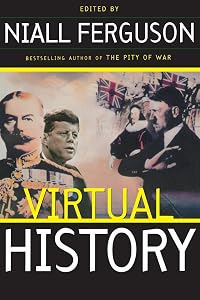
Niall Ferguson was born April 18, 1964, in Glasgow. He is a Scottish historian. He specializes in financial and economic history as well as the history of empire. He is the Laurence A. Tisch Professor of History at Harvard University and the William Ziegler Professor of Business Administration at Harvard Business School. His books include Paper show more and Iron: Hamburg Business and German Politics in the Era of Inflation 1897-1927 (1993), Virtual History: Alternatives and Counterfactuals (1997), The Pity of War: Explaining World War One (1998), The World's Banker: The History of the House of Rothschild (1998), The Cash Nexus: Money and Power in the Modern World, 1700-2000 (2001), Empire: The Rise and Demise of the British World Order and the Lessons for Global Power (2003), Colossus: The Rise and Fall of the American Empire (2004), The War of the World: Twentieth-Century Conflict and the Descent of the West (2006) and The Ascent of Money: A Financial History of the World (2008), Civilization: The West and the Rest (2011) , The Great Degeneration: How Institutions Decay and Economies Die, and The Square and the Tower: Networks and Power, from the Freemasons to Facebook. (Bowker Author Biography) show less
Work Relationships
Contains
Common Knowledge
- Canonical title
- The Pity of War: Explaining World War I
- Original title
- The Pity of War: Explaining World War I
- Original publication date
- 1998
- People/Characters
- David Lloyd George; Woodrow Wilson
- Important places
- Europe
- Important events
- World War I
Classifications
Statistics
- Members
- 1,318
- Popularity
- 18,362
- Reviews
- 16
- Rating
- (3.74)
- Languages
- 12 — Chinese, Dutch, English, Finnish, German, Greek, Italian, Romanian, Russian, Turkish, Portuguese (Portugal), Portuguese (Brazil)
- Media
- Paper, Audiobook, Ebook
- ISBNs
- 26
- ASINs
- 9