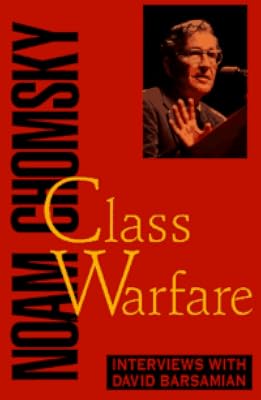
Class Warfare: Interviews with David Barsamian
by Noam Chomsky
On This Page
Description
Western societies are divided more clearly than ever before into the haves and the have-nots, the needy and the greedy. In addition, neoliberal doctrines have been reshaped into more effective instruments of oppression and domination. Through a fascinating dialogue with long-time collaborator and fellow activist David Barsamian, Noam Chomsky explores this growing economic and social crisis, arguing that it is now acceptable political discourse to discuss class warfare.Chomsky focuses his show more customarily critical eye on a range of themes and issues - from Israel to East Timor, from the US federal reserve to women's rights, from transport subsidies to the dangers of devolution - and touches on some of his more personal concerns, such as his teaching, his critics and local labour disputes. Class Warfare is challenging, thought-provoking, illuminating and profound, and a powerful road-map to the emerging global capitalism. show lessTags
Recommendations















Member Reviews
'Class Warfare' is a collection of interviews of Noam Chomsky (almost entirely concerned with his politics) conducted by David Barsamian from 1994 to 1995. It is very much of its time and is of limited value as a result. Milan Rai's 'Chomsky's Politics' (1995) is far more useful.
Chomsky's analyses are often very much to the point if sometimes his omelette is a bit over-egged but we are left, as usual, with the same problem that he always leaves us with - 'OK, so you understand how things work, how do we change it?'
And, as usual, his answers remain weak - constant propagandising and encouragement to community 'organisation' without any real understanding of a human condition that makes anarcho-communitarian bottom-up operations not show more merely unlikely but often potentially self-defeating.
He refers to the lack of urban liberal interest in the Decatur workers' strikes and seems puzzled. The room will be packed for a speech on Palestine or American foreign policy but bread and butter issues among their own working class leaves left-liberals cold. They are merely playing at politics.
American liberals (and Chomsky is just the most extreme example of one) in general are people who want to keep talking and thinking but collapse in confusion at the moment something needs the slow, patient business of persuasion and direct action through organised politics.
Chomsky, to his credit, has a very strong sense of class conflict (hence the title of the book) but seems to have a problem in defining it in any terms that would enable action. There are moments when he seems puzzled at his own cult only to inquire (strangely given his intellect) no further.
The problem is that the romantic assumption here is of intellectual equality and a sort of essentialism about the humans who create our conditions of existence. If only consciousness was raised in enough people, and these people organised, all would be well, he implies.
We are left depressed with his correct analysis and then risk wasting our life on trying to change things as accumulations of impotent individuals who have seen the light. This is classic 'Judeo-Christian' thinking that simply creates the bases for new types of elite oppression.
Most people are interests first and idealists second. The effort has to be made to ensure that a majority in a democracy understands that the existing structures are not in their interest and then creates plausible and basically honest vehicles capable of over-turning those structures.
The tragedy is that a billionaire like Donald Trump has done more in that direction for all the wrong reasons than either the US Democrat Party or its global look-alikes such as the British Labour Party. It is Trump who is exposing the falsity of the system's structures and the Left that buttresses them.
Understandably rational individuals, which include some of our very poorest, look askance at radical abstract intellectualism and ask, perfectly legitimately, how will things end up for them in a world of youthful, marginal and elderly activists and enthusiasts were they to obtain power.
Still, the analyses of late liberal capitalism, socialism for corporations, the disturbing power of military-industrial complexes, the manufacturing of consent, the propagandising to maintain the power of the few through 'trickle-down' and so much more are largely unarguable.
Chomsky is right about how our world works, specifically the world of our first truly hegemonic (at least until very recently) power, and the embedding of injustice and exploitation within that world. It is true that consciousness-raising serves its purpose.
But the world will not be changed very much by 'movements'. The power elites are extremely skilled at appropriating the watered down ideas of such a movements and cherry-picking their more ambitious and vain activists for high office. Corporate Greenery is just the most obvious today.
What actually changes things is the acquisition and deployment of power through infiltration and subversion and that too has its dangers. In the end, there is probably no substitute for the independent harrying democratic populist political party or the underground resistance movement.
Chomsky's world is the world of earnest university men, troubled individuals and excitable single issue activists in subornable NGOs. The world of actual change is deliberate defiance of existing corporate structures and elites through long term political organisation and system infiltration. show less
Chomsky's analyses are often very much to the point if sometimes his omelette is a bit over-egged but we are left, as usual, with the same problem that he always leaves us with - 'OK, so you understand how things work, how do we change it?'
And, as usual, his answers remain weak - constant propagandising and encouragement to community 'organisation' without any real understanding of a human condition that makes anarcho-communitarian bottom-up operations not show more merely unlikely but often potentially self-defeating.
He refers to the lack of urban liberal interest in the Decatur workers' strikes and seems puzzled. The room will be packed for a speech on Palestine or American foreign policy but bread and butter issues among their own working class leaves left-liberals cold. They are merely playing at politics.
American liberals (and Chomsky is just the most extreme example of one) in general are people who want to keep talking and thinking but collapse in confusion at the moment something needs the slow, patient business of persuasion and direct action through organised politics.
Chomsky, to his credit, has a very strong sense of class conflict (hence the title of the book) but seems to have a problem in defining it in any terms that would enable action. There are moments when he seems puzzled at his own cult only to inquire (strangely given his intellect) no further.
The problem is that the romantic assumption here is of intellectual equality and a sort of essentialism about the humans who create our conditions of existence. If only consciousness was raised in enough people, and these people organised, all would be well, he implies.
We are left depressed with his correct analysis and then risk wasting our life on trying to change things as accumulations of impotent individuals who have seen the light. This is classic 'Judeo-Christian' thinking that simply creates the bases for new types of elite oppression.
Most people are interests first and idealists second. The effort has to be made to ensure that a majority in a democracy understands that the existing structures are not in their interest and then creates plausible and basically honest vehicles capable of over-turning those structures.
The tragedy is that a billionaire like Donald Trump has done more in that direction for all the wrong reasons than either the US Democrat Party or its global look-alikes such as the British Labour Party. It is Trump who is exposing the falsity of the system's structures and the Left that buttresses them.
Understandably rational individuals, which include some of our very poorest, look askance at radical abstract intellectualism and ask, perfectly legitimately, how will things end up for them in a world of youthful, marginal and elderly activists and enthusiasts were they to obtain power.
Still, the analyses of late liberal capitalism, socialism for corporations, the disturbing power of military-industrial complexes, the manufacturing of consent, the propagandising to maintain the power of the few through 'trickle-down' and so much more are largely unarguable.
Chomsky is right about how our world works, specifically the world of our first truly hegemonic (at least until very recently) power, and the embedding of injustice and exploitation within that world. It is true that consciousness-raising serves its purpose.
But the world will not be changed very much by 'movements'. The power elites are extremely skilled at appropriating the watered down ideas of such a movements and cherry-picking their more ambitious and vain activists for high office. Corporate Greenery is just the most obvious today.
What actually changes things is the acquisition and deployment of power through infiltration and subversion and that too has its dangers. In the end, there is probably no substitute for the independent harrying democratic populist political party or the underground resistance movement.
Chomsky's world is the world of earnest university men, troubled individuals and excitable single issue activists in subornable NGOs. The world of actual change is deliberate defiance of existing corporate structures and elites through long term political organisation and system infiltration. show less
Conversaciones con David Barsamian
Mar 22, 2020Spanish
Ratings
Members
- Recently Added By
Lists

Exposing the Man Behind the Curtain
28 works; 3 members
Author Information

582+ Works 47,589 Members
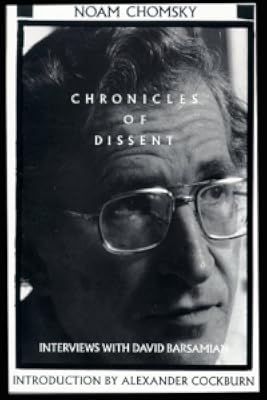
Noam Chomsky was born in Philadelphia, Pennsylvania on December 7, 1928. Son of a Russian emigrant who was a Hebrew scholar, Chomsky was exposed at a young age to the study of language and principles of grammar. During the 1940s, he began developing socialist political leanings through his encounters with the New York Jewish intellectual show more community. Chomsky received his Ph.D. from the University of Pennsylvania, where he studied linguistics, mathematics, and philosophy. He conducted much of his research at Harvard University. In 1955, he began teaching at MIT, eventually holding the Ferrari P. Ward Chair of Modern Language and Linguistics. Today Chomsky is highly regarded as both one of America's most prominent linguists and most notorious social critics and political activists. His academic reputation began with the publication of Syntactic Structures in 1957. Within a decade, he became known as an outspoken intellectual opponent of the Vietnam War. Chomsky has written many books on the links between language, human creativity, and intelligence, including Language and Mind (1967) and Knowledge of Language: Its Nature, Origin, and Use (1985). He also has written dozens of political analyses, including Manufacturing Consent: The Political Economy of the Mass Media (1988), Chronicles of Dissent (1992), and The Prosperous Few and the Restless Many (1993). (Bowker Author Biography) show less
Classifications
Statistics
- Members
- 247
- Popularity
- 131,760
- Reviews
- 2
- Rating
- (3.70)
- Languages
- English, German, Portuguese, Spanish
- Media
- Paper, Ebook
- ISBNs
- 17
- ASINs
- 3