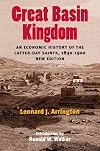
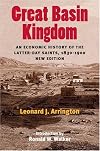
Great Basin Kingdom: An Economic History of the Latter-day Saints, 1830-1900, New Edition
by Leonard J. Arrington
On This Page
Description
"Strangers at Home reframes the way we conceive of the modernist literature that appeared in the period between the two world wars. This work shows that a body of texts written by ethnic writers during this period poses a challenge to conventional notions of America and American modernism. By engaging with modernist literary studies from the perspectives of minority discourse, postcolonial studies, and postmodern theory, Rita Keresztesi questions the validity of modernism's claim to the show more neutrality of culture. She argues that literary modernism grew out of a prejudiced, racially biased, and often xenophobic historical context that necessitated a politically conservative and narrow definition of modernism in America. With the changing racial, ethnic, and cultural makeup of the nation during the interwar era, literary modernism also changed its form and content." "Contesting traditional notions of literary modernism, Keresztesi examines American modernism from an ethnic perspective in the works of Harlem Renaissance, immigrant, and Native American writers. She discusses such authors as Countee Cullen, Nella Larsen, Zora Neale Hurston, Anzia Yezierska, Henry Roth, Josephina Niggli, Mourning Dove, D'Arcy McNickle, and John Joseph Mathews, among others. Strangers at Home makes a persuasive argument for expanding our understanding of the writers themselves as well as the concept of modernism as it is currently defined."--Jacket. show lessTags
Recommendations













Member Reviews
Okay. I'm going to try and be positive first. First, there are aspects of this information that are wildly fascinating (I think). Attempts to live the "United Order," the Utah War, Brigham Young's unique viewpoints,* Eliza Snow being touted as a feminist for the first time (that I ever heard)-- These are all interesting topics and worth exploring. Especially the latter.
It had its dry humor too. If you've read it, you'd know about the DMC. And there were several times when I laughed out loud because of the humor that the saints, not the writer, brought to the tales.
It also brings a bit of realism to the history of The Church of Jesus Christ of Latter-day Saints** It wasn't all rose gardens when they arrived in Utah and food wasn't show more always plenteous after the seagulls. Neither was the Kirtland Safety Society the first time the church weathered financial crises.
But the tone is SOOOOO dry. And Arrington, economist that he is, had not yet read Freakonomics or anything by Arthur Brooks. So he didn't know how economics could be presented to be interesting. Perhaps he bit off more than he could chew?
* Let the record show: I love Brigham Young. He is an inhabitant of a foreign country. And Arrington does little here to make him more explicable, but I firmly believe (in spite of his foibles and, perhaps because of, his humanity) that he was a prophet.
** Perhaps what rankled the most was his unending use of the nickname. But BY and others used it. So I'm overreacting. show less
It had its dry humor too. If you've read it, you'd know about the DMC. And there were several times when I laughed out loud because of the humor that the saints, not the writer, brought to the tales.
It also brings a bit of realism to the history of The Church of Jesus Christ of Latter-day Saints** It wasn't all rose gardens when they arrived in Utah and food wasn't show more always plenteous after the seagulls. Neither was the Kirtland Safety Society the first time the church weathered financial crises.
But the tone is SOOOOO dry. And Arrington, economist that he is, had not yet read Freakonomics or anything by Arthur Brooks. So he didn't know how economics could be presented to be interesting. Perhaps he bit off more than he could chew?
* Let the record show: I love Brigham Young. He is an inhabitant of a foreign country. And Arrington does little here to make him more explicable, but I firmly believe (in spite of his foibles and, perhaps because of, his humanity) that he was a prophet.
** Perhaps what rankled the most was his unending use of the nickname. But BY and others used it. So I'm overreacting. show less
Leonard Arrington, Who Died In 1999, is Considered by Most, If Not All, Serious Scholars of Mormon and Western History As the Single Most Important Figure to Write On LDS History. Great Basin Kingdom is Perhaps His Greatest Work. A Classic In Mormon Studies and Western History, Great Basin Kingdom Offers Insights Into the ‘Underdeveloped' American Economy, A Comprehensive Treatment of One of The Few Native American Religious Movements, and Detailed, Exciting Stories from Little-Known Phases of Mormon and American History.
Ratings
Members
- Recently Added By
Lists

Best in Mormon History
44 works; 2 members

Books Set in Utah
34 works; 5 members
Author Information

60+ Works 967 Members
Leonard J. Arrington (PhD, University of North Carolina) was the official Church Historian of the Church of Jesus Christ of Latter-day Saints from 1972 to 1982. During these years, he was also the director of the Charles Redd Center for Western Studies and the Lemuel H. Redd Jr. Professor of Western History at Brigham Young University (Provom show more Utah). Arrington died in 1999 at age eighty-one. show less
Some Editions
Work Relationships
Common Knowledge
- Original publication date
- 1958
Classifications
- Genres
- Economics, Nonfiction, Religion & Spirituality, History, General Nonfiction, Literature Studies and Criticism, Business
- DDC/MDS
- 330.9792 — Society, government, & culture Economics Jobs & Careers Economic geography and history North America West Coast U.S. Utah
- LCC
- HC107 .U8 .A8 — Social sciences Economic history and conditions Economic history and conditions By region or country
- BISAC
Statistics
- Members
- 106
- Popularity
- 306,832
- Reviews
- 2
- Rating
- (4.50)
- Languages
- English
- Media
- Paper, Ebook
- ISBNs
- 5
- ASINs
- 5