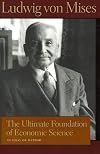
The Ultimate Foundation of Economic Science: An Essay on Method
by Ludwig Von Mises
On This Page
Description
Written toward the end of Mises's life, his last monograph, "The Ultimate Foundation of Economic Science, " returned to economics as a science based on human action. Mises believed that, since the publication of "Human Action," economists and scientists alike had misinterpreted the idea of economics as a science by deeming it epistemological positivism--that they believed that the "science" basis was still more rooted in philosophy than in actual science. In this volume, Mises argued that show more economics is a science because human action is a natural order of life and that it is the actions of humans that determine markets and capital decisions. Since Mises believed these links could be proven scientifically, he concluded that economics, with its basis on that human action, is indeed a science in its own right and not an ideology or a metaphysical doctrine. What has been described as his most passionate work, "The Ultimate Foundation of Economic Science" brings together all of the themes from Mises's previous works to proclaim what Israel Kirzner calls "the true character of economics." Ludwig von Mises (1881-1973) was the leading spokesman of the Austrian School of Economics throughout most of the twentieth century. He earned his doctorate in law and economics from the University of Vienna in 1906. In 1926, Mises founded the Austrian Institute for Business Cycle Research. From 1909 to 1934, he was an economist for the Vienna Chamber of Commerce. Before the "Anschluss," in 1934 Mises left for Geneva, where he was a professor at the Graduate Institute of International Studies until 1940, when he emigrated to New York City. From 1948 to 1969, he was a visiting professor at New York University. Bettina Bien Greaves is a former resident scholar, trustee, and longtime staff member of the Foundation for Economic Education. She has written and lectured extensively on topics of free market economics. Her articles have appeared in such journals as "Human Events, Reason, " and "The Freeman: Ideas on Liberty." A student of Mises, Greaves has become an expert on his work in particular and that of the Austrian School of economics in general. She has translated several Mises monographs, compiled an annotated bibliography of his work, and edited collections of papers by Mises and other members of the Austrian School. show lessTags
Recommendations
















Member Reviews
This is an essential component of Mises' corpus with a detail exposition of the importance of methodology for economic science. That methodology is one that recognizes the fundamental meaning of such concepts as free will, uncertainty, and the proper role of mathematics in the realm of economic research. The concluding chapter on the importance of the human mind and human action for understanding the human condition is invaluable.
The Ultimate Foundation of Economic Science : An Essay on Method by Ludwig von Mises (1962)
Ratings
Members
- Recently Added By
Author Information

91+ Works 5,214 Members
Ludwig von Mises (1881-1973) was a preeminent philosopher and economist during the twentieth century. He shared an intellectual friendship with literary giant Ayn Rand, and his theorems and philosophies have continued to influence the careers and ideas of politicians and economists alike.
Common Knowledge
- Original publication date
- 1962
Classifications
- Genres
- Economics, Nonfiction, General Nonfiction, Philosophy, History
- DDC/MDS
- 330.01 — Society, government, & culture Economics Jobs & Careers > Philosophy And Psychology
- LCC
- HB71 .V65 — Social sciences Economic theory. Demography Economic theory. Demography Economics as a science. Relation to other
- BISAC
Statistics
- Members
- 86
- Popularity
- 372,498
- Reviews
- 2
- Rating
- (4.40)
- Languages
- English, Portuguese, Spanish
- Media
- Paper, Ebook
- ISBNs
- 10
- ASINs
- 4