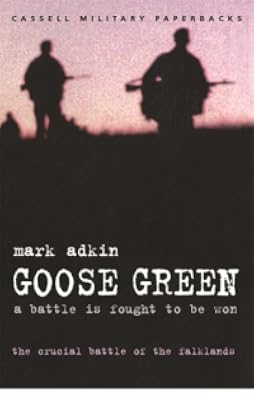
Goose Green (Cassell Military Paperbacks)
by Mark Adkin
On This Page
Description
"Probably the best and most detailed description of a key battle in the 1982 Falklands War . . . an excellent and fast paced narrative." --Michael McCarthy, historical battlefield guide This book tells the story of the battle for Goose Green--the first crucial clash of the Falklands War--through the eyes of the commanders, both British and Argentine, from brigadier to corporal. It follows in detail, with the aid of maps, the fourteen hours of vicious infantry as both sides struggled show more for the tiny settlement of Goose Green. The book explains how 2 Para came close to failure as the battalion fought over open ground, in daylight, without adequate fire support against prepared positions. Controversial questions--such as: Was it an unnecessary battle? Why did London overrule the brigadier commander's reluctance to attack? Did Col. Jones's solo charge, which won him the Victoria Cross, decide the issue?--are discussed frankly. The author, himself a former infantry officer, has had the full support of the Parachute Regiment, and has assembled the views and comments of over forty-five veterans of all ranks who fought there. "The Falklands War showed British military personnel at their best and most innovative under the most testing of conditions, and the Battle of Goose Green was one of the classic actions . . . The author has made an impressive job of reviewing the important factors, the events and decisions that led to the battle." --Firetrench "This brought home to me how the infantry fight and how the British Paratrooper has gained a worldwide reputation for being one of the best fighting men around. A superb read." --Army Rumour Service show lessTags
Recommendations



















Member Reviews
Mark Adkin offers a splendid, highly detailed account of 2 Para's attack and capture of Goose Green, a forsaken hamlet whose population of 90 makes it the second largest after Stanley in the Falkland Islands. It gained a glimpse of world attention as the first pit stop on the way to the recapture/liberation of the Falkland Islands out of the greedy little incompetent hands of the Argentine junta that had tried to bluff the Brits and were called out by the Iron Lady.
As Adkin lays out in great detail, the incompetence of the Argentine military knew no bounds. They timed the invasion so that most of the conscript soldiers had served for only two to three months. Part of the army had to stay behind to guard their backyard neighbor and the show more population. They left much of their equipment and especially the heavy weapons, the Brits would be unable to quickly transport south, on the mainland. They dispersed their forces all over the islands instead of concentrating on strategic points. Thus the two (battalion-sized) regiments that defended the isolated West Falklands were all but lost for all practical purposes. The forces that remained were dispersed in sequential, non supporting positions that violated the basic military concepts. At Goose Green, the Argentines failed to occupy the highest hills and did not put their troops on high alert when the BBC in a strange interpretation of public service pre-announced the British attack. The Brits were fortunate in their choice of opponents.
The Paras' main asset was their determination and willingness to bear pain. Their equipment, coordination and communication broke time and again, best exemplified by the suicidal solo charge of the Para's commanding officer (a charge of the Light Brigade in reverse). The sacrifice of his life resulted in a Victoria Cross but left the tactical situation unchanged. While the sequential lines of the Argentines gave the Brits local superiority, only the advent and use of the anti-tank weapons as trench busters broke the Argentinian will to fight. True to form, the Argentine leadership managed to reinforce failure just in time for their surrender.
Was it worth the price in blood? On the British side, the (re)gain was not a matter of real estate but prestige, both domestic and foreign. Great Britain was slowly and painfully reverting its decline and modernize its society and economy. The moral boost that made this possible started with the battle for Goose Green. For Argentina, the Falklands War broke the donkey generals' back and opened the a path toward democracy or what is possible thereof in a very unequal society.
Adkin's account is highly recommended to those seeking a professional analysis of the action. His emphasis is on command structure, capabilities, logistics and supply. Those seeking an adrenalin kick or a thriller, should look elsewhere. The remaining readers are rewarded by a highly detailed tactical analysis of a battailon attack with plenty of maps. show less
As Adkin lays out in great detail, the incompetence of the Argentine military knew no bounds. They timed the invasion so that most of the conscript soldiers had served for only two to three months. Part of the army had to stay behind to guard their backyard neighbor and the show more population. They left much of their equipment and especially the heavy weapons, the Brits would be unable to quickly transport south, on the mainland. They dispersed their forces all over the islands instead of concentrating on strategic points. Thus the two (battalion-sized) regiments that defended the isolated West Falklands were all but lost for all practical purposes. The forces that remained were dispersed in sequential, non supporting positions that violated the basic military concepts. At Goose Green, the Argentines failed to occupy the highest hills and did not put their troops on high alert when the BBC in a strange interpretation of public service pre-announced the British attack. The Brits were fortunate in their choice of opponents.
The Paras' main asset was their determination and willingness to bear pain. Their equipment, coordination and communication broke time and again, best exemplified by the suicidal solo charge of the Para's commanding officer (a charge of the Light Brigade in reverse). The sacrifice of his life resulted in a Victoria Cross but left the tactical situation unchanged. While the sequential lines of the Argentines gave the Brits local superiority, only the advent and use of the anti-tank weapons as trench busters broke the Argentinian will to fight. True to form, the Argentine leadership managed to reinforce failure just in time for their surrender.
Was it worth the price in blood? On the British side, the (re)gain was not a matter of real estate but prestige, both domestic and foreign. Great Britain was slowly and painfully reverting its decline and modernize its society and economy. The moral boost that made this possible started with the battle for Goose Green. For Argentina, the Falklands War broke the donkey generals' back and opened the a path toward democracy or what is possible thereof in a very unequal society.
Adkin's account is highly recommended to those seeking a professional analysis of the action. His emphasis is on command structure, capabilities, logistics and supply. Those seeking an adrenalin kick or a thriller, should look elsewhere. The remaining readers are rewarded by a highly detailed tactical analysis of a battailon attack with plenty of maps. show less
Ratings
Members
- Recently Added By
Author Information
11 Works 787 Members
Major Mark Adkin was commissioned into The Bedfordshire and Hertfordshire Regiment in 1956 and served with it and The Royal Anglian Regiment in Germany, Malaya, Mauritius and Aden. On leaving the British Army he joined the Overseas Civil Service and was posted to the Solomon Islands. Transferred to the Gilbert and Ellice Islands, he was one of the show more last British District Officers anywhere in the world. His final overseas post was as a contract officer for five years with the Barbados Defence Force, and it was as the Caribbean operations staff officer that he participated in the US invasion of Grenada in 1983. He now lives in Bedford and has written books on military subjects, including Urgent Fury, The Last Eleven? and The Charge, all published by Pen Sword Books. show less
Common Knowledge
- Important places
- Argentina; Falkland Islands; South America
- Important events
- Falklands War (1982-04-02 | 1982-06-14)
Classifications
Statistics
- Members
- 66
- Popularity
- 473,436
- Reviews
- 1
- Rating
- (3.50)
- Languages
- English
- Media
- Paper, Ebook
- ISBNs
- 7
- ASINs
- 1