On This Page
Description
Sharp-eyed orphan Eliss and her half-brother make a new home on a river barge and clash with a teen assassin amid an escalating series of pirate attacks on riverside cities.Tags
Recommendations











Member Recommendations

Member Reviews
I am so very sad that there will be no more books set in this world. Story aside, this is just one of those fantasy worlds that you want to fall into and live in for a while… maybe not permanently, as this story and the preceding two novels, Anvil of the World and House of the Stag, show, it’s not a perfect world. It’s gritty, and plagued by many of the same social ills as our own: racism, drug abuse, casual cruelty, the oppression of the poor by the rich… but there’s also a beauty and life to these that’s just pure enjoyment.
More so than the previous two books, this book is definitely YA – but also, less humor-oriented. A young woman, Eliss, is left orphaned and the sole caretaker of her younger, half-Yendri brother, show more Alder. The children have been victims of their mother’s poor choices for long before her death, and it’s a struggle for both of them to find and come to terms with their identity – and the facts that identity might not be the same for them both, and that their paths may lead in different directions.
I usually have a very low tolerance for books that bring up too many ‘issues’ – but while Bird of the River is quite chock-full of issues and definitely has strong (and positive) messages, they flow so naturally and believably out of the scenarios created here that I had not even a miniscule objection. The story is powerful and effective without being preachy.
Baker also draws a picture of daily life on a working riverboat which, although far from glamorous, is utterly believable (ok, except maybe for the mysterious magical parts). And, there’s also a murder mystery/adventure, and a bit of romance. Good fun on top, and a lot more to think about if you care to spend the time… I think if I had read this when I was 12 or 13, it would’ve been one of my all-time favorites. As it is, I really, really liked it. (And Penta, the cartographer, is amazing.)
I’d recommend this for all 13-yr-olds, all Kage Baker fans, and anyone who liked Robin Hobb’s Liveship books. (They’re not that similar, but something about the feel and the characterization, as well as the shipboard setting, reminded me of them…) show less
More so than the previous two books, this book is definitely YA – but also, less humor-oriented. A young woman, Eliss, is left orphaned and the sole caretaker of her younger, half-Yendri brother, show more Alder. The children have been victims of their mother’s poor choices for long before her death, and it’s a struggle for both of them to find and come to terms with their identity – and the facts that identity might not be the same for them both, and that their paths may lead in different directions.
I usually have a very low tolerance for books that bring up too many ‘issues’ – but while Bird of the River is quite chock-full of issues and definitely has strong (and positive) messages, they flow so naturally and believably out of the scenarios created here that I had not even a miniscule objection. The story is powerful and effective without being preachy.
Baker also draws a picture of daily life on a working riverboat which, although far from glamorous, is utterly believable (ok, except maybe for the mysterious magical parts). And, there’s also a murder mystery/adventure, and a bit of romance. Good fun on top, and a lot more to think about if you care to spend the time… I think if I had read this when I was 12 or 13, it would’ve been one of my all-time favorites. As it is, I really, really liked it. (And Penta, the cartographer, is amazing.)
I’d recommend this for all 13-yr-olds, all Kage Baker fans, and anyone who liked Robin Hobb’s Liveship books. (They’re not that similar, but something about the feel and the characterization, as well as the shipboard setting, reminded me of them…) show less
A beautiful story of a young woman traveling along a river. Eliss is smart, observant, and hard-working, and if she were any less competent she and her brother would probably be dead in a ditch somewhere. Instead, her tenacious dedication to survival means that her brother can explore the meaning of his mixed heritage and Eliss can slowly come to understand her own character and that of her lost mother.
This is set in the same fantasy world as [b:The House of the Stag|3213520|The House of the Stag|Kage Baker|http://photo.goodreads.com/books/1312058116s/3213520.jpg|3247292] and [b:Anvil of the World|297815|The Anvil of the World|Kage Baker|http://photo.goodreads.com/books/1312054576s/297815.jpg|288949]. Like those, issues of oppression show more and discrimination based on sex, race and class are ever-present but always lightly handled. Magic is threaded throughout, but never overwhelming--it's just a part of the characters' lives, not the solution to all their problems and certainly never a deus ex machina. The world building is top-notch here--the world is consistent and coherent, but never boring.
And some of that excellence is due to where Baker chose to focus her gaze. Instead of powerful people making decisions that bend the world, she chose to write about the lives of a ship's crew, who have little money and less power. This subversion of the usual fantasy storyline makes the dialog, personalities and character growth shine all the more because they're so unexpected. A song is written about Eliss's mother, and Eliss is at first furious, because it turns her mother's dingy life of poor choices into an epic tragedy. She's slightly reconciled to it when one of her mother's fellow divers mentions how grateful she is that finally, they have a song about a diver, no matter how truthful it is. Eventually, Eliss begins to come to terms with the idea that her mother was a silly woman who let her children down--but she was also a woman who'd suffered terrible personal tragedy.
I mentioned the dialog earlier, and I want to emphasize that it fantastic. It always feels natural and organic to the character, and it is dashed through with sparks of wit. By the end of this book, I felt like I knew each of the characters, that I'd shared bunk-space with them, that I'd eaten dinner beside them. I wish the book hadn't ended, because I miss them. show less
This is set in the same fantasy world as [b:The House of the Stag|3213520|The House of the Stag|Kage Baker|http://photo.goodreads.com/books/1312058116s/3213520.jpg|3247292] and [b:Anvil of the World|297815|The Anvil of the World|Kage Baker|http://photo.goodreads.com/books/1312054576s/297815.jpg|288949]. Like those, issues of oppression show more and discrimination based on sex, race and class are ever-present but always lightly handled. Magic is threaded throughout, but never overwhelming--it's just a part of the characters' lives, not the solution to all their problems and certainly never a deus ex machina. The world building is top-notch here--the world is consistent and coherent, but never boring.
And some of that excellence is due to where Baker chose to focus her gaze. Instead of powerful people making decisions that bend the world, she chose to write about the lives of a ship's crew, who have little money and less power. This subversion of the usual fantasy storyline makes the dialog, personalities and character growth shine all the more because they're so unexpected. A song is written about Eliss's mother, and Eliss is at first furious, because it turns her mother's dingy life of poor choices into an epic tragedy. She's slightly reconciled to it when one of her mother's fellow divers mentions how grateful she is that finally, they have a song about a diver, no matter how truthful it is. Eventually, Eliss begins to come to terms with the idea that her mother was a silly woman who let her children down--but she was also a woman who'd suffered terrible personal tragedy.
I mentioned the dialog earlier, and I want to emphasize that it fantastic. It always feels natural and organic to the character, and it is dashed through with sparks of wit. By the end of this book, I felt like I knew each of the characters, that I'd shared bunk-space with them, that I'd eaten dinner beside them. I wish the book hadn't ended, because I miss them. show less
This is the third book set in the Children of the Sun world. I really love the world and all the previous books (with the second one, The House of the Stag, I re-read my favourite bits 2-3 times before finally giving the book back to the library), and I think the first one, The Anvil of the World, is perfectly hilarious.
I've come to expect comedy and lightheartedness from the characters, even if their enemies are terrible and the racial tensions are grimly realistic. Kage Baker makes you laugh and cry, sometimes at the same time. When the earth-shattering events come to pass, they sneak up on you because you've been too busy laughing at the antics of the characters to notice that, gosh, there is something serious going on.
The Bird of show more the River differs from this model. It's much more plebian, restricting itself to just Children of the Sun and Yendri (no demons ... or is there?). There are no earth-shattering events (just life-shattering). It's still got funny bits and serious bits and I still laughed and cried, but more inside than out. I also felt that it was darker, a little less humorous in tone, the characters not so lighthearted (or comedic in their gravity).
That's okay. I still love this book, I just loved the other books more because they made me laugh and smile so much more. show less
I've come to expect comedy and lightheartedness from the characters, even if their enemies are terrible and the racial tensions are grimly realistic. Kage Baker makes you laugh and cry, sometimes at the same time. When the earth-shattering events come to pass, they sneak up on you because you've been too busy laughing at the antics of the characters to notice that, gosh, there is something serious going on.
The Bird of show more the River differs from this model. It's much more plebian, restricting itself to just Children of the Sun and Yendri (no demons ... or is there?). There are no earth-shattering events (just life-shattering). It's still got funny bits and serious bits and I still laughed and cried, but more inside than out. I also felt that it was darker, a little less humorous in tone, the characters not so lighthearted (or comedic in their gravity).
That's okay. I still love this book, I just loved the other books more because they made me laugh and smile so much more. show less
LOVE. Totally different from "The Company" books, except in the quality of the writing and the quirky realness of the characters. The main character's complicated relationship with her mother, her brother, and the rest of the world is delicately and thoughtfully drawn. Plus it's got just enough plot to keep pulling you forward.
(I almost cried after finishing, seeing "1952-2010" under her name. So very sad that there won't be any more of these.)
(I almost cried after finishing, seeing "1952-2010" under her name. So very sad that there won't be any more of these.)
From raygunreviews.wordpress.com
There is a bit of sadness here: Kage Baker is one of my favorite authors, yet with her death this past winter, there are not going to be many new books coming from her. The Bird of the River may be one of her very last new books.
Up until now, her fantasy world of the Children of the Sun was enjoyable, but it paled next to her science-fictional Company stories. However, with The Bird of the River, I think she just might have, with her final novel, shown the great potential that that world always promised, but never fully delivered.
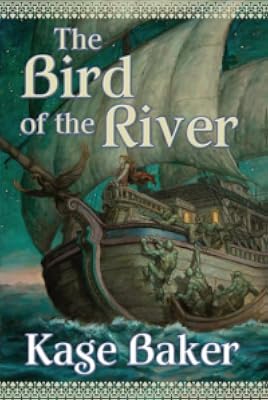
This time out we follow the adventures of teenager Eliss whose drug-addicted mother has brought up Eliss and her half-breed brother, Alder, in poverty. Eliss has often had to show more take control of the family in order to keep them from starving. Eliss's latest adventure is to return her mother to her roots as a river diver. They become a part of the crew of The Bird of the River, a barge that goes up and down the river, removing snagged trees and harvesting its lumber. However, on her first dive, Eliss's mother encounters a corpse and dies from what appears to be a heart attack.
Eliss and Alder are left alone on The Bird. The crew takes them in and gives them jobs on the barge. Soon, Krelan, a young noble on the run from a family vendetta, joins them and he and Eliss strike up a friendship, even though there is more to Krelan than meets the eye.
The storyline for the novel is mostly about the origin of the body that Eliss's mother finds, but thematically, the book is about growing beyond one's upbringing, whether it's growing beyond poverty and despair, as with Eliss, or growing beyond familial obligation, as Krelan must do.
As is to be expected with a Kage Baker novel, the characters are all well-drawn and very fleshed out. As was evident from her first novel to this, her last, Ms Baker is able with just a few words to create believable and sophisticated characters. As I have done with all of Ms Baker's books, I first read this one aloud to my wife in the evening. And, as with all of her novels, we ripped through it at a much faster pace than other books, wanting to rush to the end, but being disappointed when we got there, knowing we'd have to wait for the next novel to come out. Sadly, there won't be any more 'next novels.' Still, Ms Baker left quite an opus in the short time she was writing, so there's still a lot to return to re-read over and over again.
You're already missed, Kage. show less
There is a bit of sadness here: Kage Baker is one of my favorite authors, yet with her death this past winter, there are not going to be many new books coming from her. The Bird of the River may be one of her very last new books.
Up until now, her fantasy world of the Children of the Sun was enjoyable, but it paled next to her science-fictional Company stories. However, with The Bird of the River, I think she just might have, with her final novel, shown the great potential that that world always promised, but never fully delivered.
This time out we follow the adventures of teenager Eliss whose drug-addicted mother has brought up Eliss and her half-breed brother, Alder, in poverty. Eliss has often had to show more take control of the family in order to keep them from starving. Eliss's latest adventure is to return her mother to her roots as a river diver. They become a part of the crew of The Bird of the River, a barge that goes up and down the river, removing snagged trees and harvesting its lumber. However, on her first dive, Eliss's mother encounters a corpse and dies from what appears to be a heart attack.
Eliss and Alder are left alone on The Bird. The crew takes them in and gives them jobs on the barge. Soon, Krelan, a young noble on the run from a family vendetta, joins them and he and Eliss strike up a friendship, even though there is more to Krelan than meets the eye.
The storyline for the novel is mostly about the origin of the body that Eliss's mother finds, but thematically, the book is about growing beyond one's upbringing, whether it's growing beyond poverty and despair, as with Eliss, or growing beyond familial obligation, as Krelan must do.
As is to be expected with a Kage Baker novel, the characters are all well-drawn and very fleshed out. As was evident from her first novel to this, her last, Ms Baker is able with just a few words to create believable and sophisticated characters. As I have done with all of Ms Baker's books, I first read this one aloud to my wife in the evening. And, as with all of her novels, we ripped through it at a much faster pace than other books, wanting to rush to the end, but being disappointed when we got there, knowing we'd have to wait for the next novel to come out. Sadly, there won't be any more 'next novels.' Still, Ms Baker left quite an opus in the short time she was writing, so there's still a lot to return to re-read over and over again.
You're already missed, Kage. show less
This book was a short, quick read, but it was entertaining. It’s set in the same world as The Anvil of the World and The House of the Stag, but it has no significant connection with either book and it stands well on its own. Chronologically speaking, it definitely takes place after The House of the Stag, but I couldn’t say with any certainty where it fits in comparison with The Anvil of the World.
The story takes place entirely from the perspective of a teenage girl, Eliss, although it’s written in the third-person perspective. Her mother is a drug addict, her father is dead, and she has a 10-year-old half-brother who is of mixed race. They are barely scraping by, both because her mother is of no use and because they face a lot of show more prejudice when people see her brother. At the beginning of the book, the mother manages to get a job (mostly thanks to Eliss) on a huge river barge that sails up and down a very long river, stopping at various towns. This barge is the setting for the majority of the book.
There are some mysteries to solve – What’s up with the captain of the barge? What does the boy who joined the barge shortly after Eliss did really want? Where is the head of the dead body that was found? Who killed him? How are the bandits raiding the towns along the river so effectively? However, despite these questions, the story was pretty straight-forward and many of the answers were easy to guess from early on in the story. There was some twists (at least, I assume they were supposed to be twists) that I had guessed were coming from early on.
But even though there wasn’t anything earth shaking here, I still really enjoyed it. I liked and sympathized with the character of Eliss. She’s practical, intelligent, proactive, and determined not to make the same mistakes in life that her mother did. It was interesting to read about life on the barge, and to see all of the different towns that they stopped at on their way up the river. The story kept me reading to find out what would happen next and discover whether any of my predictions were correct.
Eliss’ brother seemed like a potentially interesting character, although he didn’t really do much more than act sullen and angry most of the time. He has some interesting experiences as well, but most of that takes place “off the page” because Eliss isn’t a direct witness. I think, if the author were still alive, he would have made an interesting subject for a fourth book in the series.
The ending wrapped everything up well and was satisfying, with a brief epilogue set four years in the future to help satisfy my curiosity about whether or not events continued on their expected course. show less
The story takes place entirely from the perspective of a teenage girl, Eliss, although it’s written in the third-person perspective. Her mother is a drug addict, her father is dead, and she has a 10-year-old half-brother who is of mixed race. They are barely scraping by, both because her mother is of no use and because they face a lot of show more prejudice when people see her brother. At the beginning of the book, the mother manages to get a job (mostly thanks to Eliss) on a huge river barge that sails up and down a very long river, stopping at various towns. This barge is the setting for the majority of the book.
There are some mysteries to solve – What’s up with the captain of the barge? What does the boy who joined the barge shortly after Eliss did really want? Where is the head of the dead body that was found? Who killed him? How are the bandits raiding the towns along the river so effectively? However, despite these questions, the story was pretty straight-forward and many of the answers were easy to guess from early on in the story. There was some twists (at least, I assume they were supposed to be twists) that I had guessed were coming from early on.
But even though there wasn’t anything earth shaking here, I still really enjoyed it. I liked and sympathized with the character of Eliss. She’s practical, intelligent, proactive, and determined not to make the same mistakes in life that her mother did. It was interesting to read about life on the barge, and to see all of the different towns that they stopped at on their way up the river. The story kept me reading to find out what would happen next and discover whether any of my predictions were correct.
Eliss’ brother seemed like a potentially interesting character, although he didn’t really do much more than act sullen and angry most of the time. He has some interesting experiences as well, but most of that takes place “off the page” because Eliss isn’t a direct witness. I think, if the author were still alive, he would have made an interesting subject for a fourth book in the series.
The ending wrapped everything up well and was satisfying, with a brief epilogue set four years in the future to help satisfy my curiosity about whether or not events continued on their expected course. show less
Technically a 3.5. Likeable characters, good world-building and setting. But deus ex machina makes me feel tired and a little spiteful, and I kept expecting, and never quite getting, to get deeper into character motivations and emotional story arcs.
Still, an engaging read, and I plan on reading the other books the author has set in this world.
Still, an engaging read, and I plan on reading the other books the author has set in this world.
Members
- Recently Added By
Lists

Books Read in 2020
4,379 works; 124 members

Read in 2020
33 works; 1 member
Author Information

105+ Works 11,920 Members
Kage Baker was born in Hollywood, California on June 10, 1952. Her first novel, In the Garden of Iden, was published in 1997. She was a science fiction and fantasy writer, who was best known for The Company series. Her other works included Mendoza in Hollywood (2000), House of the Stag (2009), and the short story Caverns of Mystery (2009). The show more Empress of Mars (2003) won the Theodore Sturgeon Award. She died from uterine cancer on January 31, 2010. (Bowker Author Biography) show less
Some Editions
Awards and Honors
Series

Common Knowledge
- Original publication date
- 2010
- People/Characters
- Eliss; Krelan; Captain Glass; Wolkin; Alder; Falena (show all 7); Mr. Riveter
- Epigraph
- May this please Athena, Workwoman.
- First words
- The sun came up.
- Last words
- (Click to show. Warning: May contain spoilers.)They walked away together, into the throng of people buying and selling, as the Bird of the River sat quiet at her mooring and the long summer day drew to a close.
Classifications
Statistics
- Members
- 215
- Popularity
- 152,474
- Reviews
- 11
- Rating
- (4.02)
- Languages
- English
- Media
- Paper, Ebook
- ISBNs
- 2
- ASINs
- 2