Busing Brewster
by Richard Michelson
On This Page
Description
Bused across town to a school in a white neigborhood of Boston in 1974, a young African American boy named Brewster describes his first day in first grade. Includes historical notes on the court-ordered busing.Tags
Recommendations














Member Reviews
This book took me by surprise with how open and honest it was with the problems African American children faced in the 1970s. The setting is crucial to this book because it lets the reader know that segregation was still happening between black and white people. This book has two main characters: Bryan and his little brother, Brewster. Bryan is upset when he learns he will not be attending his old school, Franklin. He says his new school, Central, is a "white school" and there "ain't no Negroes at Central." When the brothers arrive at school, they are "welcomed" with a mob of white people protesting against integrated schools. Bryan and Brewster are even bullied by some of the kids at school, get into a fight, and are sent to detention show more in the library. There he meets a kind librarian that encourages him to pursue his dreams. He returns home and reassures his mother his day at school was fine. I thought it was very refreshing that this children's book took on a more serious tone and covered a topic other authors might prefer to avoid. I enjoyed this eye-opening book. show less
In Busing Brewster, young readers meet Brewster, an African American child in the early 1970's that is about to begin school with his older brother Bryan in an all-white neighborhood an hour from his own. On their first day at the recently desegregated school, there is a protest by white adults and rocks are thrown at their bus. Their troubles continue when a boy only described as “Freckle-Face” picks a fight with them in the hall, and they are sent to the library for detention. Although author Richard Michelson ends his story with a sense of hope, he acknowledges that the boys may still face adversity.
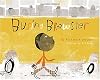
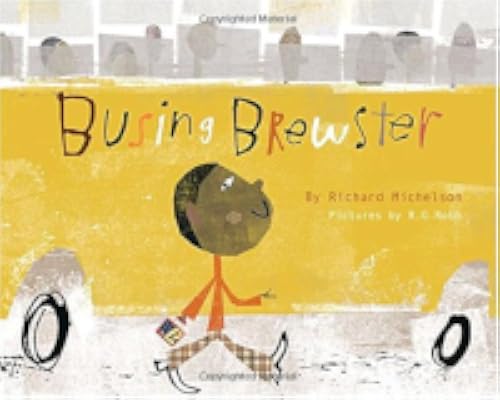
The most effective attribute of this picture book are R.G. Roth’s illustrations, which have a refreshing uniqueness to them; they show more are one part collage and one part sketch, with colors appearing to be sponged or splattered onto the page. There is an abundance of texture, and the urban setting is evoked in such a messy and loving way that it’s surprising the Roth grew up in a village and not in a city.
Although the storyline does not always flow seamlessly and may be confusing to young children, Busing Brewster is still a worthy addition for school libraries, and will be helpful for any children that are struggling as the only (or one of a few) minority in their class or even if they are just adjusting to being the new kid. This tale would do best with adult guidance, followed by a discussion of the historical events as described in the Author’s Note at the end of the book. show less
The most effective attribute of this picture book are R.G. Roth’s illustrations, which have a refreshing uniqueness to them; they show more are one part collage and one part sketch, with colors appearing to be sponged or splattered onto the page. There is an abundance of texture, and the urban setting is evoked in such a messy and loving way that it’s surprising the Roth grew up in a village and not in a city.
Although the storyline does not always flow seamlessly and may be confusing to young children, Busing Brewster is still a worthy addition for school libraries, and will be helpful for any children that are struggling as the only (or one of a few) minority in their class or even if they are just adjusting to being the new kid. This tale would do best with adult guidance, followed by a discussion of the historical events as described in the Author’s Note at the end of the book. show less
This is the story of a boy named Brewster who can't wait to start the first grade until his mother tells him that he'll be going to Central, a school in the white neighborhood. When Brewster gets to school there's a bunch of white people with signs protesting the blacks arriving at the originally all-white school. They even broke one of the bus windows with a rock. As soon as Brewster walks into the school he goes to the water fountain to get some water, where a kid starts bullying him because of the color of his skin. Bryan, Brewster's brother, stands up for him, but both Bryan and Brewster still end up in detention. Miss O'Grady, the librarian, noticed Brewster picked a rocket ship book from the library and says that he'll make a show more great astronaut one day, but Brewster replies that he's going to be president one day. He suddenly felt stupid saying that knowing there's never been a black president before, but Miss O'Grady believes in Brewster. She explains to them that every child deserves an education and reads them a book about Kennedy, who was an Irish Catholic that became president during a time when people didn't want the Irish in their schools. Brewster returns home that day and tells her that he's going to be president one day.
This story was set in America during the mid-1950s, shortly after segregation in public schools was no longer allowed. This setting clarifies conflict between the main character and the other characters in the story since the main characters started to attend a predominately white school. I think this setting also illuminates the character, Miss O'Grady, because she was so caring of Brewster, regardless of his skin color and regardless of how the other characters treated him.
I absolutely love this book. Because this book is told from Brewster's perspective, it explains segregation in a child-friendly way and in a way that children would view it as if it were happening to them, which is really cool. I also love how kind and how much the teacher believes in Brewster despite the color of his skin. As a future teacher, I aspire to make a difference in my student's lives like Miss O'Grady did to Brewster. I think this book is a great book to read to your students when learning about segregation. show less
This story was set in America during the mid-1950s, shortly after segregation in public schools was no longer allowed. This setting clarifies conflict between the main character and the other characters in the story since the main characters started to attend a predominately white school. I think this setting also illuminates the character, Miss O'Grady, because she was so caring of Brewster, regardless of his skin color and regardless of how the other characters treated him.
I absolutely love this book. Because this book is told from Brewster's perspective, it explains segregation in a child-friendly way and in a way that children would view it as if it were happening to them, which is really cool. I also love how kind and how much the teacher believes in Brewster despite the color of his skin. As a future teacher, I aspire to make a difference in my student's lives like Miss O'Grady did to Brewster. I think this book is a great book to read to your students when learning about segregation. show less
This book took me by surprise. I had not expected to read about the barriers of racism in a children's book. That is not to say that it is not valuable. It saddened me to read about a little boy who is subjected to such blatant racism. However, this would be such an invaluable resource for all children of the United States as well as other countries to realize the kind of reality African-Americans used to face. This would be a good jumping off point to talk about any racism that they have noticed or experienced, themselves.
The story of elementary school segregation and integration as told from the point of view of an African-American school boy in the 70s is well punctuated by its playful and childlike stylized illustrations. The pictures emphasize and keep childlike the point of view of the first grade boy who has no idea why he is moving to the white-school uptown. It does a great job of relating a very serious and intense topic to young children.
Good for black history month, general read aloud.
Good for black history month, general read aloud.
Brewster's first day of school is rife with conflict. `As the author notes, this book is a based on the fact that many young African American children were bused in the 1970's into previously all-white schools. Interestingly, Brewster, the author's character of the story told the friendly librarian he wanted to be President one day! As the author notes, he wrote the book before Barack Obama was elected the first African American president of the United States. Thus, Brewster's dream of the possibility of the potential black president occurred.
The illustrations and the story are strong, but not overpowering. This was written as a backdrop of the United States Supreme Court 's outlawing segregated schools in 1954, with the enactment of show more Brown vs. Board of Education. As the author notes in this book, in 1971, the Supreme Court took the mandate further and forced busing. Instead of allowing black students to attend a white school, some black children were forced to do so, and were bused far from their house. And, likewise, white students also were bused outside of their neighborhoods. This was a failed experiment, which led to violence and dissatisfaction, but black students did indeed have opportunities in previously all-white schools that were not available to them previously.
Brewster attends a previously all-white school. His first day is filled with comments from white students that his kind should go back where they belong. There were police who helped to integrate the schools. In this story, in order to control potential violence, the policeman brings students to the library. Brewster finds the library to be a safe space, and a wonderful white woman who is the librarian reaches out to him. Thus, Brewster's first day of school has a ray of sunshine that carries him forward.
From personal experience, it was a librarian in the small town school where I lived, who helped me feel safe and wanted. My skin was not black, but I had a dysfunctional childhood, and it was the librarian who welcomed me and gave me a love of reading which lasted all my life.
Highly Recommended. Four Stars! show less
The illustrations and the story are strong, but not overpowering. This was written as a backdrop of the United States Supreme Court 's outlawing segregated schools in 1954, with the enactment of show more Brown vs. Board of Education. As the author notes in this book, in 1971, the Supreme Court took the mandate further and forced busing. Instead of allowing black students to attend a white school, some black children were forced to do so, and were bused far from their house. And, likewise, white students also were bused outside of their neighborhoods. This was a failed experiment, which led to violence and dissatisfaction, but black students did indeed have opportunities in previously all-white schools that were not available to them previously.
Brewster attends a previously all-white school. His first day is filled with comments from white students that his kind should go back where they belong. There were police who helped to integrate the schools. In this story, in order to control potential violence, the policeman brings students to the library. Brewster finds the library to be a safe space, and a wonderful white woman who is the librarian reaches out to him. Thus, Brewster's first day of school has a ray of sunshine that carries him forward.
From personal experience, it was a librarian in the small town school where I lived, who helped me feel safe and wanted. My skin was not black, but I had a dysfunctional childhood, and it was the librarian who welcomed me and gave me a love of reading which lasted all my life.
Highly Recommended. Four Stars! show less
I liked this book for many reasons. I liked the plot and the illustrations. It is about a boy and his brother who are starting at a new school. They are African American and their new school is a “white school.” They were really nervous to start at a new school and had to overcome obstacles because of their race. I loved that this book made us take on a new perspective. The readers get the chance to put themselves into someone else’s shoes. It gave us a chance to see how things used to be and how far our nation has come, in regards to discrimination. For example, when the boy found out he was changing schools, he said, “Central’s a white school” and “ain’t no negroes at Central.” This is shocking because this isn’t show more something that we worry about now. We get up and go to our school, no matter our race. So, I really like that this book teaches history. The illustrations were amazing and really helped to develop the characters. The illustrations were different because they were partially made out of patterns and weren’t “perfect.” For example, on one page, the houses and buildings all “blended” together. There weren’t really clear lines. Maybe the illustrator did this because the boys were in a messy situation starting at a new school. For example, when they arrived, white people were all outside holding signs that said, “whites only.” All of the white people looked about the same. I think the illustrator did this to show they all had the same feelings about African Americans coming to “their” school. The boy met a white boy on his first day of school. When the boy’s dad came to pick him up, he said, “wish them coloreds all stayed at Franklin,” to his son. The son looks back at the boy and gives him a weird look. This helped to develop the character because we see how the boy’s both feel by the looks on their faces. For example, the African American boy looks really sad and lonely. I also liked how the author used different font. For example, words like “smash,” “bam,” and “crash,” were in big, bold print to make them stand out. I think the main idea is to show what segregation was like and how far we have come in acceptance. It provides an opportunity to teach a big part of history to a younger audience. show less
Members
- Recently Added By
Lists

Picture Books About Civil Rights
51 works; 4 members
Author Information

28+ Works 1,701 Members
Awards and Honors
Common Knowledge
- Canonical title
- Busing Brewster
- People/Characters
- Brewster; Bryan; Jules; Big Earl; Freckle-Face; Miss O'Grady
- Dedication
- For Jeff Dwyer and Elizabeth O'Grady-- My Irish agents ExtraO'ridinare. --R.M.
For Cheryl, Cassidy and Grace. --R.R. - First words
- All summer I've been playing on the school playground with Bryan.
- Quotations
- "Mama hopes I'll be president," I say proudly. I feel stupid as soon as I say it. Even I know there's never been a Negro president.
- Last words
- (Click to show. Warning: May contain spoilers.)"Maybe tomorrow," I say, "I"ll learn how to swim."
Classifications
Statistics
- Members
- 130
- Popularity
- 248,196
- Reviews
- 35
- Rating
- (4.12)
- Languages
- English
- Media
- Paper, Ebook
- ISBNs
- 7
- ASINs
- 3