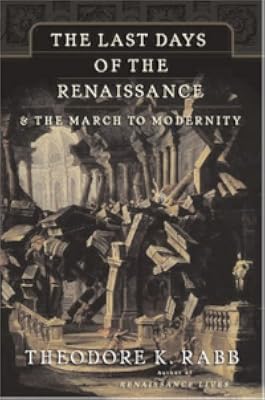
The Last Days of the Renaissance: And the March to Modernity
by Theodore K. Rabb
On This Page
Description
There is little debate that the Renaissance began at the end of the fourteenth century. Its end, though, is much more difficult to pin down. Here, for the first time, renowned classicist Theodore Rabb defines the changes that marked the shift away from the Renaissance to Modernity, and explains why these changes took place. The European Renaissance is usually characterized by the belief that a distinct antique civilization represented the ideal for all human endeavors. But there were other show more unities that defined the era: a shift in the role of the aristocracy from a warrior class to a cultural elite, a growth in education, a more thoughtful probing into the sciences, and the use of the arts for nonreligious purposes.By the dawn of the seventeenth century, four developments had swept over the world, altering these unities and ending the Renaissance: a break with the period's obsession with the past, which invited openness to innovation; a quest for central political control to cure increasing instability; a change in direction of people's passion and enthusiasm; and a new commitment to reason. With thoughtful, wide-lens scholarship and close, detailed looks throughout at the significant moments of change, Rabb offers us a radically new understanding of one of the most pivotal shifts in modern history. show lessTags
Recommendations










Member Reviews
Historians often debate the features that distinguish one period from another, but less frequently consider the developments that mark the end of an epoch. Rabb’s essay on periodization in European history takes up the challenge of describing evidence for the end of the Renaissance, which he regards as a ‘unity of patterns in time’ which itself had replaced the unity of patterns that distinguished the medieval period.
In seeking to describe the coherencies that mark an historical epoch, Rabb acknowledges the inconsistencies, contradictions, and ambiguities inherent in the historian’s art. He takes his lead from the philosopher R.G. Collingwood in insisting that history is neither invented nor found, but is the product of a show more dialogue between the historian and the materials left to us by the past. Any good historian must know that the past is always changing.
For its part, the Renaissance destroyed the sense of coherence that medieval society had created. Beginning in the 13th c., we can detect the erosion of papal authority and a growing dissatisfaction with religious doctrine and practice. In the secular realm, the impetus came not so much from dissatisfaction as from the pressure of external forces, notably technology and disease. Rabb is particularly good on the upheaval in military affairs (the size and organization of armies, developments in fortification and armaments, and the mustering of both natural and human resources for the purpose of waging war) resulting from the use of gunpowder. Likewise, the demographic and economic effects of the Black Death undid long-standing patterns in European society, clearing the way for the “commercialization” of European life. Rabb’s succinct account of these transformations is insightful enough to hold the interest of even experienced readers in European history.
The cultural shift that distinguished the Renaissance from the previous period was the deliberate rejection of the immediate past and a return to antiquity for guidance and inspiration. A cultural “flowering” or rebirth is frequently presented as the prime feature of the Renaissance, but Rabb emphasizes instead the disquiet and unease that pervaded all aspects of European life between the 14th and 17th centuries. Whereas the traditional narrative describes the period as one marked by the creation of new opportunities, Rabb provides ample evidence for interpreting the Renaissance as an age characterized by intensified antagonisms, doubts, and confusions. The prevailing mood was one of crisis rather than of mastery.
Ultimately, the yearning for assurance and stability led to the acceptance of new ideas in the second half of the 17th c., the result not of intellectual debate, writes Rabb, but of a shift in mood. New commitments and ambitions transformed everything from politics and views of war to art and the quest for knowledge. The authority accorded to science struck a fatal blow to Renaissance assumptions, and antiquity was deemed inadequate for the challenges faced by European societies entering an age of revolution.
One of the most difficult tasks for historians is presenting convincing evidence for how people of an earlier period thought. “Culture” as an explanation for historical change has gained much currency, though efforts to unpack culture and to describe its distinguishing features often result in muddled thinking and woolly prose. Rabb’s discussion of the European mood and mindset at critical junctures evades both shortcomings. The Last Days of the Renaissance is intellectual history of the first rank. show less
In seeking to describe the coherencies that mark an historical epoch, Rabb acknowledges the inconsistencies, contradictions, and ambiguities inherent in the historian’s art. He takes his lead from the philosopher R.G. Collingwood in insisting that history is neither invented nor found, but is the product of a show more dialogue between the historian and the materials left to us by the past. Any good historian must know that the past is always changing.
For its part, the Renaissance destroyed the sense of coherence that medieval society had created. Beginning in the 13th c., we can detect the erosion of papal authority and a growing dissatisfaction with religious doctrine and practice. In the secular realm, the impetus came not so much from dissatisfaction as from the pressure of external forces, notably technology and disease. Rabb is particularly good on the upheaval in military affairs (the size and organization of armies, developments in fortification and armaments, and the mustering of both natural and human resources for the purpose of waging war) resulting from the use of gunpowder. Likewise, the demographic and economic effects of the Black Death undid long-standing patterns in European society, clearing the way for the “commercialization” of European life. Rabb’s succinct account of these transformations is insightful enough to hold the interest of even experienced readers in European history.
The cultural shift that distinguished the Renaissance from the previous period was the deliberate rejection of the immediate past and a return to antiquity for guidance and inspiration. A cultural “flowering” or rebirth is frequently presented as the prime feature of the Renaissance, but Rabb emphasizes instead the disquiet and unease that pervaded all aspects of European life between the 14th and 17th centuries. Whereas the traditional narrative describes the period as one marked by the creation of new opportunities, Rabb provides ample evidence for interpreting the Renaissance as an age characterized by intensified antagonisms, doubts, and confusions. The prevailing mood was one of crisis rather than of mastery.
Ultimately, the yearning for assurance and stability led to the acceptance of new ideas in the second half of the 17th c., the result not of intellectual debate, writes Rabb, but of a shift in mood. New commitments and ambitions transformed everything from politics and views of war to art and the quest for knowledge. The authority accorded to science struck a fatal blow to Renaissance assumptions, and antiquity was deemed inadequate for the challenges faced by European societies entering an age of revolution.
One of the most difficult tasks for historians is presenting convincing evidence for how people of an earlier period thought. “Culture” as an explanation for historical change has gained much currency, though efforts to unpack culture and to describe its distinguishing features often result in muddled thinking and woolly prose. Rabb’s discussion of the European mood and mindset at critical junctures evades both shortcomings. The Last Days of the Renaissance is intellectual history of the first rank. show less
I'd really give it a 3.5. Read it for my Renaissance History class and liked what it had to offer, but felt that it was - not disorganized, but rather thrown at the reader in an overwhelming way, presuming quite a bit of background. I got most of the early Renaissance stuff, but not the later because we focused mainly on Italy during the class, and there is a major group of scholars who see the Renaissance as having happened in Italy and the spread of Renaissance ideas in Europe as being just that - repercussions. So, I liked Rabb's thesis of periodization being incredibly important in the study of history and when and why they form and how, and when and why and how they break down, but I didn't really go along with his timing exatly, show more and because of how he did time the period, I was quite lost. The book should have been longer and included more detail, to my mind. show less
Ratings
Members
- Recently Added By
Author Information

25+ Works 1,093 Members
Theodore J. Rabinowicz was born in Teplice-Sanov, Czechoslovakia on March 5, 1937. He received bachelor's and master's degrees at Queen's College, Oxford and a Ph.D. in European and colonial American history from Princeton University. He taught at Stanford University, Northwestern University, and Harvard University before joining the faculty at show more Princeton in 1967. He took emeritus status there in 2006. He was an expert in European history, who believed in an interdisciplinary approach to teaching history. In 1970, he was one of the founding editors of The Journal of Interdisciplinary History. He wrote numerous books including Enterprise and Empire: Merchant and Gentry Investment in the Expansion of England, 1575-1630; Renaissance Lives: Portraits of an Age; The Last Days of the Renaissance and the March to Modernity; The Artist and the Warrior: Military History Through the Eyes of the Masters; and Why Does Michelangelo Matter?: A Historian's Questions About the Visual Arts. He died on January 7, 2019 at the age of 81. (Bowker Author Biography) show less
Common Knowledge
- Original publication date
- 2006
- Original language
- English
Classifications
- Genres
- History, Nonfiction, General Nonfiction
- DDC/MDS
- 940.21 — History & geography History of Europe History of Europe Europe: Renaissance, Reformation, Enlightenment, Napolean Renaissance period 1453-1517
- LCC
- CB369 .R33 — Auxiliary Sciences of History History of Civilization History of Civilization By period
- BISAC
Statistics
- Members
- 154
- Popularity
- 213,571
- Reviews
- 2
- Rating
- (3.50)
- Languages
- English
- Media
- Paper, Ebook
- ISBNs
- 2
- ASINs
- 2