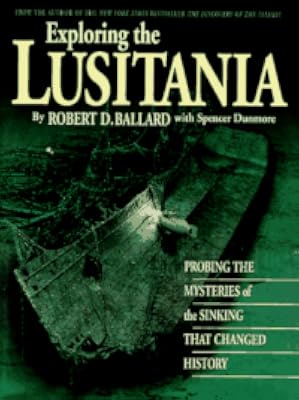
Exploring the Lusitania: Probing the Mysteries of the Sinking That Changed History
by Robert Ballard, Spencer Dunmore
On This Page
Description
Underwater images help answer questions about the sinking of British passenger liner, Lusitania, in 1915, which killed 1,195 civilians.Tags
Recommendations













Member Recommendations

Member Reviews
I borrowed this book from the library because I'd just finished listening to Erik Larson's Dead Wake, and reviewing the print copy of that book, and was disappointed to find only one illustration of this famous ship. I didn't know much about the Lusitania itself and wanted to learn more.
The book does not disappoint. It is full of period photographs and illustrations of the ship (and related materials, such as postcards, ads, and menus), and the aftermath of its sinking, as well as people on the ship. There are also maps and diagrams to help the reader understand the layout of the ship, its final journey (and the journey of the German submarine that sunk it).
Robert Ballard is best known as the man who explored the sunken Titanic, and show more there are a number of pages in the last quarter of the book devoted to his expedition to the Lusitania wreck in 1993. This narrative and the accompanying photographs are also extremely interesting, especially the "then and now" comparison photographs of parts of the ship from 1904 to 1915 with the sunken part in 1993. Ballard's theory that coal dust in empty bins ignited and caused the second, post-torpedo explosion (not any contraband or a boiler or a conspiracy) that ultimately sunk the ship.
The book ends with a chronology of the ship, acknowledgments and photo/illustration credits, a bibliography, and an index. Definitely recommended to anyone who wants to learn more about the Lusitania, whose sinking ultimately led to the United States entry into World War I.
© Amanda Pape - 2015
[This book was borrowed from and returned to the local public library. This review also appears on Bookin' It.] show less
The book does not disappoint. It is full of period photographs and illustrations of the ship (and related materials, such as postcards, ads, and menus), and the aftermath of its sinking, as well as people on the ship. There are also maps and diagrams to help the reader understand the layout of the ship, its final journey (and the journey of the German submarine that sunk it).
Robert Ballard is best known as the man who explored the sunken Titanic, and show more there are a number of pages in the last quarter of the book devoted to his expedition to the Lusitania wreck in 1993. This narrative and the accompanying photographs are also extremely interesting, especially the "then and now" comparison photographs of parts of the ship from 1904 to 1915 with the sunken part in 1993. Ballard's theory that coal dust in empty bins ignited and caused the second, post-torpedo explosion (not any contraband or a boiler or a conspiracy) that ultimately sunk the ship.
The book ends with a chronology of the ship, acknowledgments and photo/illustration credits, a bibliography, and an index. Definitely recommended to anyone who wants to learn more about the Lusitania, whose sinking ultimately led to the United States entry into World War I.
© Amanda Pape - 2015
[This book was borrowed from and returned to the local public library. This review also appears on Bookin' It.] show less
This book provides solid background, historical and personal, and puts to rest the conspiracy theories associated with the torpedoing and sinking of the Lusitania in 1915. There were ample warnings that the ship would be the target of German subs on its return journey to England, all of which were ignored.
Ballard sets out to prove that three essential elements were involved. One, German warfare changed the rules of traditional warfare, the Captain refused to accept that possibility and ignored all warnings and procedural changes, and the torpedo struck a technical weakness in the ship.
Prior to this event, all nations were expected to avoid striking non-combatants, such as unarmed ships. The Captain made decisions based more upon the show more comfort of his ship's elite than upon wartime realities--zigzagging would be too unsettling and time consuming and speed, one of the ship's greatest assets, was less important than reaching port at the right time. Finally, no one allowed for the accumulation of coal dust in her nearly empty bunkers, which would combine with oxygen and a spark when the torpedo ripped into the hull. show less
Ballard sets out to prove that three essential elements were involved. One, German warfare changed the rules of traditional warfare, the Captain refused to accept that possibility and ignored all warnings and procedural changes, and the torpedo struck a technical weakness in the ship.
Prior to this event, all nations were expected to avoid striking non-combatants, such as unarmed ships. The Captain made decisions based more upon the show more comfort of his ship's elite than upon wartime realities--zigzagging would be too unsettling and time consuming and speed, one of the ship's greatest assets, was less important than reaching port at the right time. Finally, no one allowed for the accumulation of coal dust in her nearly empty bunkers, which would combine with oxygen and a spark when the torpedo ripped into the hull. show less
I thought this book was wonderful: well organized and spectacularly illustrated.
The first 140 or so pages provide an overview of the history of Lusitania and her sinking. It is certainly not the kind of detailed historical account I found in Diana Preston's marvelous volume, but it appeared accurate and reasonably complete. And the photographs were marvelous! It is chock full of historical photographs of both the exterior and interior of the great liner -- including seldom-seen images of the spartan 3rd-class (or "third cabin") accommodations. We also see samples of menus and Cunard Line promotional literature of the time.
About 50 pages are devoted to Ballard's expedition to the remains of Lusitania where she lies off the Irish coast, show more and his own hypothesis (a reasonable one, I think) about the source of the "second explosion" after the torpedo hit and the reason the ship sank so quickly. The photographs (which include a trifold of the entire wreck, backed with a trifold diagram of the ship as she was) are stunning. I was also impressed by attempts to make the images understandable to the average viewer; they are presented, in most cases, with diagrams of the ship indicating what portion we are seeing and photos of those itiems/sections as they were in the liner's heyday.
Highly recommended! show less
The first 140 or so pages provide an overview of the history of Lusitania and her sinking. It is certainly not the kind of detailed historical account I found in Diana Preston's marvelous volume, but it appeared accurate and reasonably complete. And the photographs were marvelous! It is chock full of historical photographs of both the exterior and interior of the great liner -- including seldom-seen images of the spartan 3rd-class (or "third cabin") accommodations. We also see samples of menus and Cunard Line promotional literature of the time.
About 50 pages are devoted to Ballard's expedition to the remains of Lusitania where she lies off the Irish coast, show more and his own hypothesis (a reasonable one, I think) about the source of the "second explosion" after the torpedo hit and the reason the ship sank so quickly. The photographs (which include a trifold of the entire wreck, backed with a trifold diagram of the ship as she was) are stunning. I was also impressed by attempts to make the images understandable to the average viewer; they are presented, in most cases, with diagrams of the ship indicating what portion we are seeing and photos of those itiems/sections as they were in the liner's heyday.
Highly recommended! show less
I guess that's the book I read. Large format picture book that focuses on history of the Lusitania episode as well as the discovery and investigation of the wreck. The book I read was called Robert Ballard's Lusitania, but had the same author. History was more interesting than the exploration of the wreck in this case.
I found this used after reading "Dead Wake" and noting it in Larson's bibliography. It is a nice pictorial companion to that book. The Goodreads database says there is no hardcover version of this book, but that is what I have.
Robert Ballard's underwater exploration of the Lusitania. Full story, great pictures, and good illustrations.
Excellent photos including the historic ones.
Members
- Recently Added By
Author Information

60+ Works 7,795 Members
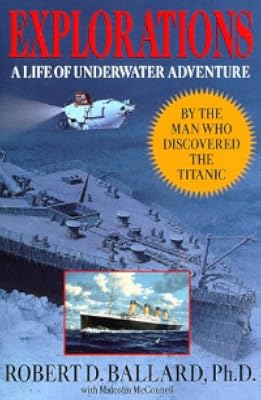
Robert Ballard was born in Wichita, Kansas, in 1942, and was educated at the University of California at Santa Barbara, the University of Hawaii, the University of Southern California, and the University of Rhode Island, where he received his Ph.D. in 1974. Part explorer, part geologist, part oceanographer, and part marine engineer, Ballard has show more worked at the Woods Hole Oceanographic Institute in Falmouth, Massachusetts, since 1969. He is currently director of the Center for Marine Exploration there. Ballard is perhaps best known to the general public in connection to the luxury liner Titanic. Ballard organized and participated in the expedition that discovered the ship in 1985. More important, however, is his work in designing underwater survey vehicles and in participating in dives to explore the ocean floor. His work in marine design and engineering, in particular, has led to a dramatic increase in the scope of deep-sea exploration. In the 1960s, Ballard helped develop the Alvin, a deep-sea, three-man submersible equipped with a remote controlled mechanical arm for collecting specimens from the ocean floor. The device played an important role in mid-ocean studies, including exploration of the Mid-Atlantic Ridge and dives to the Cayman Trough, a 24,000-foot-deep gash in the ocean floor south of Cuba. Ballard was part of the Galapagos Hydrothermal Expedition in 1977, which discovered and investigated deep-sea thermal vents spouting mineral-rich water from volcanic cracks in the Earth's crust. In the 1980s, Ballard helped develop the Argo-Jason unmanned submersible system, the most advanced craft of its kind. Argo is a 16-foot submersible vehicle and Jason is a self-propelled robot tethered to Argo. The search for the Titanic was undertaken as a test of the Argo-Jason system; the success of the expedition demonstrated its capabilities and, according to Ballard, "ushered in a new era of undersea exploration." The author of several bestselling books on deep-sea exploration, Ballard also contributes regularly to National Geographic and other magazines and he has produced several videotapes of deep-sea expeditions. His reputation as a "science populizer" has prompted harsh criticism from some of his scientific colleagues. In 1985, Ballard was one of four scientists awarded a Secretary of the Navy Research Chair in Oceanography, an award that carries with it an $800,000 grant for oceanographic research. (Bowker Author Biography) show less

20+ Works 807 Members
Common Knowledge
- Canonical title
- Exploring the Lusitania: Probing the Mysteries of the Sinking That Changed History
- Original title
- Exploring the Lusitania
- Original publication date
- 1995
- People/Characters
- Robert D. Ballard; Chrissie Aitken; Oliver Bernard; Avis Dolphin; Charles Frohman; Ian Holbourn (show all 12); Alice Lines; Margaret Mackworth; Walther Schwieger; William Turner; Alfred Gwynne Vanderbilt; Edith Williams
- Important places
- Liverpool, England, UK; Atlantic Ocean; North Atlantic Ocean; Kinsale, County Cork, Ireland; Ireland; Cobh, County Cork, Ireland (as Queenstown, Ireland) (show all 7); New York, New York, USA
- Important events
- Sinking of the Lusitania (1915-05-07); World War I (1914 | 1918)
- Dedication*
- Groß wird man, indem man auf den Schultern anderer steht. Dieses Buch ist all den Wissenschaftlern, Ingenieuren, Technikern und Freunden gewidmet, die in den letzten dreißig Jahren mit mir aufs Meer gefahren sind, um Dinge ... (show all)zu sehen, die niemand vor ihnen gesehen hat, und die meine Träume zu den ihren gemacht haben.
- First words
- The Old Head of Kinsale, 1993 -- The rocky finger of land called the old head of Kinsale juts out three miles from the southern coast of Ireland, its lighthouse standing like a sentry at its farthest point.
- Last words*
- (Click to show. Warning: May contain spoilers.)"Obwohl die Zeit vergeht und die kleinen grauen Zellen verschleißen, sehe ich den Liner, während ich hier sitze, immer noch vor mir ... wie er einfach ins Wasser hinabgleitet."
Augenzeuge George Henderson über den Untergang der Lusitania.
*Some information comes from Common Knowledge in other languages. Click "Edit" for more information.
Classifications
Statistics
- Members
- 295
- Popularity
- 109,563
- Reviews
- 7
- Rating
- (4.06)
- Languages
- Dutch, English, German
- Media
- Paper
- ISBNs
- 7
- ASINs
- 3