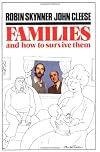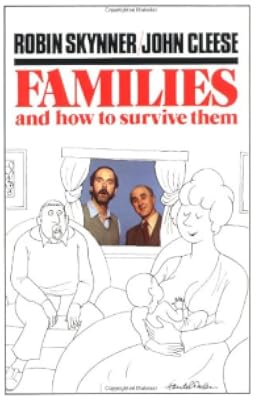
Families and How to Survive Them
by Robin Skynner (Author), John Cleese (Author)
On This Page
Description
What makes a family happy? Why do some marriages 'succeed' and others 'fail'. How can we free ourselves from the legacy of past mistakes and bring about positive change? Love, sex and marriage and parenthood, depression and sadness, independence and experience are just a few of the many issues explored in coversation by family therapist Robin Skynner and his former patient and comedian, John Cleese. Guiding us through the daily issues that confront us all, FAMILIES AND HOW TO SURVIVE THEM show more offers vital advice in helping each of us to maintain a happy, healthy family life. Looking candidly at everything from our relationships with our parents to why and how we choose our partners, no emotional stone is left unturned- jealousy, rage, fear, envy, love, obsession, hope and despair - all are featured-with practical advice on how to turn round a negative situation and bring about change for the better. show lessTags
Recommendations


















Member Reviews
This is an easy-to-read introduction to family therapy, presented as a dialogue between psychiatrist Robin Skynner and comedian John Cleese, who had participated in group therapy with Skynner. Skynner’s special interests within the broader field of family therapy seem to have been what leads us to marry the person we do and the characteristics of happy families.
The book is more than forty years old, and more than once, such as in the presentation of the causes of autism, the definition of borderline disorder, or the factors shaping sexual identity, I wondered what more recent research might say.
Beyond that, I found myself bored. After ninety or so pages, I skipped ahead to the final chapter, on sex, and found even that couldn’t keep show more my interest. I guess that, given that Cleese was a co-author, I expected it to be funnier (the cartoons were nice, though). Still, there were parts that I found enlightening and helpful. show less
The book is more than forty years old, and more than once, such as in the presentation of the causes of autism, the definition of borderline disorder, or the factors shaping sexual identity, I wondered what more recent research might say.
Beyond that, I found myself bored. After ninety or so pages, I skipped ahead to the final chapter, on sex, and found even that couldn’t keep show more my interest. I guess that, given that Cleese was a co-author, I expected it to be funnier (the cartoons were nice, though). Still, there were parts that I found enlightening and helpful. show less
Excellent. Written as conversations between John Cleese (of Fawlty Towers fame) and his family therapist, Robin Skynner. This book looks at psychiatry for the layman, in terms of why some people are happy while others aren't; why some people have repressed emotions, and what happens to them; what can cause people to become 'stuck' in their development from babyhood. I don't agree with every word - the recommendations about strict discipline for children seem over-harsh to me, for instance - but much of what's said is revelatory and fascinating. I first read this about twelve years ago, and found it extremely helpful in understanding my sons better. Even now, as an empty-nester, I can see a lot of value in this for self-help, and show more figuring out how people tick and why some are easier to get along with than others - quite apart from their different personality preferences.
The humour is decidedly 'British', and a non-British friend once told me that she simply didn't get the cartoons, which she even found mildly offensive in places. Take it with a pinch of salt - but if you ever wanted to know why some families get along and others don't, in broad terms, I'd recommend this book highly. show less
The humour is decidedly 'British', and a non-British friend once told me that she simply didn't get the cartoons, which she even found mildly offensive in places. Take it with a pinch of salt - but if you ever wanted to know why some families get along and others don't, in broad terms, I'd recommend this book highly. show less
My goodness, was this accepted as true thirty years ago?
Robin Skynner says that the parents are to blame for everything that goes wrong in a child, except they can't help it because of their parents. Pretty hopeless, really.
Especially to blame for sexual 'deviance'. He specifically doesn't want homosexuallity called perversion, but he is convinced that it is caused by the upbringing and could be cured if the patient really wanted that. (But too much trouble really, so we don't bother. And we won't insist on rubbing it in that it's really very abnormal, even if it is. Aren't we kind and considerate?)
He also seems to think that all interaction between mental and physical illness starts at the mental side, and that medicinal care could be show more replaced with psychiatric treatment. show less
Robin Skynner says that the parents are to blame for everything that goes wrong in a child, except they can't help it because of their parents. Pretty hopeless, really.
Especially to blame for sexual 'deviance'. He specifically doesn't want homosexuallity called perversion, but he is convinced that it is caused by the upbringing and could be cured if the patient really wanted that. (But too much trouble really, so we don't bother. And we won't insist on rubbing it in that it's really very abnormal, even if it is. Aren't we kind and considerate?)
He also seems to think that all interaction between mental and physical illness starts at the mental side, and that medicinal care could be show more replaced with psychiatric treatment. show less
Written in an unconventional dialogue form, this book explores the inner workings of the modern family, and the interactions between couples and their children.
Spooky good. Some may question the science, and I wondered if the information is dated, but it made so much sense that I have nothing bad to say about it.
De verhaalstijl van het boek is pakkend, de auteur doet je dat ook verwachten. Maar de positie die het boek in neemt over bijvoorbeeld 'afwijkende' sexuele voorkeuren en keuzes maakt de inhoud een stuk discutabeler.
May 10, 2009Dutch
Zeer duidelijke uitleg over hoe relaties functioneren en waarom mensen doen zoals ze doen. Met de beschrijvingen over homoseksualiteit waagt hij zich op glad ijs.
Dec 2, 2012 (Edited)Dutch
Members
- Recently Added By
Author Information


John Cleese, October 27, 1939 - John Cleese was born on October 27, 1939 in Weston-Super-Mare, Somerset, England to Reginald Cleese, and insurance salesman, and Muriel Cross. He attended Cambridge University beginning in 1960 and joined the Footlights Club in his second term. In 1963, a Footlights production called "A Clump of Plinths" became so show more popular that the production spawned Cambridge Circus and ran in London's West End. He eventually earned his law degree from Cambridge. In 1964, the show traveled first to New Zealand and then to America for 24 performances on Broadway. By the late 60's, Cleese was established as an actor and a writer. In 1969, the BBC, looking for a new show to fill an empty time slot, coupled Cleese and pal Graham Chapman with three graduates from Oxford, Eric Idle, Terry Jones and Michael Palin, as well as Terry Gilliam to create Monty Python's Flying Circus. The BBC produced 45 episodes which have been run and rerun over 30 years. Flying Circus became a cult classic and spawned yet another television show, "Fawlty Towers" as well as books and feature films such as "Monty Python's Life of Brian" and "Monty Python and the Holy Grail." Cleese then came down with a debilitating flu-like illness which his doctor suggested might be psychosomatic. After working with a therapist, Cleese returned with no signs of the illness and even joined the doctor in writing two books, "Families and How to Survive Them" and "Life and How to Survive It." He went on to create training films for corporations through his company called Video Arts. These videos enabled training to be fun as well as informative. Through all of this, Cleese has demonstrated his ability to perform in all walks of life and has made a name for himself doing what he loves best. (Bowker Author Biography) show less
Some Editions
Series
Belongs to Publisher Series
Rainbow pocketboeken (181)
Common Knowledge
- Canonical title
- Families and How to Survive Them
- Original title
- Families and How to Survive Them
- Original publication date
- 1983
- Quotations
- Yes, the world's always changing. In fact we need a certain level of change, of stimulation. If we get too little, we feel bored and only half alive. Change is harmful only when it goes beyond the ability of our system to cop... (show all)e with it -- as when there's a big sudden change or too many small changes in a row that don't allow us to recover our equilibrium. (pg. 69)
Classifications
- Genres
- Nonfiction, General Nonfiction
- DDC/MDS
- 306.85 — Society, government, & culture Social sciences, sociology & anthropology Social Behavior - Dating, Marriage, Divorce Marriage, partnerships, unions; family Family
- LCC
- HQ728 — Social sciences The family. Marriage, Women and Sexuality The Family. Marriage. Women The family. Marriage. Home
- BISAC
Statistics
- Members
- 546
- Popularity
- 54,386
- Reviews
- 7
- Rating
- (3.47)
- Languages
- 11 — Czech, Danish, Dutch, English, Estonian, German, Hungarian, Polish, Portuguese, Spanish, Swedish
- Media
- Paper, Audiobook, Ebook
- ISBNs
- 32
- ASINs
- 7