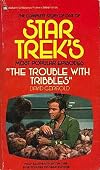
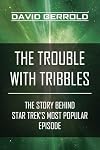
The Trouble with Tribbles
by David Gerrold
On This Page
Description
Fiction. Science Fiction. Entertainment. David Gerrold, the creator of "Tribbles," recalls how this popular episode of Star Trek was made, from conceptualizing the first draft to the final script, shooting on set, and explaining the techniques and disciplines of TV writing. Plus, receive 32 pages of photos, original illustrations by Tim Kirk, and much more!.Tags
Recommendations














Member Reviews
The Publisher Says: David Gerrold, the creator of "Tribbles," recalls how this popular episode of Star Trek was made, from conceptualizing the first draft to the final script, shooting on set, and explaining the techniques and disciplines of TV writing. Plus, receive 32 pages of photos, original illustrations by Tim Kirk, and much more!
My Review: Start with this excellent advice:
The mix of advice and anecdote, of trivia and trivialities that absolutely make a fanboy's day, make this a perfect package of fan service show more with a redeeming dose of wisdom. It's a terrific gift for a young Trek fan, or someone seeking a blow-by-blow of television's peculiar ways with words. show less
My Review: Start with this excellent advice:
Taking something seriously means immersing yourself in it and treating it with respect and making it part of yourself.
–and–
Once you make a decision to do something or to be something, start preparing for it immediately.
The mix of advice and anecdote, of trivia and trivialities that absolutely make a fanboy's day, make this a perfect package of fan service show more with a redeeming dose of wisdom. It's a terrific gift for a young Trek fan, or someone seeking a blow-by-blow of television's peculiar ways with words. show less
David Gerrold’s inside story of the production of “The Trouble with Tribbles,” a second-season episode of Star Trek, reveals how messy writing for a weekly television show can be. Gerrold has the sole writing credit, but he is unsure how many of his words made it to the screen. Show creator and executive producer Gene Roddenberry, producer Gene L. Coon, and associate producer Bob Justman suggested some changes and vetoed others. The script went through many drafts, at least one because Gerrold’s typewriter had an elite font that led him to produce a script that was twenty pages too long when converted to the standard pica font used for show scripts. Unlike many television writers, Gerrold hung out on the set. Once, as he was show more making cuts with a black marker, actors stopped by to encourage him not to cut their lines.
The whole episode had a close call because the tribbles might have been too similar to the cuddly Martian critters in Heinlein’s The Rolling Stones. Gerrold swears he did not have Heinlein in mind when he wrote his script, and show lawyers cleared the story with Heinlein.
Gerrold respects the professionalism of the show’s actors and producers. He says it was a happy set, but one can only imagine how much more difficult it would be to write for a series in which folks did not get along.
The book contains a shooting script for the episode. If you are at all nostalgic about the original Star Trek series, you will find reading “The Trouble with Tribbles” no trouble at all. show less
The whole episode had a close call because the tribbles might have been too similar to the cuddly Martian critters in Heinlein’s The Rolling Stones. Gerrold swears he did not have Heinlein in mind when he wrote his script, and show lawyers cleared the story with Heinlein.
Gerrold respects the professionalism of the show’s actors and producers. He says it was a happy set, but one can only imagine how much more difficult it would be to write for a series in which folks did not get along.
The book contains a shooting script for the episode. If you are at all nostalgic about the original Star Trek series, you will find reading “The Trouble with Tribbles” no trouble at all. show less
Mildly interesting - it was fun seeing the Star Trek back-lot stuff. I'm far less interested in Gerrold's travails as a new scriptwriter, which is a large part of the content - what his agent said and what he said and the legal niceties of selling ideas, scripts, and rewrites (each separately). The actual script (more or less - he mentions quite a few bits where what was on paper (that he could find, years later) and what was filmed differed slightly) was amusing to read - it's not my favorite episode, but it's one I enjoy. There is a chapter on Heinlein's flatcats, and how Gerrold didn't use them as a pattern, at least consciously. Including that legal took it up with Heinlein and all he asked for was a copy of the script (which he got show more - signed by Gerrold, who hadn't realized the problem at that point). This is one of multiple mildly amusing reminisces. Glad I read it, but I doubt I'll bother to reread. show less
This review is also published on my blog.
Time for another step back in the Trek schedule. Today, we'll take a look at David Gerrold's The Trouble With Tribbles, published on 12 April 1973.
This book goes into some detail about how Gerrold came to write the titular episode, and includes several drafts as well as the final script, each annotated with information about how and why some of the earlier concepts were changed for the final script. In addition to describing the writing process, Gerrold gives a bit of information about how the props were made and how shooting went, and finally reflects on the impact the episode has had, both on him and others. He concludes the book with an anecdote about sending a spare tribble to a hospital to show more encourage a girl, paralyzed by meningitis, in her recovery.
This isn't the first time I've mentioned this book--I noted it last year, when I wrote about Gerrold's The World of Star Trek (published simultaneously), but I've only recently acquired a copy. Was it worth the wait?
Not really. It's well written, of course, and amusing enough to read, but by the time I got through the final draft of "The Trouble With Tribbles", I was pretty well sick of the story. Whitfield's The Making of Star Trek goes into more interesting detail about the production aspects, and Gerrold's own The World of Star Trek is a more interesting look at the writing. The form of the book is basically autobiographical, but it's rather scant of details. There's a little talk at the beginning on how Gerrold has always been a fan of science fiction, and a few more anecdotes scattered throughout, but otherwise the focus is very much on the revision of the script.
My suggestion: unless you're a particularly big fan of "The Trouble With Tribbles", read The World of Star Trek, instead. show less
Time for another step back in the Trek schedule. Today, we'll take a look at David Gerrold's The Trouble With Tribbles, published on 12 April 1973.
This book goes into some detail about how Gerrold came to write the titular episode, and includes several drafts as well as the final script, each annotated with information about how and why some of the earlier concepts were changed for the final script. In addition to describing the writing process, Gerrold gives a bit of information about how the props were made and how shooting went, and finally reflects on the impact the episode has had, both on him and others. He concludes the book with an anecdote about sending a spare tribble to a hospital to show more encourage a girl, paralyzed by meningitis, in her recovery.
This isn't the first time I've mentioned this book--I noted it last year, when I wrote about Gerrold's The World of Star Trek (published simultaneously), but I've only recently acquired a copy. Was it worth the wait?
Not really. It's well written, of course, and amusing enough to read, but by the time I got through the final draft of "The Trouble With Tribbles", I was pretty well sick of the story. Whitfield's The Making of Star Trek goes into more interesting detail about the production aspects, and Gerrold's own The World of Star Trek is a more interesting look at the writing. The form of the book is basically autobiographical, but it's rather scant of details. There's a little talk at the beginning on how Gerrold has always been a fan of science fiction, and a few more anecdotes scattered throughout, but otherwise the focus is very much on the revision of the script.
My suggestion: unless you're a particularly big fan of "The Trouble With Tribbles", read The World of Star Trek, instead. show less
(Original Review, 1980-11-19)
I have always found the similarities between RAH's "Flatcats" in THE ROLLING STONES and Gerrold's "Tribbles" in THE TROUBLE WITH TRIBBLES to be more than just coincidence [2018 EDIT: Incidentally Star Trek writers wrote two episodes based on this same story: "The Trouble with Tribbles" (Star Trek) and "Trials and Tribble-ations" (DS9)]. For the uninitiated, Flatcats look EXACTLY like tribbles, except that they have three tiny eyes in their fur. They purr when stroked in a pleasing manner, and, most importantly, they REPRODUCE like... well, like tribbles. The ROLLING STONES have an interesting time when they bring one aboard their spaceship and then take off on a long trip... it produces 8 little'uns, which show more in turn quickly produce 8 each... which... Anyone who knows Gerrold, can you find out if he knew about RAH's book... and in any event, if I was RAH I would have screamed bloody murder...[2018 EDIT: Here] Read THE ROLLING STONES instead. It’s much better.
[2018 EDIT: This review was written at the time as I was running my own personal BBS server. Much of the language of this and other reviews written in 1980 reflect a very particular kind of language: what I call now in retrospect a “BBS language”.] show less
I have always found the similarities between RAH's "Flatcats" in THE ROLLING STONES and Gerrold's "Tribbles" in THE TROUBLE WITH TRIBBLES to be more than just coincidence [2018 EDIT: Incidentally Star Trek writers wrote two episodes based on this same story: "The Trouble with Tribbles" (Star Trek) and "Trials and Tribble-ations" (DS9)]. For the uninitiated, Flatcats look EXACTLY like tribbles, except that they have three tiny eyes in their fur. They purr when stroked in a pleasing manner, and, most importantly, they REPRODUCE like... well, like tribbles. The ROLLING STONES have an interesting time when they bring one aboard their spaceship and then take off on a long trip... it produces 8 little'uns, which show more in turn quickly produce 8 each... which... Anyone who knows Gerrold, can you find out if he knew about RAH's book... and in any event, if I was RAH I would have screamed bloody murder...[2018 EDIT: Here] Read THE ROLLING STONES instead. It’s much better.
[2018 EDIT: This review was written at the time as I was running my own personal BBS server. Much of the language of this and other reviews written in 1980 reflect a very particular kind of language: what I call now in retrospect a “BBS language”.] show less
Gives an interesting perspective of the progress of a story from idea, to script to actual episode.
The birth, sale, and final production of one episode (of Star Trek)
Members
- Recently Added By
Author Information

138+ Works 12,224 Members
David Gerrold is one of the most popular science fiction writers working today. His first professional sale, the Star Trek episode "Trouble With Tribbles," won a Hugo Award. He has written for television, published more than forty books, and had columns in six different magazines. In 1995, his novelette "The Martian Child" won both the Hugo and show more Nebula Awards. Gerrold lives in San Fernando, California, and teaches writing at Pepperdine University show less
Work Relationships
Reference guide/companion to
Common Knowledge
- Canonical title
- The Trouble with Tribbles
- Original title
- The Trouble with Tribbles: The Birth, Sale, and Final Production of One Episode
- Alternate titles
- The Trouble with Tribbles: The Birth, Sale, and Final Production of One Episode
- Original publication date
- 1973-04 (eng.) (eng.)
- Dedication
- This book should be dedicated to
Erwin Blocker and Gene Coon and Gene Roddenberry and William Shatner and Leonard Nimoy and DeForest Kelley and Jim Doohan and Walter Koenig and Nichelle Nicols and Majel Barnett and George ... (show all)Takei and all the other good people who made it possible
But I'm sure they'll understand that this book is a special one - so it has to be for
Betty Ballantine
who's pretty special herself. - First words
- Foreword:
This book is the story of a television script, where it came from, how it was written, how it was eventually filmed and finally got onto the air as an episode of STAR TREK.
In 1966, I was a rabbit. - Last words
- (Click to show. Warning: May contain spoilers.)Every once in a while, I begin to feel that my existence is justified.
- Disambiguation notice
- Careful! Do NOT combine with Photonovel of the same name by the same author!
Classifications
Statistics
- Members
- 538
- Popularity
- 55,112
- Reviews
- 7
- Rating
- (3.80)
- Languages
- English
- Media
- Paper, Ebook
- ISBNs
- 10
- ASINs
- 13