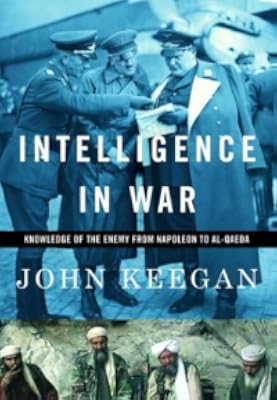
Intelligence in War: Knowledge of the Enemy from Napoleon to Al-Qaeda
by John Keegan
On This Page
Description
Examines a series of historical wartime events to delineate the strategies and outcomes of each while linking the function of their intelligence operations, refuting perceptions that intelligence superiority is a key to war success.Tags
Recommendations




Member Reviews
Written shortly after the 9/11 attacks, and so a bit tentative on al-Quaeda and developments in Iraq. Otherwise quite good.
Keegan starts with anecdotes, mostly about his occasional brushes with (more or less) friendly intelligence organizations. including the first female head of MI6 (England isn't what it used to be) and the CIA (in the person of William Casey, who invited him for a secret interview simply because he liked Keegan's books, but who Keegan found quite unintelligible -- he later learned Casey's colleagues called him The Mumbler.) Keegan also recounts an attempt at recruitment that he refused to touch with a ten-foot pole.
Keegan is skeptical of intelligence, particularly when it gets confused with subversion. To be more show more precise, he does not think much of subversion; he thinks much better of intelligence, which he believes can be an honorable activity, but points out that good intelligence accomplishes a lot less than some folks suppose. You still need the mailed fist.
His case studies are interesting. The first is the pursuit by Nelson of the French expedition to Egypt. Nelson got caught in a terrible storm, lost touch with his frigates -- the scouting ships of the age of sail -- astutely guessed that Napoleon was headed east, double back on Sicily after Napoleon seized Malta, raced east agaIn and managed to reach Alexandria before Napoleon, wondered if Turkey might be the target, contacted British diplomats who sent him back to Egypt, caught Napoleon's fleet and destroyed it. Not, however, before Napoleon's army was ashore, so while Nelson saved India, Napoleon still caused a lot of mischief. And history would have been quite different if Napoleon's 30,000 troops had been intercepted at sea in their transports, guarded by the weaker French fleet.
The second case study is Stonewall Jackson in the Shenandoah Valley. Here the crucial intelligence was decent maps, and only Jackson had them. The U.S. was surprisingly poorly mapped in the 1860s, even in the East; the Army had concerned itself mostly with coastal mapping. Jackson took advantage of the much superior knowledge of the terrain given him by local mapmakers to keep the Union forces guessing. But, at that, he was nearly caught; intelligence is not a sure key to victory after all.
Wireless intelligence gets a good share of the book, beginning with the Emden and Scharnhorst's forces in the First World War, continuing with Crete and Midway, and concluding with the Battle of the Atlantic. The British knew more or less just what was going to hit them at Crete but lost anyway; the intelligence was just confused enough that Freyberg guarded against a sea landing that was not, in fact, much of a threat, and didn't quite hold onto Maleme airfield. At that, the Germans won only through sheer recklessness that meant massive casualties among some of their best troops. Midway is the quintessential intelligence victory; yet it could easily have gone hte other way. Keegan makes the provocative suggestion that intelligence actually delayed victory in the Battle of the Atlantic by keeping the British from coming to grips with the U-boats, and defeating them, earlier. He points out that careful statistical analysis shows, not only that the British never came anywhere as close to being starved out as in the First World War, but were never really in any danger of being starved out at all. Huh.
There is a fascinating discussion of the wealth of human intelligence that tipped the British off to the V-program -- and the great reluctance to believe the V-2 was for real. Fortunately for Britain; the V-1 was a surprisingly cheap and effective weapon, and the diversion of so much resources to the expensive and relatively ineffective V-2 was all to the benefit of the British.
Keegan thinks SOE was a bad idea all around, being based on Churchill's experience with guerrilla wars in the Empire that simply wasn't applicable in Europe under the Nazis. I think he convinced me.
al-Quaeda: Intelligence alone ain't gonna win that war. And we're really bad at that kind of intelligence. Well, it's interesting this was already clear to Keegan in 2003.
Two thumbs up.
Top
Profile
Display posts from previous:
Sort by
Post new topic Reply to topic Page 1 of 1
[ 1 post ]
Board index » Primary Sources-the believers, the gullible and the greedy. » Books -- Good and Bad
All times are UTC - 5 hours [ DST ]
Who is online
Users browsing this forum: No registered users and 2 guests show less
Keegan starts with anecdotes, mostly about his occasional brushes with (more or less) friendly intelligence organizations. including the first female head of MI6 (England isn't what it used to be) and the CIA (in the person of William Casey, who invited him for a secret interview simply because he liked Keegan's books, but who Keegan found quite unintelligible -- he later learned Casey's colleagues called him The Mumbler.) Keegan also recounts an attempt at recruitment that he refused to touch with a ten-foot pole.
Keegan is skeptical of intelligence, particularly when it gets confused with subversion. To be more show more precise, he does not think much of subversion; he thinks much better of intelligence, which he believes can be an honorable activity, but points out that good intelligence accomplishes a lot less than some folks suppose. You still need the mailed fist.
His case studies are interesting. The first is the pursuit by Nelson of the French expedition to Egypt. Nelson got caught in a terrible storm, lost touch with his frigates -- the scouting ships of the age of sail -- astutely guessed that Napoleon was headed east, double back on Sicily after Napoleon seized Malta, raced east agaIn and managed to reach Alexandria before Napoleon, wondered if Turkey might be the target, contacted British diplomats who sent him back to Egypt, caught Napoleon's fleet and destroyed it. Not, however, before Napoleon's army was ashore, so while Nelson saved India, Napoleon still caused a lot of mischief. And history would have been quite different if Napoleon's 30,000 troops had been intercepted at sea in their transports, guarded by the weaker French fleet.
The second case study is Stonewall Jackson in the Shenandoah Valley. Here the crucial intelligence was decent maps, and only Jackson had them. The U.S. was surprisingly poorly mapped in the 1860s, even in the East; the Army had concerned itself mostly with coastal mapping. Jackson took advantage of the much superior knowledge of the terrain given him by local mapmakers to keep the Union forces guessing. But, at that, he was nearly caught; intelligence is not a sure key to victory after all.
Wireless intelligence gets a good share of the book, beginning with the Emden and Scharnhorst's forces in the First World War, continuing with Crete and Midway, and concluding with the Battle of the Atlantic. The British knew more or less just what was going to hit them at Crete but lost anyway; the intelligence was just confused enough that Freyberg guarded against a sea landing that was not, in fact, much of a threat, and didn't quite hold onto Maleme airfield. At that, the Germans won only through sheer recklessness that meant massive casualties among some of their best troops. Midway is the quintessential intelligence victory; yet it could easily have gone hte other way. Keegan makes the provocative suggestion that intelligence actually delayed victory in the Battle of the Atlantic by keeping the British from coming to grips with the U-boats, and defeating them, earlier. He points out that careful statistical analysis shows, not only that the British never came anywhere as close to being starved out as in the First World War, but were never really in any danger of being starved out at all. Huh.
There is a fascinating discussion of the wealth of human intelligence that tipped the British off to the V-program -- and the great reluctance to believe the V-2 was for real. Fortunately for Britain; the V-1 was a surprisingly cheap and effective weapon, and the diversion of so much resources to the expensive and relatively ineffective V-2 was all to the benefit of the British.
Keegan thinks SOE was a bad idea all around, being based on Churchill's experience with guerrilla wars in the Empire that simply wasn't applicable in Europe under the Nazis. I think he convinced me.
al-Quaeda: Intelligence alone ain't gonna win that war. And we're really bad at that kind of intelligence. Well, it's interesting this was already clear to Keegan in 2003.
Two thumbs up.
Top
Profile
Display posts from previous:
Sort by
Post new topic Reply to topic Page 1 of 1
[ 1 post ]
Board index » Primary Sources-the believers, the gullible and the greedy. » Books -- Good and Bad
All times are UTC - 5 hours [ DST ]
Who is online
Users browsing this forum: No registered users and 2 guests show less
From the earliest times, commanders have sought knowledge of the enemy, his strengths and weaknesses, his dispositions and intentions. But how much effect, in the 'real time' of a battle or a campaign, can this knowledge have?
In this magisterial new study, the author of A History of Warfare goes to the heart of a series of important conflicts to develop a powerful argument about intelligence in war. Keegan's narrative sweep is enthralling, whether portraying the dilemmas of Nelson seeking Napoleon's fleet, Stonewall Jackson in the American Civil War, Bletchley as it seeks to crack Ultra during the Battle of the Atlantic, the realities of the secret war in the Falklands or the numerous intelligence issues in the contemporary fight show more against terrorism. show less
In this magisterial new study, the author of A History of Warfare goes to the heart of a series of important conflicts to develop a powerful argument about intelligence in war. Keegan's narrative sweep is enthralling, whether portraying the dilemmas of Nelson seeking Napoleon's fleet, Stonewall Jackson in the American Civil War, Bletchley as it seeks to crack Ultra during the Battle of the Atlantic, the realities of the secret war in the Falklands or the numerous intelligence issues in the contemporary fight show more against terrorism. show less
I generally like John Keegan's histories - and the straight history portion of this is no exception - but when it comes to situating the role of intelligence in war, Keegan seems to miss the boat on its utility and indeed, its intended purpose.
The dominant thesis throughout this book is that intelligence is useful and important to military commanders, but that at the end of the day it wins neither battles nor wars. Which is not untrue; however, that would seem to be a straw man argument that few would defend. The point is not that intelligence is a substitute for combat prowess, the will to fight, or more precise and/or deadly munitions; rather, intelligence is a combat enabler or multiplier, a discipline that can enhance the odds of show more victory or allow one force to avoid giving battle altogether.
Nelson took longer than he might have to locate the French fleet in the Mediterranean because of intelligence lapses, but it was also almost entirely owing to intelligence that he was able to track it to Egypt and give battle at all. Stonewall Jackson's reliance on local knowledge and the geography of the Shenendoah Valley allowed to to harass and outmaneuver the pursuing Union forces without being forced to stand and fight, which may have been the only thing standing between the Army of the Valley and utter destruction.
Intelligence matters in peacetime and in war, and is not an optional discipline that a commander can make do without. Tactical and operational knowledge is a standard for which J2s and S2s alike strive, and are what has led the United States to make great strides in battlefield awareness, information dominance, and other ISR platforms and doctrines. If any cliché is, in fact, an accurate one, it would be that while intelligence may not win wars, it sure can lose them.
Keegan's epilogue, written during the run-up to the Iraq War in late 2002, holds up especially poorly. The Central Intelligence Agency's tradecraft primer, for instance, highlights the unquestioned assumption that the Hussein regime's refusal to permit international inspectors full access to Iraq's WMD facility was because of duplicity and Iraqi noncompliance. This was a true failure to consider competing hypotheses, such as the fact that a full international confirmation that Iraq had no weapons of mass destruction might thus reduce the country's - and thus Hussein's - standing throughout the region and the Arab world. This was an intelligence failure, but it doesn't follow that because of this, intelligence was useless in anything but a tactical or operational role during the Iraq War.
Keegan decries the merging of covert action and intelligence-gathering in a single agency (in the case of the United States, the CIA), as he blame's Churchill's SOE orders to "set Europe ablaze" for the incorporation of Yugoslavia into the Soviet bloc, as well as the near-miss with Greece. These two functions, he posits, are best kept separated, not least because covert action is doomed to failure and intelligence is a noble, if self-justifying, pursuit. But it was, in fact, insurgency that doomed US efforts in Iraq, and given the "gray" and "hybrid" wars of 2008 and beyond, it is clear that intelligence and covert action are not only enablers for the coming wars, but will in fact comprise much of their operations in the future.
Throughout his career, Keegan believed in - and advocated for - the supremacy of the fighting man above all other factors. Intelligence, technology, infrastructure - as important as these might be, even the finest incarnations of them could lead to defeat, and an average private prove victorious given enough training and talent. But as the era of interstate conflict draws not to a close, per se, but to a new chapter, the importance and role of intelligence in war will only continue to grow in importance. Hopefully, so too in reliability. show less
The dominant thesis throughout this book is that intelligence is useful and important to military commanders, but that at the end of the day it wins neither battles nor wars. Which is not untrue; however, that would seem to be a straw man argument that few would defend. The point is not that intelligence is a substitute for combat prowess, the will to fight, or more precise and/or deadly munitions; rather, intelligence is a combat enabler or multiplier, a discipline that can enhance the odds of show more victory or allow one force to avoid giving battle altogether.
Nelson took longer than he might have to locate the French fleet in the Mediterranean because of intelligence lapses, but it was also almost entirely owing to intelligence that he was able to track it to Egypt and give battle at all. Stonewall Jackson's reliance on local knowledge and the geography of the Shenendoah Valley allowed to to harass and outmaneuver the pursuing Union forces without being forced to stand and fight, which may have been the only thing standing between the Army of the Valley and utter destruction.
Intelligence matters in peacetime and in war, and is not an optional discipline that a commander can make do without. Tactical and operational knowledge is a standard for which J2s and S2s alike strive, and are what has led the United States to make great strides in battlefield awareness, information dominance, and other ISR platforms and doctrines. If any cliché is, in fact, an accurate one, it would be that while intelligence may not win wars, it sure can lose them.
Keegan's epilogue, written during the run-up to the Iraq War in late 2002, holds up especially poorly. The Central Intelligence Agency's tradecraft primer, for instance, highlights the unquestioned assumption that the Hussein regime's refusal to permit international inspectors full access to Iraq's WMD facility was because of duplicity and Iraqi noncompliance. This was a true failure to consider competing hypotheses, such as the fact that a full international confirmation that Iraq had no weapons of mass destruction might thus reduce the country's - and thus Hussein's - standing throughout the region and the Arab world. This was an intelligence failure, but it doesn't follow that because of this, intelligence was useless in anything but a tactical or operational role during the Iraq War.
Keegan decries the merging of covert action and intelligence-gathering in a single agency (in the case of the United States, the CIA), as he blame's Churchill's SOE orders to "set Europe ablaze" for the incorporation of Yugoslavia into the Soviet bloc, as well as the near-miss with Greece. These two functions, he posits, are best kept separated, not least because covert action is doomed to failure and intelligence is a noble, if self-justifying, pursuit. But it was, in fact, insurgency that doomed US efforts in Iraq, and given the "gray" and "hybrid" wars of 2008 and beyond, it is clear that intelligence and covert action are not only enablers for the coming wars, but will in fact comprise much of their operations in the future.
Throughout his career, Keegan believed in - and advocated for - the supremacy of the fighting man above all other factors. Intelligence, technology, infrastructure - as important as these might be, even the finest incarnations of them could lead to defeat, and an average private prove victorious given enough training and talent. But as the era of interstate conflict draws not to a close, per se, but to a new chapter, the importance and role of intelligence in war will only continue to grow in importance. Hopefully, so too in reliability. show less
An average book filled with tibits of information. The book is categorized as military history. I'm glad to have read it since Keegan is a smooth writer so it was easy to follow where he was meandering about. Several chapters I just ignored since they were overly complex and confusing for my taste. I rarely do this to a book's author but I felt I needed to devote mt time to other more famiiar sections where I could judge accurately the worth of his opinions. Keegan's opinion thus are not mine nor the logical steps for how he arrives at them. In the Introduction, he alludes to having met Kim Philby. He doesn't mention his name explicitly but that's who he is talking about. He speaks of him positively as if that is his entry to the world show more of intelligence machinations. Philby was a traitor and had many agents personally killed. So Keegan takes his position on intelligence from the Intelligence community and how they operate. This is an involved subject with many aspects of organizational charting. The book is valuable in that sense as it shows who consumes intelligence and by whom it is produced. There are obviously competing governmental organs who gain or lose supremacy in this struggle. Keegan sees the intelligence community as legitimate actors in the quest for secret leverage among the political decision makers.
The chapter on The Battle of Midway gave me some new historical insights on the battle though I disagree with his conclusions. The sections on German U-boats and German rocket technology were also interesting. Like in most chapters, Keegan downplays British failures to capitalize on the intellgence they achieved and says it never changed the inevitable outcome of the wars. Keegan adopts the Intelligence "expert" point of view by categorizing the secret intelligence as numeric and mathematical and therefore objective, which of course it is not. Intelligence is always weighted on the way it exists and the manner in which is was obtained. How it is interpreted is also an element of its subjective value. Keegan says that Churchill formed the modern military special forces contingent through his WWII (SOE) Special Operations Executive. This is a British point of View as US Special Forces trace their own origins back to the French and Indian War (1754-1763) and before.
This is a book which introduces the reader to mapmaking, espionage, ciphers, double agents and photographic and digital surveillance as well as aircraft and naval warfare systems and counter measures. Another priest said the writing style is "very dry." This is true, and I might add, boring at times but this is more of compendium of information than a history of intelligence in warfare. AntiAmerican bias in the writing, but once that is acknowledged and established, you're free to sail. show less
The chapter on The Battle of Midway gave me some new historical insights on the battle though I disagree with his conclusions. The sections on German U-boats and German rocket technology were also interesting. Like in most chapters, Keegan downplays British failures to capitalize on the intellgence they achieved and says it never changed the inevitable outcome of the wars. Keegan adopts the Intelligence "expert" point of view by categorizing the secret intelligence as numeric and mathematical and therefore objective, which of course it is not. Intelligence is always weighted on the way it exists and the manner in which is was obtained. How it is interpreted is also an element of its subjective value. Keegan says that Churchill formed the modern military special forces contingent through his WWII (SOE) Special Operations Executive. This is a British point of View as US Special Forces trace their own origins back to the French and Indian War (1754-1763) and before.
This is a book which introduces the reader to mapmaking, espionage, ciphers, double agents and photographic and digital surveillance as well as aircraft and naval warfare systems and counter measures. Another priest said the writing style is "very dry." This is true, and I might add, boring at times but this is more of compendium of information than a history of intelligence in warfare. AntiAmerican bias in the writing, but once that is acknowledged and established, you're free to sail. show less
My reactions to reading this book in 2004.
The thesis of this book is pretty straightforward: that intelligence is only valuable if you have the military strength to use it. A corollary is that you must have the will to use it and your strength. Keegan points out that wars are won by doing and not the thinking of intelligence work. (This book makes the distinction between "espionage" -- a peace time activity usually involving human agents and often directed at enemy agents -- and intelligence, the wartime gathering of information to be used in planning and conducting military operations.)
I agree with Keegan that, between enemies of similar will, the militarily stronger will prevail no matter what the relative strengths of their show more intelligence work is. To prove his point, Keegan looks at several battles. Admiral Horatio Nelson worked as his own intelligence analyst in pursuing Napoleon's fleet before he eventually destroyed it at Aboukir. His intelligence was limited but eventually he found the fleet and destroyed it. In a chapter I must admit I didn't completely understand the relevance of, Stonewall Jackson uses detailed topographical knowledge, supplied by amateur cartographer Jedediah Hotchkiss, of the Shenandoah Valley in 1862 to keep a much larger force of three Union armies at bay. The increased speed of communications and intelligence brought by radio is examined in the struggle of the British and Germans in the waters of the South Pacific and South Atlantic in the latter part of 1914. That speed of communications and the vast web of British cable and radio communications didn't help them much in finding the East Asiatic Squadron. When they did, the German force defeated them soundly off the coast of Chile in the Battle of Coronel. It was only luck by which the British encountered that victorious force off the Falkland Islands and defeated it soundly.
Two case studies from World War II provide Keegan's strongest evidence coming, as they do, from the Allied forces breaking enemy codes.
The German invasion of Crete stands as almost the perfect possession of intelligence. The defender of Crete possessed advanced timing of the invasion, knowledge of the size of the enemy force and where it would land. The Germans still won, narrowly. Keegan thinks it was mostly because of a difference in the will of the forces involved. While the New Zealand forces were good (Rommel considered New Zealand soldiers the best in the world, bar none), their commander did not press the issue when he should have, thinking he could retreat from a disputed airfield, regroup, and retake it. He should have held it from the beginning. Keegan does say the German victory may have also been helped by General Freyberg (a respected, much decorated combat veteran) holding troops in reserve for a amphibious landing that never occurred. Ambiguities in intelligence analysis didn't make it clear if particular units would try an airborne or seaborne assault.
The Battle of Midway comes across not as an American victory due to intelligence but luck. While the American navy used intelligence from code breaking to determine where the Japanese forces were and to bring battle to them, the battle itself was going quite badly for the American until, in the space of five minutes, various incidents and decisions worked together to allow the Americans to sink three Japanese carriers. Keegan argues that, even if the United States had lost the Battle of Midway, the Japanese would have still lost the war.
The Battle of the Atlantic was shortened by Ultra intercepts, but it was not won. Keegan argues that the U-Boats were bound to loose because they had to take the battle to the convoys and numbers and tactics then worked against them. In terms of shipping tonnage and ships sank, the Battle of the Atlantic didn't put much of a dent in Allied war efforts though many lives were lost.
In a chapter that is not about a battle per se, Keegan talks about the intelligence efforts of the British against the V-1 and V-2 rocket programs. Keegan says that the V-1 program could have mounted a serious threat against the staging areas for the Normandy invasion. The British had a wealth of human intelligence, some actual pieces from test flights, and photo intelligence. However, the very newness of the German programs (not only was the V-2 revolutionary, so was the V-1), personal disputes between the scientific advisors to Winston Churchill, and having to sort out two novel weapons programs kept the British from doing anything about the threat until the weapons actually started being used. Even then, British bombing raids on the launch sites only set the program back a bit. Ultimately, it was German decisions which doomed the program's to failure despite the brilliant innovations they represented. (Keegan makes the point that not only is the V-2 ancestor to today's ICBM, but so was its mobile launch vehicle which made the location of the V-2s much harder to pin down -- they only needed to be at a launch site for less than an hour. The V-1 program belonged to the Luftwaffe (the Luftwaffe was notoriously lax about its communications and most of the Ultra intercepts were from them; the Gestapo had little if any of their communications intercepted), and the V-2 program belonged to the Army. They both competed for the same resources. The Germans should have invested their efforts into the V-1 program which was more effective and could have significantly delayed the Normandy landings. As it was, it was those landings which allowed the overrunning of the V-1 bases.
The only post-World War Two battle Keegan covers is the Falklands War in which the Argentineans suffered from a lack of intelligence even worse than the British (who knew little about the Argentinean navy or air force). Keegan does mention the various SAS missions into Argentina itself. In relation to the special forces, Keegan does interestingly, if briefly, talk about the British being, via commandoes and the SOE, the fathers of all modern special forces. They derive from the British tradition of Englishmen going native and commanding local irregular forces (usually natives that were defeated by the British) in various Imperial provinces. Keegan sees them as effective. However, Churchill, particularly enamored with irregular and guerilla warfare after his Boer War experience (he was a great admirer of the Boers and a personal friend to some after the war), didn't realize that not every occupier would respond with the relevant restraint that the British did in that war. Keegan seems to imply that the British fostering of guerilla movements created a doctrine and body of practice to draw on that created the nasty, unrestrained guerilla wars in Northern Ireland, Vietnam, Israel, and other places. Keegan sees special forces as effective but limited in their knowledge of local customs and conditions. The fostering by the Special Operations Executive of resistance movements in various Nazi occupied countries was to rectify that, to "set Europe ablaze". However, in retrospect, it doesn't seem to have been militarily effective though it helped the morale of the occupied and their self-esteem. In fact, Keegan sees them mostly as arming Communist groups that eventually took over Yugloslavia, almost prevailed in Greece, and killed many in France after the country was liberated. He argues that intelligence and subversion techniques should not be coupled as they are in the Central Intelligence Agency, an organization influenced by its older British peers and the experience of the Office of Strategic Services.
Keegan starts out the book with a handy five vital steps of intelligence use: acquisition, delivery, acceptance, interpretation, and implementation (an overlooked step -- people who can act on the information have to be persuaded of its worth). Keegan also talks interestingly about his own experience with the intelligence community -- which he tried to avoid lest it complicate his life as a journalist (He was a defense editor for the Daily Telegraph.) or be given misinformation.
There are some things I would have liked covered better. I think Keegan is too hard on the lack of real significance of human espionage though I agree with the comments in his bibliography that many books on intelligence are filled with speculation, gossip, and self-aggrandizement. He never really says what he thinks about the link between intelligence and the war on Al-Qaeda though he says intelligence there will require a return to agents like those romanticized in Rudyard Kipling's Kim and not signals interception or code-breaking. Perhaps he takes it as evident that the West has the strength to prevail but that intelligence is needed to bring the shadowy, diffuse enemy to battle -- a battle in which they are bound to loose -- assuming our will holds. One of the advantages of Keegan being a defense reporter is that he keeps abreast of modern military developments and issues. I'd already wondered how Keegan's thesis affects the current U.S. plan to transform the military on the assumption that better intelligence and communication can justify a smaller force. Keegan alludes to that, seems to indicate a skepticism, but doesn't take the issue any further. Perhaps he has elsewhere.
All in all, another good book from Keegan. show less
The thesis of this book is pretty straightforward: that intelligence is only valuable if you have the military strength to use it. A corollary is that you must have the will to use it and your strength. Keegan points out that wars are won by doing and not the thinking of intelligence work. (This book makes the distinction between "espionage" -- a peace time activity usually involving human agents and often directed at enemy agents -- and intelligence, the wartime gathering of information to be used in planning and conducting military operations.)
I agree with Keegan that, between enemies of similar will, the militarily stronger will prevail no matter what the relative strengths of their show more intelligence work is. To prove his point, Keegan looks at several battles. Admiral Horatio Nelson worked as his own intelligence analyst in pursuing Napoleon's fleet before he eventually destroyed it at Aboukir. His intelligence was limited but eventually he found the fleet and destroyed it. In a chapter I must admit I didn't completely understand the relevance of, Stonewall Jackson uses detailed topographical knowledge, supplied by amateur cartographer Jedediah Hotchkiss, of the Shenandoah Valley in 1862 to keep a much larger force of three Union armies at bay. The increased speed of communications and intelligence brought by radio is examined in the struggle of the British and Germans in the waters of the South Pacific and South Atlantic in the latter part of 1914. That speed of communications and the vast web of British cable and radio communications didn't help them much in finding the East Asiatic Squadron. When they did, the German force defeated them soundly off the coast of Chile in the Battle of Coronel. It was only luck by which the British encountered that victorious force off the Falkland Islands and defeated it soundly.
Two case studies from World War II provide Keegan's strongest evidence coming, as they do, from the Allied forces breaking enemy codes.
The German invasion of Crete stands as almost the perfect possession of intelligence. The defender of Crete possessed advanced timing of the invasion, knowledge of the size of the enemy force and where it would land. The Germans still won, narrowly. Keegan thinks it was mostly because of a difference in the will of the forces involved. While the New Zealand forces were good (Rommel considered New Zealand soldiers the best in the world, bar none), their commander did not press the issue when he should have, thinking he could retreat from a disputed airfield, regroup, and retake it. He should have held it from the beginning. Keegan does say the German victory may have also been helped by General Freyberg (a respected, much decorated combat veteran) holding troops in reserve for a amphibious landing that never occurred. Ambiguities in intelligence analysis didn't make it clear if particular units would try an airborne or seaborne assault.
The Battle of Midway comes across not as an American victory due to intelligence but luck. While the American navy used intelligence from code breaking to determine where the Japanese forces were and to bring battle to them, the battle itself was going quite badly for the American until, in the space of five minutes, various incidents and decisions worked together to allow the Americans to sink three Japanese carriers. Keegan argues that, even if the United States had lost the Battle of Midway, the Japanese would have still lost the war.
The Battle of the Atlantic was shortened by Ultra intercepts, but it was not won. Keegan argues that the U-Boats were bound to loose because they had to take the battle to the convoys and numbers and tactics then worked against them. In terms of shipping tonnage and ships sank, the Battle of the Atlantic didn't put much of a dent in Allied war efforts though many lives were lost.
In a chapter that is not about a battle per se, Keegan talks about the intelligence efforts of the British against the V-1 and V-2 rocket programs. Keegan says that the V-1 program could have mounted a serious threat against the staging areas for the Normandy invasion. The British had a wealth of human intelligence, some actual pieces from test flights, and photo intelligence. However, the very newness of the German programs (not only was the V-2 revolutionary, so was the V-1), personal disputes between the scientific advisors to Winston Churchill, and having to sort out two novel weapons programs kept the British from doing anything about the threat until the weapons actually started being used. Even then, British bombing raids on the launch sites only set the program back a bit. Ultimately, it was German decisions which doomed the program's to failure despite the brilliant innovations they represented. (Keegan makes the point that not only is the V-2 ancestor to today's ICBM, but so was its mobile launch vehicle which made the location of the V-2s much harder to pin down -- they only needed to be at a launch site for less than an hour. The V-1 program belonged to the Luftwaffe (the Luftwaffe was notoriously lax about its communications and most of the Ultra intercepts were from them; the Gestapo had little if any of their communications intercepted), and the V-2 program belonged to the Army. They both competed for the same resources. The Germans should have invested their efforts into the V-1 program which was more effective and could have significantly delayed the Normandy landings. As it was, it was those landings which allowed the overrunning of the V-1 bases.
The only post-World War Two battle Keegan covers is the Falklands War in which the Argentineans suffered from a lack of intelligence even worse than the British (who knew little about the Argentinean navy or air force). Keegan does mention the various SAS missions into Argentina itself. In relation to the special forces, Keegan does interestingly, if briefly, talk about the British being, via commandoes and the SOE, the fathers of all modern special forces. They derive from the British tradition of Englishmen going native and commanding local irregular forces (usually natives that were defeated by the British) in various Imperial provinces. Keegan sees them as effective. However, Churchill, particularly enamored with irregular and guerilla warfare after his Boer War experience (he was a great admirer of the Boers and a personal friend to some after the war), didn't realize that not every occupier would respond with the relevant restraint that the British did in that war. Keegan seems to imply that the British fostering of guerilla movements created a doctrine and body of practice to draw on that created the nasty, unrestrained guerilla wars in Northern Ireland, Vietnam, Israel, and other places. Keegan sees special forces as effective but limited in their knowledge of local customs and conditions. The fostering by the Special Operations Executive of resistance movements in various Nazi occupied countries was to rectify that, to "set Europe ablaze". However, in retrospect, it doesn't seem to have been militarily effective though it helped the morale of the occupied and their self-esteem. In fact, Keegan sees them mostly as arming Communist groups that eventually took over Yugloslavia, almost prevailed in Greece, and killed many in France after the country was liberated. He argues that intelligence and subversion techniques should not be coupled as they are in the Central Intelligence Agency, an organization influenced by its older British peers and the experience of the Office of Strategic Services.
Keegan starts out the book with a handy five vital steps of intelligence use: acquisition, delivery, acceptance, interpretation, and implementation (an overlooked step -- people who can act on the information have to be persuaded of its worth). Keegan also talks interestingly about his own experience with the intelligence community -- which he tried to avoid lest it complicate his life as a journalist (He was a defense editor for the Daily Telegraph.) or be given misinformation.
There are some things I would have liked covered better. I think Keegan is too hard on the lack of real significance of human espionage though I agree with the comments in his bibliography that many books on intelligence are filled with speculation, gossip, and self-aggrandizement. He never really says what he thinks about the link between intelligence and the war on Al-Qaeda though he says intelligence there will require a return to agents like those romanticized in Rudyard Kipling's Kim and not signals interception or code-breaking. Perhaps he takes it as evident that the West has the strength to prevail but that intelligence is needed to bring the shadowy, diffuse enemy to battle -- a battle in which they are bound to loose -- assuming our will holds. One of the advantages of Keegan being a defense reporter is that he keeps abreast of modern military developments and issues. I'd already wondered how Keegan's thesis affects the current U.S. plan to transform the military on the assumption that better intelligence and communication can justify a smaller force. Keegan alludes to that, seems to indicate a skepticism, but doesn't take the issue any further. Perhaps he has elsewhere.
All in all, another good book from Keegan. show less
One of Keegan's best. In this book Keegan examines the value of intelligence in war and concludes intelligence has been over-rated in the histories of warfare. He uses examples from Nelson to the current War on Terror.
I'd broadly agree with the review by ben_a -- this isn't Keegan at his best, and whilst the central argument ("intelligence is useful, but can't be decisive in itself") is well-presented, there's a lot of padding in the case studies. Some of the chapters show evidence of recycling of material that he has used elsewhere -- there are sloppy edits, and unusual amounts of repetition within the chapters.
The chapter on the V1 and V2 programme, in particular, looks very cobbled-together, and seems to go round in circles a few times.
It also looks as though the sub-title ("...from Napoleon to Al-Qaeda"), presumably imposed by the publisher, has pushed Keegan into writing speculatively about the "war on terror", a role he clearly isn't very show more comfortable with. (To add insult to injury, I discovered, far too late to think about returning it, that my copy had been bound with two copies of the second set of plates and none of the first set!)
It's probably worth reading this book as an antidote to the romantic idea of espionage as a war-winning activity, but it's a shame the author wasn't given time to do the job properly. show less
The chapter on the V1 and V2 programme, in particular, looks very cobbled-together, and seems to go round in circles a few times.
It also looks as though the sub-title ("...from Napoleon to Al-Qaeda"), presumably imposed by the publisher, has pushed Keegan into writing speculatively about the "war on terror", a role he clearly isn't very show more comfortable with. (To add insult to injury, I discovered, far too late to think about returning it, that my copy had been bound with two copies of the second set of plates and none of the first set!)
It's probably worth reading this book as an antidote to the romantic idea of espionage as a war-winning activity, but it's a shame the author wasn't given time to do the job properly. show less
Members
- Recently Added By
Lists

Best Espionage (Non-Fiction)
32 works; 6 members

LtGen James Mattis' Reading List
58 works; 2 members
Author Information

60+ Works 22,266 Members
John Keegan, May 15, 1934 - August 2, 2012 John Keegan was born in London, England on May 15, 1934. He received a degree in history from Balliol College, Oxford in 1953. After graduation, he went to the United States on a grant to study the Civil War. When he returned to London, he wrote political reports for the United States Embassy and in 1960 show more was appointed as a lecturer at the Royal Military Academy at Sandhurst, England, a post he held for 25 years. During this time he also held visiting professorships at Princeton University and Vassar College. In 1997, he began working for the Daily Telegraph as a defense correspondent and then military affairs editor. He also contributed to the American website National Review Online. During his lifetime, he wrote more than 20 books about military history, the majority of which focus on warfare from the 14th to the 21st centuries. His works included Barbarossa: Invasion of Russia, The Face of Battle, A History of Warfare, Who Was Who in World War II, The Second World War, The American Civil War, The Mask of Command, and The Iraq War. He was knighted in 2000. He died on August 2, 2012 at age of 78. (Bowker Author Biography) show less
Some Editions
Common Knowledge
- Canonical title*
- Intelligence in War : Knowledge of the Enemy from Napoleon to Al-Qaeda
- Original title
- Intelligence in war
- Original publication date
- 2003
- People/Characters
- Winston Churchill; Karl Dönitz; Bernard Freyberg; Adolf Hitler; Stonewall Jackson; Abraham Lincoln (show all 12); George B. McClellan; Karl von Müller; Napoleon Bonaparte; Horatio Nelson, 1st Viscount Nelson; Chester W. Nimitz; Maximilian Graf von Spee
- Important events
- Napoleonic Wars; American Civil War (1861 | 1865); World War I (1914 | 1918); World War II (1939 | 1945); Battle of the Atlantic (1939 | 1945); World War II, Pacific Theater (1941-12-07 | 1945-09-02) (show all 9); Battle of Crete; Battle of Midway (1942-06-04 | 1942-06-07); Falklands War
- Dedication
- To Rose
*Some information comes from Common Knowledge in other languages. Click "Edit" for more information.
Classifications
- Genres
- History, Nonfiction, General Nonfiction
- DDC/MDS
- 355.3432 — Society, government, & culture Public administration & military science The Military - Land, Air & Sea / Warfare Organization and personnel of military forces Special service Military Intelligence & Special Warfare Military Intelligence
- LCC
- UB250 .K44 — Military Science Military administration Military administration Intelligence
- BISAC
Statistics
- Members
- 1,182
- Popularity
- 21,282
- Reviews
- 20
- Rating
- (3.46)
- Languages
- 8 — English, Estonian, Finnish, Italian, Polish, Portuguese, Spanish, Swedish
- Media
- Paper, Audiobook, Ebook
- ISBNs
- 24
- ASINs
- 6