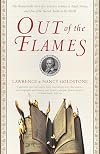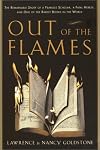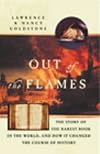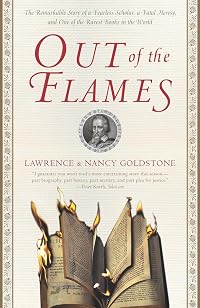
Out of the Flames: The Remarkable Story of a Fearless Scholar, a Fatal Heresy, and One of the Rarest Books in the World
by Lawrence Goldstone, Nancy Goldstone
On This Page
Description
"Michael Servetus is one of those hidden figureheads of history who is remembered not for his name but for the revolutionary deeds that stand in his place. Both a scientist and a freethinking theologian, Servetus is credited with the discovery of pulmonary circulation in the human body as well as the authorship of a polemical masterpiece that cost Servetus his life. The Christianismi Restitutio, a heretical work of biblical scholarship written in 1553, aimed to refute the orthodox show more Christianity that Servetus's old colleague, John Calvin, supported. After the book spread through the ranks of the Protestant hierarchy, Servetus was tried and agonizingly burned at the stake, the last known copy of the Restitutio chained to his leg. Servetus's execution is significant because it marked a turning point in the quest for freedom of expression, due largely to the development of the printing press and the proliferation of books in Renaissance Europe. Three copies of the Restitutio managed to survive the burning, despite every effort on the part of his enemies to destroy them. As a result, the book became almost a surrogate for its author, going into hiding and relying on covert distribution until it could be read freely, centuries later." "Out of the Flames tracks the history of this special work, examining Servetus's life and times and the politics of the first information revolution during the sixteenth century. Lawrence and Nancy Goldstone follow the clandestine journey of the three copies through the subsequent centuries and explore the author's legacy and influence over the thinkers that shared his spirit and genius, such as Leibniz, Voltaire, Jefferson, and William Osler. Out of the Flames is an extraordinary testament to the power of ideas, the enduring legacy of books, and the triumph of individual courage."--Jacket. show lessTags
Recommendations

















Member Reviews
Reformation-era physician and theologian Michael Servetus is remembered today for two things: he was the first anatomist to accurately describe the circulation of the blood through the heart, and he died a heretic's brutal death at the stake in John Calvin's Geneva. Lawrence and Nancy Goldstone tell the story of Servetus's life and thought in Out of the Flames., with a special emphasis on the fate of Servetus' written works, many of which moldered in obscurity for years.
Calvin (aka "the Ayatollah of Geneva") held a personal grudge against Servetus because the scholar had written a scathing line-by-line critique of Calvin's magnum opus, The Institutes of the Christian Religion. The reformer was determined that his rival's work would show more not outlive him. After an unjust trial, Calvin had Servetus burned at the stake along with his books, and ordered all remaining copies destroyed. Today, only three copies of his Christianismi Restitutio, the book in which Servetus famously rejected the doctrine of the Trinity and described the circulation of the heart, are known to have survived.
Although he was a martyr, the Goldstones do not portray Servetus as a saint. He was brilliant, but also arrogant and in some ways, foolish. He courted his own death by insisting on stopping by Geneva on his way to exile in Italy.
The Goldstones did a lot of research, and it seems they didn't want to leave a single bit of it out. The book gets confusing and a little ponderous as they tell the back stories of many figures through the ages, some of whom were only tangentially related to Servetus. Nonetheless, this is a good introduction to the life and work of a man who held fast to his convictions in the face of murderous opposition. show less
Calvin (aka "the Ayatollah of Geneva") held a personal grudge against Servetus because the scholar had written a scathing line-by-line critique of Calvin's magnum opus, The Institutes of the Christian Religion. The reformer was determined that his rival's work would show more not outlive him. After an unjust trial, Calvin had Servetus burned at the stake along with his books, and ordered all remaining copies destroyed. Today, only three copies of his Christianismi Restitutio, the book in which Servetus famously rejected the doctrine of the Trinity and described the circulation of the heart, are known to have survived.
Although he was a martyr, the Goldstones do not portray Servetus as a saint. He was brilliant, but also arrogant and in some ways, foolish. He courted his own death by insisting on stopping by Geneva on his way to exile in Italy.
The Goldstones did a lot of research, and it seems they didn't want to leave a single bit of it out. The book gets confusing and a little ponderous as they tell the back stories of many figures through the ages, some of whom were only tangentially related to Servetus. Nonetheless, this is a good introduction to the life and work of a man who held fast to his convictions in the face of murderous opposition. show less
Not the dissertation some might wish, but rather a gripping story told in the manner, perhaps, of the old Connections series. There is much to be learned here about the history of religious institutions (to be honest, I hadn't paid much attention to Unitarianism), the seductive allure to power of anyone who believes they have "the" moral truth that cannot abide nonconformers (I knew John Calvin was a dry humorless preacher, but I had been unaware of his parallels with Hitler: both were failed humanists/artists, who then made it their life missions to destroy or at least pass judgment over the societies that had rejected their mediocre talents). And behind it all, the book that managed to survive, showing yet again the enduring force of show more the written, published word, beyond anything imaginable for the its pale digital reflection. show less
This book had been sitting on my shelves for how many years? Forever. But once I picked it up I was completely hooked and could hardly put it down. At first it is the story of Michael Servetus, a man who refuted Calvin's repressive theology and was burned at the stake for it -- it is also a history of the printing press, The Reformation, the Inquisition, medicine, rare book collecting, and heresy. There is so much in this book that it sometimes feels like it is maybe spinning off the rails, but it is all so interesting that you can hardly help but want to follow wherever it goes.
Myself, I did sometimes want to read a little more of Servetus's actual writings, but then, I guess that just gives me more books to add to my TBR pile, which show more is fine. show less
Myself, I did sometimes want to read a little more of Servetus's actual writings, but then, I guess that just gives me more books to add to my TBR pile, which show more is fine. show less
The story of Michael Servetus, a 16th century scholar who couldn't keep his mouth shut and pissed everybody off--it was a toss-up if he was going to be burned at the stake by the Catholics or by Calvin. It was Calvin, and it was because Servetus espoused unitarianism--the idea that there is one God, one embodiment--not a trinity.
The fantastic thing about this book is that it starts by tracing the threads of information that lead to the person of Servetus--universities in the Middle Ages, his family, etc.--then goes on to tell about his life, scholarship, persecution and death--and finally traces the three copies of his book down through the ages to the present day.
The fantastic thing about this book is that it starts by tracing the threads of information that lead to the person of Servetus--universities in the Middle Ages, his family, etc.--then goes on to tell about his life, scholarship, persecution and death--and finally traces the three copies of his book down through the ages to the present day.
I love these authors! This text describes a book considered destroyed (by John Calvin) in the 1500's. That book was written by an eccentric genius - Michael Servetus. Some copies did survive. The first part of Out of the Flames, authors trace the history of the writing of the book with the religious background at the time, lots of detail about education and medical knowledge in the 1500s.
I would normally never read about organized religions, but this was never dry, and always made me curious to know what happened next. The history of discovering the few copies found is described as a mystery unfolding. The last third of the book gives credit to those people in history that recognized Michael Servetus's genius and kept his name and show more theories alive. I found the Doctor in the 1800s (Sir William Osler) very appealing, and reading his mini biography I was so involved I forgot the Servetus connection for many pages.
Its a great read for anyone that loves history, mysteries and understands the hunt and appreciation of rare books. show less
I would normally never read about organized religions, but this was never dry, and always made me curious to know what happened next. The history of discovering the few copies found is described as a mystery unfolding. The last third of the book gives credit to those people in history that recognized Michael Servetus's genius and kept his name and show more theories alive. I found the Doctor in the 1800s (Sir William Osler) very appealing, and reading his mini biography I was so involved I forgot the Servetus connection for many pages.
Its a great read for anyone that loves history, mysteries and understands the hunt and appreciation of rare books. show less
Michael Servetus was not only the anti-trinitarian heretic burned at the stake by John Calvin in Geneva in 1553; he was also a learned physician who theorized micro-circulation of blood in the human body some 7 decades before William Harvey. His story and the story of the suppression of his book in which he theorized circulation of the blood are both historically important and of much interest to those who care for history.
Yet I found this book to be a bit of a disappointment. Although fun to read, the authors tend toward glib historical generalizations. They jump about to whatever aspects of the Servetus story happen to catch their fancy. Do we really need ten pages on the medical career of the late 19th century Canadian physician who show more took up Servetus' cause and made it known to the medical historians of his generation? A more systematic and scholarly presentation of the material would have been in order, at least for this reader. show less
Yet I found this book to be a bit of a disappointment. Although fun to read, the authors tend toward glib historical generalizations. They jump about to whatever aspects of the Servetus story happen to catch their fancy. Do we really need ten pages on the medical career of the late 19th century Canadian physician who show more took up Servetus' cause and made it known to the medical historians of his generation? A more systematic and scholarly presentation of the material would have been in order, at least for this reader. show less
This is the history of a particular book of theology in the 1500's by Michael Servetus (who also discovered pulmonary circulation in the human body). It's interesting but a bit dry as it revolves around his refutation of Calvinistic Christianity.
Members
- Recently Added By
Lists

2022 Christmas Gifts
60 works; 13 members
Author Information

26 Works 5,656 Members
Lawrence Goldstone is the author or co-author of more than a dozen books, including two other innovation histories: Drive!: Henry Ford, George Selden, and the Race to Invent the Auto Age and Birdmen: The Wright Brothers, Glenn Curtiss, and the Battle to Control the Skies. He has written for the Wall Street Journal, Los Angeles Times, Boston Globe, show more New Republic, Chicago Tribune, and Miami Herald. He and his wife, author Nancy Goldstone, live in Sagaponack, New York. show less

16 Works 6,772 Members
Nancy Goldstone's previous books include The Rival Queens: Catherine de' Medici, Her Daughter, Marguerite de Valois, and the Betrayal That Ignited a Kingdom and The Lady Queen: The Notorious Reign of Joanna I, Queen of Naples, Jerusalem, and Sicily. She lives in Sagaponack New York. Nancygoldstone.com
Some Editions
Common Knowledge
- Canonical title
- Out of the Flames: The Remarkable Story of a Fearless Scholar, a Fatal Heresy, and One of the Rarest Books in the World
- Original publication date
- 2002
- People/Characters
- Michael Servetus (1511-1553); John Calvin (1509-1564); Balthazar Arnoullet; Charles V, 1500–1558, Holy Roman Emperor; Desiderius Erasmus (ca. 1469-1536); François I, King of France (show all 12); Galen; Martin Luther (1483-1546); William Osler; Joseph Priestley; Ptolemy; Voltaire
- Important places
- Europe (Medieval); Spain; Geneva, Geneva, Switzerland; Germany
- Important events
- Protestant Reformation
- Epigraph
- If then, dead books may be committed to the flames.
how much more live books, that is to say, men?
Matthieu Ory,
Inquisitor of Heretical Pravity for the Realm of France
Paris, 1544 - Dedication
- For Emily
- First words
- Shortly after noon on a cold and rainy late October day in 1553, a procession began at the town hall of Geneva, in western Switzerland, on the border with France. (Prologue)
Michael Servetus was born Miguel Serveto Conesa alias Revés on Saint Michael's Day, September 29, 1511, in the small town of Villanueva de Sijena, in the province of Huesca. - Last words
- (Click to show. Warning: May contain spoilers.)Today, the three copies of Christianismi Restituto can still be found at the Österrichische Nationalbibliothek in Vienna, the Bibliothèque Nationale in Paris, and the library of the University of Edinburgh.
- Publisher's editor
- Gerry Howard
Classifications
- Genres
- Nonfiction, Religion & Spirituality, History, General Nonfiction, Biography & Memoir
- DDC/MDS
- 273.6 — Religion History of Christianity Doctrinal controversies and heresies in general church history Heresies 10th-16th century: Antinomian, Bogomils, Cathars and Patarenes, the Waldenses, the Anabaptists, Paulicians
- LCC
- BX9869 .S4 .G57 — Philosophy, Psychology and Religion Christian Denominations Christian Denominations Protestantism Other Protestant denominations Unitarianism
- BISAC
Statistics
- Members
- 771
- Popularity
- 36,387
- Reviews
- 14
- Rating
- (4.23)
- Languages
- Chinese, English
- Media
- Paper, Ebook
- ISBNs
- 5
- ASINs
- 3