
The Europeans
by Henry James
On This Page
Description
Henry James, the nineteenth-century American writer who was lauded for his skill with insightful, elegantly styled prose, was fascinated by the differences between Americans and their European counterparts. This theme was a feature of many of his works, including the novella The Europeans. In this text, James takes a comic approach to highlighting the stark contrasts between the two cultures..
Tags
Recommendations


















Member Recommendations

Member Reviews
It's a funny thing (to start review/thought like someone much older and, presumably, more East Coast than I actually am) but I'd actually forgotten how much I love Henry James' use of language. Now, it's been years, maybe half a decade, since I last read James. The book in question was his "The American" which in typical James fashion illustrates the growing chasm of difference between two ostensible (and superficially similar) counterparts: white Americans of the New World juxtaposed with white Europeans of the Old World. But I remember thoroughly enjoying James' delineation of social and cultural divisions and how such essential arbitraries can be just that, a paradox founded on something reified into all but spoken law, but really show more predicated on nothing save belief and assumption, or to put it more simply: air. And in reading James I found then as I found now the joy (and the work) of reading his language.
And that's the thing, really. I didn't realize until visiting James again with "The Europeans" that I'd grown so complacent in my reading habits. For the past few years I've read more than a few texts that would/could/should be classified as 'complex' or at the very least 'not simple'...but only now, in writing this review, do I realize that, save for a few exceptions, that complexity lay, mostly, in content but not in style. William H. Gass and his "Omensetter's Luck" would be one of those exceptions and in bringing that up it seems to me that a more fitting counterpart to James could not be found (at least not in my subjective and recently read oeuvre). I'd forgotten that James, like Gass, doesn't ask of the reader, he demands of the reader a certain level of cognizance, of linguistic flexibility, and even malleability of comprehension (given the floweriness of his sentences in both structure and word choice) and that these authors (used in the abstract) and their books only 'work' and even function as well as the reader is able to integrate, cognitively, with the words on the page.
Is it easy or light/'beach' reading? No, or at least I wouldn't say it is for most. But that's exactly the point. Some books are simply read. While are others are read as a threshold to further experience. For Gass, his content and style allowed this transcendence. And for my new/old friend James, it's a corollary to this, a profusion of rich and fecund sentences that build upon the (admittedly) simple and even cannibalized concepts of his other novels to create something like a language lover's (and reader's) dream.
The only reason this novel gets a three and not a four from me can be stated a lot more simply; it's too damn short. James himself apparently gestured towards this when (I think?) his brother criticized the novel and he responded in kind. So, in essence, what we have here is novel and a story with a gorgeously demanding first and second act...but unfortunately let down just a bit by a truncated and even somewhat neutered final act. But again, in the case of James and a very small number of others, the experience inherent inthe act of reading and comprehending his words (almost) more than makes up for the other failings of the text. show less
And that's the thing, really. I didn't realize until visiting James again with "The Europeans" that I'd grown so complacent in my reading habits. For the past few years I've read more than a few texts that would/could/should be classified as 'complex' or at the very least 'not simple'...but only now, in writing this review, do I realize that, save for a few exceptions, that complexity lay, mostly, in content but not in style. William H. Gass and his "Omensetter's Luck" would be one of those exceptions and in bringing that up it seems to me that a more fitting counterpart to James could not be found (at least not in my subjective and recently read oeuvre). I'd forgotten that James, like Gass, doesn't ask of the reader, he demands of the reader a certain level of cognizance, of linguistic flexibility, and even malleability of comprehension (given the floweriness of his sentences in both structure and word choice) and that these authors (used in the abstract) and their books only 'work' and even function as well as the reader is able to integrate, cognitively, with the words on the page.
Is it easy or light/'beach' reading? No, or at least I wouldn't say it is for most. But that's exactly the point. Some books are simply read. While are others are read as a threshold to further experience. For Gass, his content and style allowed this transcendence. And for my new/old friend James, it's a corollary to this, a profusion of rich and fecund sentences that build upon the (admittedly) simple and even cannibalized concepts of his other novels to create something like a language lover's (and reader's) dream.
The only reason this novel gets a three and not a four from me can be stated a lot more simply; it's too damn short. James himself apparently gestured towards this when (I think?) his brother criticized the novel and he responded in kind. So, in essence, what we have here is novel and a story with a gorgeously demanding first and second act...but unfortunately let down just a bit by a truncated and even somewhat neutered final act. But again, in the case of James and a very small number of others, the experience inherent inthe act of reading and comprehending his words (almost) more than makes up for the other failings of the text. show less
Perhaps the weakest of his early novels, even including his first, disowned novel Watch and Ward, despite the fact that James's skills have developed quite a bit with Roderick Hudson and The American to allow a nice interplay between exposition and dialogue.
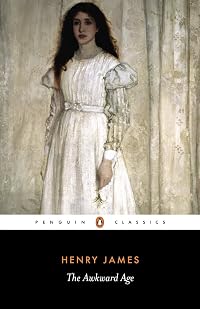
At times, The Europeans feels like a play—or else that it would work better as a play. We all know that James tried his hand as a playwright with Guy Domville and flopped, almost never recovering from that public failure. In later works, we can see the "playwright" James more seamlessly weaving his novelistic vision in works like The Awkward Age, which is more dialogue than anything else: a script lacking stage directions, and often lacking clarity on who's speaking. Ah, Jamesian show more ambiguity at its finest!
Here, though, James was confined by two things: his editor wanted a short, 100-page piece after his lengthy previous novel; and his editor also wanted a happy ending—so we have a very compressed plot, with some of the most interesting characters we've yet encountered in James's novels (the Baroness Münster; her brother, Felix; the rebellious, free-spirited American, Gertrude; and some others who don't quite come off the page), which feel, in the novel's quickness and brevity, to be mere caricatures than deftly-drawn characters. And we have an Austenian end that comes far too abruptly and leaves the reader entirely without satisfaction after the drawn out games, intrigue, and sly subterfuge that's come before it.
All in all, though, it's an intriguing experiment in James's oeuvre, in that he tends to focus much more on Americans abroad; here, we have Europeans in America, so we see that inverted: it's not so much how Americans are polluted by (and how they pollute) Europe and the Old World traditions, but rather, how the Old Word can influence them all the same, even on their own soil.
If anything, this proves that James works best with large canvases, as in his finest novels of the late period. Still, this is an interesting, if minor, inversion of The American, if a bit stale and lackluster. show less
At times, The Europeans feels like a play—or else that it would work better as a play. We all know that James tried his hand as a playwright with Guy Domville and flopped, almost never recovering from that public failure. In later works, we can see the "playwright" James more seamlessly weaving his novelistic vision in works like The Awkward Age, which is more dialogue than anything else: a script lacking stage directions, and often lacking clarity on who's speaking. Ah, Jamesian show more ambiguity at its finest!
Here, though, James was confined by two things: his editor wanted a short, 100-page piece after his lengthy previous novel; and his editor also wanted a happy ending—so we have a very compressed plot, with some of the most interesting characters we've yet encountered in James's novels (the Baroness Münster; her brother, Felix; the rebellious, free-spirited American, Gertrude; and some others who don't quite come off the page), which feel, in the novel's quickness and brevity, to be mere caricatures than deftly-drawn characters. And we have an Austenian end that comes far too abruptly and leaves the reader entirely without satisfaction after the drawn out games, intrigue, and sly subterfuge that's come before it.
All in all, though, it's an intriguing experiment in James's oeuvre, in that he tends to focus much more on Americans abroad; here, we have Europeans in America, so we see that inverted: it's not so much how Americans are polluted by (and how they pollute) Europe and the Old World traditions, but rather, how the Old Word can influence them all the same, even on their own soil.
If anything, this proves that James works best with large canvases, as in his finest novels of the late period. Still, this is an interesting, if minor, inversion of The American, if a bit stale and lackluster. show less
A delightful and delicate tale of how two branches of a family (one unsophisticated, upright New Englanders one sophisticated, upright Europeans) come together to their mutual confusion and ultimate benefit (well benefit to some!). I had never thought of Henry James as a humourist but there is one scene towards the end of this book that had me laughing out loud.
I picked this for the "out of my comfort zone" square in Seattle Public Library's summer book bingo challenge. My younger self at one point threw The Beast in the Jungle across the room, yelling, "Get a job!" I've grown up a little since but I still don't love James's interiority or the upper-crust settings. Still, this is probably the least uncomfortable of James's novels I could have chosen. This is more like a charming badminton match between Europe and New England than the intense spelunking that scared me back in college.
As with most of what I've read so far by James, I didn't particularly like any of these characters (except Gertrude), but that didn't bother me. I still liked seeing the world through Eugenia's eyes, except when I show more couldn't. I may or may not have understood her behavior at the end, if there was anything to understand. I did like the balance of happy storybook ending with murky lack of resolution, though. I'm glad I took this challenge. show less
As with most of what I've read so far by James, I didn't particularly like any of these characters (except Gertrude), but that didn't bother me. I still liked seeing the world through Eugenia's eyes, except when I show more couldn't. I may or may not have understood her behavior at the end, if there was anything to understand. I did like the balance of happy storybook ending with murky lack of resolution, though. I'm glad I took this challenge. show less
5/10.
Ugh.
If I had not known and loved Henry James in different incarnations, this would have stopped me dead cold in my pursuit of knowing him better. I may, in fact, have to re-think all of Henry James with the taint of this on my hands. The first 20, and the last 20 pages save this from a Zero rating: something actually happens in those two tranches that lifts it above stick people speaking in wooden tones and executing wooden actions. It reminded me of childhood games where we hoisted brooms and sticks and whacked whacked whacked at each other pretending we were real soldiers in a real war.
Where is the tug of (real) war that I've come to know and love of James -- the moral duality that pushes and pulls old against new; that offers show more subtleties of thought, depth of perception? It is completely lacking, and lies recumbent in the dismal do-nothing Mr. Acton and apathetic, draggy Baroness Munster in her sorry state. These emotionless, passive people choke one to death with their soulless lives. Ugh again.
My rating seems terribly high for so many platitudes all in a row. Was it the rich, sumptuous Christmas pudding of literary constructs that James builds? Loaded with empty calories, and only good as long as the sentence lasts. It has to be that. It can only be that. show less
Ugh.
If I had not known and loved Henry James in different incarnations, this would have stopped me dead cold in my pursuit of knowing him better. I may, in fact, have to re-think all of Henry James with the taint of this on my hands. The first 20, and the last 20 pages save this from a Zero rating: something actually happens in those two tranches that lifts it above stick people speaking in wooden tones and executing wooden actions. It reminded me of childhood games where we hoisted brooms and sticks and whacked whacked whacked at each other pretending we were real soldiers in a real war.
Where is the tug of (real) war that I've come to know and love of James -- the moral duality that pushes and pulls old against new; that offers show more subtleties of thought, depth of perception? It is completely lacking, and lies recumbent in the dismal do-nothing Mr. Acton and apathetic, draggy Baroness Munster in her sorry state. These emotionless, passive people choke one to death with their soulless lives. Ugh again.
My rating seems terribly high for so many platitudes all in a row. Was it the rich, sumptuous Christmas pudding of literary constructs that James builds? Loaded with empty calories, and only good as long as the sentence lasts. It has to be that. It can only be that. show less
In the pub earlier this evening, I was trying to explain my thoughts about this novella to my partner, and managed to cobble together something about being told that the female lead was charming, but seeing no evidence of it. My partner, clever as he is, responded with a knowledgeable "Ah, telling, not showing", which pretty much summed it up for me. Turns out (as most librarything readers are probably aware) that there has been a recent movement towards revealing your characters through showing your reader what they're like, rather than telling your reader what they're like. So, in The Europeans, a modern Henry James would probably have demonstrated to his reader that Eugenia was charming, by showing instances of her charm. Perhaps show more that's what the real Henry actually thought he was doing, but for me, Eugenia was not charming, Gertrude was not unusual and misunderstood, and throughout the entire novella, the characters felt like they were straining against their imposed characteristics, to reveals their true selves (mostly dull).
There were saving graces; I found Felix and Robert Acton believable and quite interesting, but in general, I wasn't sorry to finish this one. I usually enjoy Henry James, so I'm hoping that this is an aberration, but it has put me off somewhat. Not a novel I would recommend. show less
There were saving graces; I found Felix and Robert Acton believable and quite interesting, but in general, I wasn't sorry to finish this one. I usually enjoy Henry James, so I'm hoping that this is an aberration, but it has put me off somewhat. Not a novel I would recommend. show less
I always enjoy James's ability to capture the subtleties in his characters, to the point where as to what they are thinking or feeling - the reader must almost have an intuition more than a knowledge of what will happen next. The Baroness's interest in Robert is dubious as is Robert's; Felix and Gertrude finally come together but in a most unorthodox fashion. Only Charlotte and her clergyman seem an obvious fit, but it's one that will seemingly never happen!
Of course, my favourite are all the half-said words and little piques, which are a careful observation of society and its mores. The pitting of Americans and European is charming albeit sometimes stereotypical, but created a great backdrop for all the romantic intrigues.
A light, show more delightful, little book in James's traditional style. show less
Of course, my favourite are all the half-said words and little piques, which are a careful observation of society and its mores. The pitting of Americans and European is charming albeit sometimes stereotypical, but created a great backdrop for all the romantic intrigues.
A light, show more delightful, little book in James's traditional style. show less
Members
- Recently Added By
Lists

Out of Copyright
244 works; 14 members

1870s
15 works; 2 members

Books Read in 2022
5,226 works; 112 members

American Lit for Eng 11 Research Project
368 works; 6 members

Art of Reading
188 works; 5 members
Fiction (Mostly) in Selective Bibliography of American Literature 1775-1900
431 works; 3 members
Author Information

1,061+ Works 87,953 Members
Some Editions
Series
Belongs to Publisher Series
Work Relationships
Common Knowledge
- Canonical title
- The Europeans: A Sketch; The Europeans
- Original title
- The Europeans
- Original publication date
- 1878
- People/Characters
- Eugenia, Baroness Munster; Felix Young; Gertrude Wentworth; Charlotte Wentworth; Robert Acton; Mr Wentworth (show all 9); Clifford Wentworth; Lizzie Acton; Mr Brand
- Important places
- Boston, Massachusetts, USA
- Related movies
- The Europeans (1979 | IMDb)
- First words
- A narrow grave-yard in the heart of a bustling, indifferent city, seen from the windows of a gloomy-looking inn, is at no time an object of enlivening suggestion; and the spectacle is not at its best when the mouldy tombstone... (show all)s and funereal umbrage have received the ineffectual refreshment of a dull, moist snowfall.
- Last words
- (Click to show. Warning: May contain spoilers.)Mr. Wentworth at last found himself listening for it; and Robert Acton, after his mother's death, married a particularly nice young girl.
- Original language
- English
Classifications
Statistics
- Members
- 1,824
- Popularity
- 11,981
- Reviews
- 28
- Rating
- (3.57)
- Languages
- 14 — Catalan, Danish, English, Estonian, Finnish, French, German, Hebrew, Hungarian, Italian, Polish, Portuguese, Spanish, Swedish
- Media
- Paper, Audiobook, Ebook
- ISBNs
- 170
- ASINs
- 42