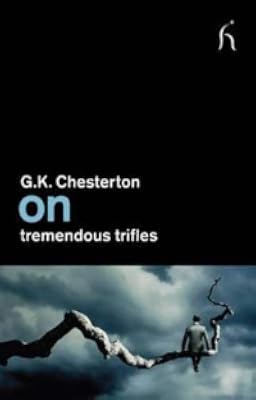
On Tremendous Trifles
by G. K. Chesterton
On This Page
Description
In a popular series of articles first published in 1909, G. K. Chesterton sought to celebrate the everyday objects and activities that are frequently taken for granted and yet which enrich life inestimably. These essays offer an uplifting tour of the preoccupations of one of the preeminent writers of his day and serve as a valuable insight into daily life in the early 20th century.Tags
Recommendations












Member Recommendations

Member Reviews
There is an undeniable charm in Mr. Chesterton's contrarian stance. I think possibly it is displayed more pleasingly in these slight essays than in his more famous and polemical works. His constant succession of one liners and paradoxes can become somewhat wearisome when the most serious subjects are being discussed. His prejudices are never justified, only displayed. In these little efforts, however, that is not a problem. He is the master of the unexpected viewpoint, and these essays delight and entertain.
 This review was written for LibraryThing Early Reviewers.
What do a piece of chalk, croquet, the contents of a man's pockets, fairy tales, toy theatres, and singing while you work have in common? All are topics of columns written by G.K. Chesterton for the Daily News in the first decade of the 20th century. A selection of 39 Chesterton's columns was published as Tremendous Trifles. Hesperus Press has now reprinted 21 of the 39 columns as On Tremendous Trifles.
Chesterton states his rationale for his pieces in the essay, Tremendous Trifles: "they show what can be achieved with a commonplace existence and the sacred spectacles of exaggeration." He contrasts his style with that of Kipling, who "show[s] how many extraordinary things a man may see if he is active and strides from continent to show more continent...". In contrast, Chesterton's style is "to show how many extraordinary things even a lazy and ordinary man may see if he can spur himself to the single activity of seeing." Chesterton's observations are penetrating rather than descriptive, idealistic rather than cynical, and are suffused with spiritual undertones.
The Little Birds Who Won't Sing is my favorite essay in the collection. Gothic carvings of medieval people at work inspire Chesterton to reflect on this question: "How did people come to chant rude poems while pulling certain ropes or gathering certain fruit, and why did nobody do anything of the kind while producing any of the modern things? Why is a modern newspaper never printed by people singing in chorus? Why do shopmen seldom, if ever, sing?" Chesterton tries his hand at writing songs for bank clerks and postal clerks, and the resulting lines illustrate the absurdity of the idea. He concludes that "there is something spiritually suffocating about our life... Bank clerks are without songs, not because they are poor, but because they are sad."
This Hesperus Press selection is designed for reading rather than for sitting decoratively on a bookshelf. It's just the right size to carry in a pocket, handbag, or briefcase, to pull out and dip into while sitting in a doctor's waiting room or waiting for soccer practice to end. It just might inspire readers to be more observant of their surroundings, and to rediscover the wonder of ordinary things.
This review is based on a complimentary copy provided by the publisher through LibraryThing's Early Reviewers program. show less
Chesterton states his rationale for his pieces in the essay, Tremendous Trifles: "they show what can be achieved with a commonplace existence and the sacred spectacles of exaggeration." He contrasts his style with that of Kipling, who "show[s] how many extraordinary things a man may see if he is active and strides from continent to show more continent...". In contrast, Chesterton's style is "to show how many extraordinary things even a lazy and ordinary man may see if he can spur himself to the single activity of seeing." Chesterton's observations are penetrating rather than descriptive, idealistic rather than cynical, and are suffused with spiritual undertones.
The Little Birds Who Won't Sing is my favorite essay in the collection. Gothic carvings of medieval people at work inspire Chesterton to reflect on this question: "How did people come to chant rude poems while pulling certain ropes or gathering certain fruit, and why did nobody do anything of the kind while producing any of the modern things? Why is a modern newspaper never printed by people singing in chorus? Why do shopmen seldom, if ever, sing?" Chesterton tries his hand at writing songs for bank clerks and postal clerks, and the resulting lines illustrate the absurdity of the idea. He concludes that "there is something spiritually suffocating about our life... Bank clerks are without songs, not because they are poor, but because they are sad."
This Hesperus Press selection is designed for reading rather than for sitting decoratively on a bookshelf. It's just the right size to carry in a pocket, handbag, or briefcase, to pull out and dip into while sitting in a doctor's waiting room or waiting for soccer practice to end. It just might inspire readers to be more observant of their surroundings, and to rediscover the wonder of ordinary things.
This review is based on a complimentary copy provided by the publisher through LibraryThing's Early Reviewers program. show less
This review was written for LibraryThing Early Reviewers.This book shares a lot in common with the Seinfeld—they’re both essentially works about nothing (at least nothing we’d consider worth considering). Tremendous Trifles is a collection of short essays on the things most of us wouldn’t pause to think twice about.
In Chesterton’s able hands, topics such as the detritus in one’s pocket or the magnificence of a blank canvas (otherwise known as a ceiling) reach sublime heights. It’s wonderful to think that the most meaningless items in life are worth (at least) 1,250 words and a column in the local newspaper.
Some might accuse Chesterton of excessive indulgence. You either love his verbose style or hate it. I enjoy slowing down to the leisurely pace he sets.
Since there are numerous show more editions of Tremendous Trifles around, I should make a few notes about this Hesperus edition. The binding holds together well, the text is crisp, the cover’s cleanly designed, and there’s handy fold-overs on the front and back cover to mark your place. This is the sort of quality paperback that makes you want to buy the rest of the publisher’s set.
Disclaimer: A review copy of this book was provided at no cost through LibraryThing’s Early Reviewer’s program. show less
In Chesterton’s able hands, topics such as the detritus in one’s pocket or the magnificence of a blank canvas (otherwise known as a ceiling) reach sublime heights. It’s wonderful to think that the most meaningless items in life are worth (at least) 1,250 words and a column in the local newspaper.
Some might accuse Chesterton of excessive indulgence. You either love his verbose style or hate it. I enjoy slowing down to the leisurely pace he sets.
Since there are numerous show more editions of Tremendous Trifles around, I should make a few notes about this Hesperus edition. The binding holds together well, the text is crisp, the cover’s cleanly designed, and there’s handy fold-overs on the front and back cover to mark your place. This is the sort of quality paperback that makes you want to buy the rest of the publisher’s set.
Disclaimer: A review copy of this book was provided at no cost through LibraryThing’s Early Reviewer’s program. show less
This review was written for LibraryThing Early Reviewers.This book was a pleasure to read and to handle. Sturdy covers, crisp good weight pages, in a clear and pleasing font, with a decent amount of white space.
This book consists of a foreword by Ben Schott, a selection of the essays and articles originally published in the Daily News 1902 - 1909, and a short biography of G K Chesterton. Most of the essays are short and pithy, have a light touch, are playful, sometimes witty, and sometimes funny. As the title suggests "On Tremendous Trifles" is about the small things in life that actually turn out to be rather important, or give us great pleasure, or cause the most vexation. Profound realisations, and trains of thought, and paradoxes, spring from small activities like drawing in chalk on show more brown parcel paper, or from absurd situations, like seeing a poster in s a window bearing the words "Should shop assistants marry?" There is a good deal to enjoy, and to think on, so I'll be re-reading this book. show less
This book consists of a foreword by Ben Schott, a selection of the essays and articles originally published in the Daily News 1902 - 1909, and a short biography of G K Chesterton. Most of the essays are short and pithy, have a light touch, are playful, sometimes witty, and sometimes funny. As the title suggests "On Tremendous Trifles" is about the small things in life that actually turn out to be rather important, or give us great pleasure, or cause the most vexation. Profound realisations, and trains of thought, and paradoxes, spring from small activities like drawing in chalk on show more brown parcel paper, or from absurd situations, like seeing a poster in s a window bearing the words "Should shop assistants marry?" There is a good deal to enjoy, and to think on, so I'll be re-reading this book. show less
This review was written for LibraryThing Early Reviewers.This is a small, slender trade paperback from Hesperus Press, which just feels pleasant to the hand, with its matte finish and front and back flaps. It is foreworded by Ben Schott - who is clearly someone I need to follow up on soon; the foreword was as much fun as one of the essays.
And when I say it's as much fun, that's a tremendous compliment, because these essays are great fun. I've laughed out loud reading them more often than during any other book I can think of recently; the best word I can associate with this book is "delight". A turn of phrase here, the turning upside down of a phrase there, a philosophical conceit somewhere, a purely GKC insult elsewhere - I love it.
Throughout, the essays provoke laughter, and nodding of my show more head, and blank stares as a new way of looking at things unwinds behind my eyes. They're essays about his sprained ankle - and thus the advantages of having a leg; and the wind in the trees, or is it the trees in the wind?; and a cab-man's mistake, which becomes a metaphysical question about what is real. There is the hansom cab that throws him out, and the cows which gather to consult about his strange behavior, and the croquet game which alarms him (which was one of my favorites), and, of course, his pocket contents ... I would start listing my favorite quotes, but that would entail most of the book. What a wonderful treasure this book is.
http://agoldoffish.wordpress.com/2010/06/01/the-world-will-never-starve-for-want... show less
And when I say it's as much fun, that's a tremendous compliment, because these essays are great fun. I've laughed out loud reading them more often than during any other book I can think of recently; the best word I can associate with this book is "delight". A turn of phrase here, the turning upside down of a phrase there, a philosophical conceit somewhere, a purely GKC insult elsewhere - I love it.
Throughout, the essays provoke laughter, and nodding of my show more head, and blank stares as a new way of looking at things unwinds behind my eyes. They're essays about his sprained ankle - and thus the advantages of having a leg; and the wind in the trees, or is it the trees in the wind?; and a cab-man's mistake, which becomes a metaphysical question about what is real. There is the hansom cab that throws him out, and the cows which gather to consult about his strange behavior, and the croquet game which alarms him (which was one of my favorites), and, of course, his pocket contents ... I would start listing my favorite quotes, but that would entail most of the book. What a wonderful treasure this book is.
http://agoldoffish.wordpress.com/2010/06/01/the-world-will-never-starve-for-want... show less
This review was written for LibraryThing Early Reviewers.G.K. Chesterton produced prodigious quantities of essays, novels, plays, poems and journalism as well as illustrating numerous publications. He had an ability to take an ordinary topic and make it entertaining while maintaining a philosophical aspect, all written in a very elegant Edwardian style.
This publication of essays is a selection of articles written for the Daily News. One of my favourites is On Lying in Bed which begins "Lying in bed would be an altogether perfect and supreme experience if only one had a coloured pencil long enough to draw on the ceiling" and goes on to suppose that Michaelangelo got his inspiration while so occupied.
Thanks to Hesperus Press for re-printing neglected, little known, or unjustly forgotten show more classics. The quality of this publication is exceptional with cover and pages that feel beautiful. I intend to accumulate a collection of Hesperus books. show less
This publication of essays is a selection of articles written for the Daily News. One of my favourites is On Lying in Bed which begins "Lying in bed would be an altogether perfect and supreme experience if only one had a coloured pencil long enough to draw on the ceiling" and goes on to suppose that Michaelangelo got his inspiration while so occupied.
Thanks to Hesperus Press for re-printing neglected, little known, or unjustly forgotten show more classics. The quality of this publication is exceptional with cover and pages that feel beautiful. I intend to accumulate a collection of Hesperus books. show less
This review was written for LibraryThing Early Reviewers.G. K. Chesterton (1874-1936) was one of the most prolific writers of his time, and his writings covered every imaginable genre, from biography to literary criticism to nonfiction to detective stories. "Tremendous Trifles" was originally a collection of 39 short essays published between 1902 and 1909 in the London newspaper Daily News. This new edition from Hesperus Press contains 21 of the essays, along with a forward and a short biography of Chesterton. The essays cover such wide-ranging topics as the importance of fairy tales, the excitement of discovering the contents of one’s pockets, the beauties of white chalk on brown paper, and “the advantages of having one leg.” Chesterton examines these seemingly trivial topics and show more relates them to important philosophical concerns of the modern age.
Anyone familiar with Chesterton’s writing style will know what to expect in this collection of essays: audacious paradoxes, wildly exaggerated statements, unusual metaphors, and playful treatment of ultimately serious subjects. I would certainly recommend this collection to Chesterton fans, although I wish the Hesperus edition contained all 39 of the original essays instead of just 21! For newcomers to Chesterton’s work, I would recommend starting with a full-length book like Orthodoxy, where he is able to explain his views in more detail. One thing that amused me about the forward to this edition was the editor’s statement that “the collection might best be appreciated now as a period piece” – a statement with which I think Chesterton would completely disagree! While the essays certainly do address the concerns of a particular time period, they also make claims about universal human truths, and I think Chesterton would want his readers – whether they ultimately agree with him or not – to take his views seriously. show less
Anyone familiar with Chesterton’s writing style will know what to expect in this collection of essays: audacious paradoxes, wildly exaggerated statements, unusual metaphors, and playful treatment of ultimately serious subjects. I would certainly recommend this collection to Chesterton fans, although I wish the Hesperus edition contained all 39 of the original essays instead of just 21! For newcomers to Chesterton’s work, I would recommend starting with a full-length book like Orthodoxy, where he is able to explain his views in more detail. One thing that amused me about the forward to this edition was the editor’s statement that “the collection might best be appreciated now as a period piece” – a statement with which I think Chesterton would completely disagree! While the essays certainly do address the concerns of a particular time period, they also make claims about universal human truths, and I think Chesterton would want his readers – whether they ultimately agree with him or not – to take his views seriously. show less
This review was written for LibraryThing Early Reviewers.Members
- Recently Added By
Author Information

798+ Works 59,655 Members
Gilbert Keith Chesterton was born in London, England, in 1874. He began his education at St Paul's School, and later went on to study art at the Slade School, and literature at University College in London. Chesterton wrote a great deal of poetry, as well as works of social and literary criticism. Among his most notable books are The Man Who Was show more Thursday, a metaphysical thriller, and The Everlasting Man, a history of humankind's spiritual progress. After Chesterton converted to Catholicism in 1922, he wrote mainly on religious topics. Chesterton is most known for creating the famous priest-detective character Father Brown, who first appeared in "The Innocence of Father Brown." Chesterton died in 1936 at the age of 62. (Bowker Author Biography) show less
Some Editions
Work Relationships
Is an abridged version of
Common Knowledge
- Original publication date
- 1909
- First words
- Once upon a time there were two little boys who lived chiefly in the front garden, because their villa was a model one.
- Quotations
- The joy of Satan in standing on a peak is not a joy in largeness, but a joy in beholding smallness, in the fact that all men look like insects at his feet.
The great human dogma, then, is that the wind moves the trees. The great human heresy is that the trees move the wind. - Last words
- (Click to show. Warning: May contain spoilers.)Prince, wide your Empire spreads, I ween,
Yet happier is that moistened Mayor,
Who drinks her cognac far from fine,
The lovely city of Lierre. - Disambiguation notice
- Please note: "On Tremendous Trifles" should not be combined with "Tremendous Trifles". The former is an abridged volume.
Classifications
Statistics
- Members
- 33
- Popularity
- 858,056
- Reviews
- 15
- Rating
- (4.43)
- Languages
- English
- Media
- Paper
- ISBNs
- 1