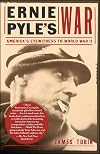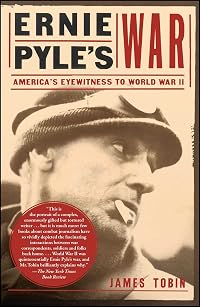
Ernie Pyle's War: America's Eyewitness to World War II
by James Tobin
On This Page
Description
When a machine-gun bullet ended the life of war correspondent Ernie Pyle in the final days of World War II, Americans mourned him in the same breath as they mourned Franklin Roosevelt. To millions, the loss of this American folk hero seemed nearly and great as the loss of the wartime president. If the hidden horrors and valor of combat persist at all in the public mind, it is because of those writers who watched it and recorded it in the faith that war is too important to be confined to the show more private memories of the warriors. Above all these writers, Ernie Pyle towered as a giant. Through his words ad his compassion, Americans everywhere gleaned their understanding of what they came to call "The Good War." Pyle walked a troubled path to fame. Though insecure and anxious, he created a carefree and kindly public image in his popular prewar column - all the while struggling with inner demons and a tortured marriage. War, in fact, offered. Pyle an escape hatch from his own personal hell. It also offered him a subject precisely suited to his talent - a shrewd understanding of human nature, an unmatched eye for detail, a profound capacity to identify with the suffering soldiers whom he adopted as his own, and a plain yet poetic style reminiscent of Mark Twain and Will Rogers. These he brought to bear on the Battle of Britain and all the great American campaigns of the war - North Africa, Sicily, Italy, D-Day, and Normandy, the liberation of Paris, and finally Okinawa, where he felt compelled to go because of his enormous public stature despite premonitions of death. show lessTags
Recommendations














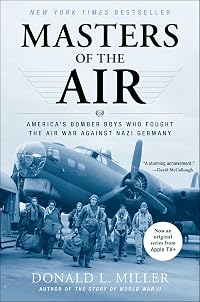
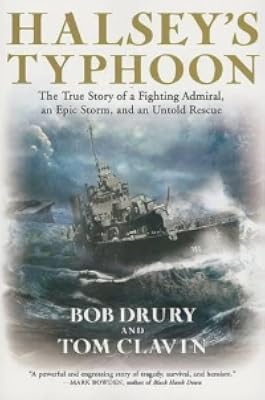
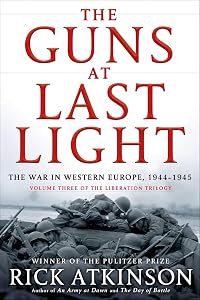
Member Reviews
Written in 1997, Tobin takes a long look back into war correspondence and the unique character of Ernie Pyle. The book chronicles Pyle's life and personal struggles as WWII's consummate journalist, but also examines what made Pyle different as the defining voice of the common soldier. It attempts to define what war was and is, politically, morally and practically. Tobin shows that Pyle, though not a philosopher, nevertheless struggles with the age-old questions of how soldiers convert from husbands and fathers to “patriotic” killers. Pyle gradually changed his views of what we were fighting for. He wrote in simple, down-home style that endeared his columns to the vast majority of Americans and he never glorified war as anything show more other than what it was from what he saw. Tobin relies on generous excerpts from Pyle's writings, his columns, personal interviews with friends, and his correspondence to Pyle's editors that revealed his personal doubts and feelings. This is an excellent book that helps keep alive the legacy of WWII with generations after the fact. show less
In his time, Pyle was probably the most famous war correspondent in the USA if not the world. His folksy thoughtful columns from the front were widely read in America and even in England. He spent the first part of the war in the European theatre and then under pressure from readers who had family serving in the Pacific, he went there. On ships & islands, he found a different type of war from what he had experienced in the foxholes of Europe. He felt that the personnel serving in the pacific had it soft living on clean ships with good food and showers or enjoying R &R on a tropical island.
The book also covers his journalistic career before the war when he wrote about early aviation and then about the America he found as he drove or show more flew through the 48 states talking to people and describing the landscape to fund his columns. We also learn about his rocky marriage with a woman who suffered from mental illness.
There is an appendix in which the author gives us a sample of Pyle columns so we can witness for ourselves what made him a popular columnist.
Well written and very readable. show less
The book also covers his journalistic career before the war when he wrote about early aviation and then about the America he found as he drove or show more flew through the 48 states talking to people and describing the landscape to fund his columns. We also learn about his rocky marriage with a woman who suffered from mental illness.
There is an appendix in which the author gives us a sample of Pyle columns so we can witness for ourselves what made him a popular columnist.
Well written and very readable. show less
I finished James Tobin's Ernie Pyle's War: America's Eyewitness to World War II.
A short book under 300 pages that includes an appendice of some of his work both before and during the war.
This was a great dip into the life of Ernie Pyle, a man I knew only through reputation. It provides a compact whole life history and goes into his family, marriage and career before the war and if course his work most notable in the ETO with his unfortunately short stint in the Pacific Theater.
Both a simple and complex man at the same time who was limited by his past yet yearned for greatness. His reporting throughout his career focused on the common man and soldier, reporting on their daily experience.
Always a loyal following, slow to fame who show more blossomed into greatness during the war.
A great read. show less
A short book under 300 pages that includes an appendice of some of his work both before and during the war.
This was a great dip into the life of Ernie Pyle, a man I knew only through reputation. It provides a compact whole life history and goes into his family, marriage and career before the war and if course his work most notable in the ETO with his unfortunately short stint in the Pacific Theater.
Both a simple and complex man at the same time who was limited by his past yet yearned for greatness. His reporting throughout his career focused on the common man and soldier, reporting on their daily experience.
Always a loyal following, slow to fame who show more blossomed into greatness during the war.
A great read. show less
Archived collection of Pyle's wartime columns, including The Death of Captain Waskow, Jan 10 1944. This is one of the best known of his columns and adapted in part for use in the 1945 movie "Story of G.I. Joe" with Robert Mitchum and Burgess Meredith.
The columns are fascinating reading, echoes of a world gone, with the foibles and prejudices and strengths thereof. The author was present at D Day, and his observations are both horrifying and heartrending. Copyright Scripps Howard Foundation.
These were saved in .pdf format for my Nook.
The columns are fascinating reading, echoes of a world gone, with the foibles and prejudices and strengths thereof. The author was present at D Day, and his observations are both horrifying and heartrending. Copyright Scripps Howard Foundation.
These were saved in .pdf format for my Nook.
I didn't know much about Ernie Pyle when I picked up this book. It was so interesting to see how he developed a very unique career in journalism, unlike that of anyone else. He basically just talked to people and wrote what he saw from the common man's view, leaving the bigger stories and facts and figures to other reporters. He had a beautiful way of describing things, and it was enjoyable to see excerpts of his writing throughout the book. I also learned a bit about life in the 30s and 40s, and got an insider's view of WWII through his eyes. Recommended reading for anyone interested in history, WWII or journalism.
When I was in high school, back in the days when we actually studied history rather than “social studies,” I remember learning about Ernie Pyle, one of the foremost American newspaper correspondents during World War II. Therefore, while driving through west central Indiana last year and seeing a sign for the Ernie Pyle State Historic Site at Dana, IN, we decided to stop. I purchased this book from their gift shop to serve as a memento of our visit and to learn more about Pyle, who was born Ernest Taylor Pyle on a tenant farm outside of Dana, IN, in 1900, and attended but didn’t graduate from Indiana University. Instead, he accepted a job at a paper in LaPorte, IN, where he worked for three months before moving to Washington, D.C. show more to be a reporter for a tabloid newspaper, The Washington Daily News.
While in Washington, Pyle met Geraldine "Jerry" Siebolds and married her in 1925. In 1928, he started the country's first aviation column, which he wrote for four years. After serving as managing editor of the Daily News for a couple of years, he returned to writing with a series of national columns for the Scripps-Howard Alliance group about the unusual places he saw and people he met in his travels. His articles were written in a folksy style, much like a personal letter to a friend, and enjoyed a following in some 300 newspapers. With America’s entry into World War II, he became a special war correspondent, covering actions in North Africa, the invasion of Sicily, and D-Day, writing from the perspective of the common soldier, an approach that won him the Pulitzer Prize in 1944. Pyle decided to cover events in the Pacific, and on April 18, 1945, was struck in the left temple by Japanese machine-gun fire on Ie Shima, an island off Okinawa, and died instantly. James Tobin’s account of Pyle’s life and work, emphasizing his efforts during the war, won the National Book Critics Circle Award in 1998.
One of the disadvantages of a biography is that one often has to read about “warts and all.” Pyle’s wife Jerry, who called herself an atheist, suffered from intermittent bouts of mental illness and alcoholism. Pyle himself dealt with severe emotional insecurities and was a heavy drinker. Jerry just wanted them to live together, but Pyle at least insisted on marriage because “he could not shame his parents by living in sin.” The only time Jerry got pregnant, she chose to have an abortion, and she tried to commit suicide a couple of times. Because of the problems they divorced in 1942, and there are references in the book to several affairs that Pyle had during this time, but they remarried by proxy a year later. Also, Pyle and many of his co-workers, and apparently the author too, were very profane and vulgar men. Their language is liberally sprinkled with cursing (especially the “d” and “h” words), a lot of taking the Lord’s name in vain (including various forms of “go**am”), and even some actual obscenities (such as the “f” and “s” words among others). The book ends with an Appendix that contains a potpourri of Pyle's articles. For very mature, older teens and adults making an in-depth study of World War II, the book contains some important information, but it is definitely not for children. This book is not to be confused with Ernie’s War, a collection of Pyle’s World War II dispatches edited by David Nichols. show less
While in Washington, Pyle met Geraldine "Jerry" Siebolds and married her in 1925. In 1928, he started the country's first aviation column, which he wrote for four years. After serving as managing editor of the Daily News for a couple of years, he returned to writing with a series of national columns for the Scripps-Howard Alliance group about the unusual places he saw and people he met in his travels. His articles were written in a folksy style, much like a personal letter to a friend, and enjoyed a following in some 300 newspapers. With America’s entry into World War II, he became a special war correspondent, covering actions in North Africa, the invasion of Sicily, and D-Day, writing from the perspective of the common soldier, an approach that won him the Pulitzer Prize in 1944. Pyle decided to cover events in the Pacific, and on April 18, 1945, was struck in the left temple by Japanese machine-gun fire on Ie Shima, an island off Okinawa, and died instantly. James Tobin’s account of Pyle’s life and work, emphasizing his efforts during the war, won the National Book Critics Circle Award in 1998.
One of the disadvantages of a biography is that one often has to read about “warts and all.” Pyle’s wife Jerry, who called herself an atheist, suffered from intermittent bouts of mental illness and alcoholism. Pyle himself dealt with severe emotional insecurities and was a heavy drinker. Jerry just wanted them to live together, but Pyle at least insisted on marriage because “he could not shame his parents by living in sin.” The only time Jerry got pregnant, she chose to have an abortion, and she tried to commit suicide a couple of times. Because of the problems they divorced in 1942, and there are references in the book to several affairs that Pyle had during this time, but they remarried by proxy a year later. Also, Pyle and many of his co-workers, and apparently the author too, were very profane and vulgar men. Their language is liberally sprinkled with cursing (especially the “d” and “h” words), a lot of taking the Lord’s name in vain (including various forms of “go**am”), and even some actual obscenities (such as the “f” and “s” words among others). The book ends with an Appendix that contains a potpourri of Pyle's articles. For very mature, older teens and adults making an in-depth study of World War II, the book contains some important information, but it is definitely not for children. This book is not to be confused with Ernie’s War, a collection of Pyle’s World War II dispatches edited by David Nichols. show less
Tobin's book is more than your run-of-the-mill biography, the author includes an appendix with samples of Pyle’s columns and several black and white photographs of the journalist.
Members
- Recently Added By
Lists

Books Read in 2021
5,361 works; 114 members
Author Information

7 Works 730 Members
James Tobin won the National Book Critics Circle Award for his first book, Ernie Pyle's War, and the J. Anthony Lukas Work-in-Progress Award for To Conquer the Air. Twice nominated for the Pulitzer Prize in journalism, he holds a Ph.D. in history from the University of Michigan
Awards and Honors
Common Knowledge
- Original publication date
- 1997
- People/Characters
- Ernie Pyle
Classifications
- Genres
- Nonfiction, History, Biography & Memoir, General Nonfiction
- DDC/MDS
- 070.4 — Computer science, information & general works News media, journalism & publishing Documentary media, educational media, news media; journalism; publishing Journalism
- LCC
- PN4874 .P88 .T63 — Language and Literature Literature (General) Literature (General) Journalism. The periodical press, etc. By region or country
- BISAC
Statistics
- Members
- 232
- Popularity
- 140,036
- Reviews
- 7
- Rating
- (4.00)
- Languages
- English
- Media
- Paper, Ebook
- ISBNs
- 5
- ASINs
- 2