
Colin Alexander
Author of Starman's Saga: The Long, Strange Journey of Leif The Lucky
About the Author
Colin Alexander is the publisher of The Five Star Bulletin, a popular advisory service for futures traders. Since 1996, his service has consistently been rated in the top ten by Commodity Traders Consumers Report. In 1998 he launched Stocktimer, a successful advisory service for buying stocks and show more selling stocks short. Mr. Alexander is author of several trading books, including Capturing Full-Trend Profits in the Commodity Futures Markets and the widely acclaimed Five Star Futures Trades. show less
Series
Works by Colin Alexander
Timing Techniques for Commodity Futures Markets: Effective Strategy and Tactics for Short-Term and Long-Term Traders (2007) 6 copies
Capturing full-trend profits in the commodity futures markets : maximizing reward and minimizing risk with the Wellspring System (1992) 3 copies
The Twilight of the Peaks 1 copy
Tagged
Common Knowledge
There is no Common Knowledge data for this author yet. You can help.
Members
Reviews

Firstly, I want to mention that I read this as a standalone and didn’t realize it was actually the third novel in the series, “Leif the Lucky.” However, I turned out to be quite lucky myself, because the book was actually written to be read as either a standalone or a continuation. Secondly, I’d like to thank Netgalley for giving me a copy of this book (and for exposing me to authors and books I might not discover otherwise) in exchange for an honest review!
Content Warnings:
- show more attempted rape (of a child)
Representation :
- several secondary characters are people of color
Leif Grettison has just returned from a successful mission and plans to drop off his crew (or most of his crew) back on Earth so he can journey to the next star with his love, his pilot-in-command, Yang Yong. But Earth has changed since they’ve been gone: an apocalyptic war has killed most of the planet’s population and left the rest to fight over the scraps. After a disaster sends Leif down to the planet alone, he finds himself in the middle of a civil war in what used to be the United States and in a culture that worships astronauts (“starmen”) as fervently as it hates technology. One thing is for certain: his presence will change things, one way or another.
Leif the Lucky is a novel told in three parts, each of which have a very distinct tone and—interestingly enough—genre.
- Part I takes place in space and feels like reading hard science fiction, which is what I expected of this book, to be honest. Leif is among a crew of numerous diverse characters, there are copious amounts of technobabble, and he seems to have a well-established romance carried over from the previous two books.
- Part II is set in a small post-apocalyptic Earth town and feels almost like an alternative Western with its gun-slinging townspeople and Raiders and technology that never advanced past the printing press and pistol.
- Part III segues more effortlessly into military fiction (my least favorite only because of its genre). The amount of action contrasts well with the previous part, and although I'm not that familiar with military fiction, the battles and strategies come across as very intelligently written.
I like the flow of the latter two parts much better than the first, which feels cramped and rushed to fit everything that it has to before Leif goes to Earth (like a very long prologue, almost). For the most part, the writing sounds very natural and the voice distinct. I feel like I've read so many snarky first-person PoV's that I almost consider myself kind of immune to them, but reading from Leif's perspective actually had me chuckling out loud here and there. I'm not even a big fan of his type of characters, and still he won me over (most of the time). His habit of telling jokes that always fall flat might be the thing; it's a very endearing quality.
However, by a truly massive lead, my favorite character is Yong, who I recognize as being autistic (from traits I myself have) with her flat affect and her tendency to say very little. Unfortunately, the rest of the characters feel much less defined and a good number seem to be written solely to further Leif's character development.
I think the biggest problem I have with this novel, though, is the lack of an overarching plot. Each part feels so different from each other; part one could be an entirely separate novella—all three could be novellas in a series, actually. They each have their beginnings, middles, and endings, but nothing ties them together other than their main character, Leif. This could possibly be the author's style, and by skipping the first two books accidentally I'm just not used to it. In any case, I wish it didn't feel like the three parts were of completely different genres, because it was so strange going into this expecting hard sci-fi and getting sci-fi, a romantic Western, and military fiction.
There's more than one way to say that, though. Colin Alexander can obviously write well in multiple genres (even if part two is his weakest; he's at his best when writing battle scenes, scenes discussing battle strategy, spaceship technobabble, and his main character's inner dialogue/voice—character development and romance aren't as solid).
The book's end has hints to another novel, one that made me want to immediately jump into Leif's next adventure. I think I'll start with his first, however. I have spend a little bit more time with Yong before the third installment. show less
Content Warnings:
- show more attempted rape (of a child)
Representation :
- several secondary characters are people of color
Leif Grettison has just returned from a successful mission and plans to drop off his crew (or most of his crew) back on Earth so he can journey to the next star with his love, his pilot-in-command, Yang Yong. But Earth has changed since they’ve been gone: an apocalyptic war has killed most of the planet’s population and left the rest to fight over the scraps. After a disaster sends Leif down to the planet alone, he finds himself in the middle of a civil war in what used to be the United States and in a culture that worships astronauts (“starmen”) as fervently as it hates technology. One thing is for certain: his presence will change things, one way or another.
Leif the Lucky is a novel told in three parts, each of which have a very distinct tone and—interestingly enough—genre.
- Part I takes place in space and feels like reading hard science fiction, which is what I expected of this book, to be honest. Leif is among a crew of numerous diverse characters, there are copious amounts of technobabble, and he seems to have a well-established romance carried over from the previous two books.
- Part II is set in a small post-apocalyptic Earth town and feels almost like an alternative Western with its gun-slinging townspeople and Raiders and technology that never advanced past the printing press and pistol.
- Part III segues more effortlessly into military fiction (my least favorite only because of its genre). The amount of action contrasts well with the previous part, and although I'm not that familiar with military fiction, the battles and strategies come across as very intelligently written.
I like the flow of the latter two parts much better than the first, which feels cramped and rushed to fit everything that it has to before Leif goes to Earth (like a very long prologue, almost). For the most part, the writing sounds very natural and the voice distinct. I feel like I've read so many snarky first-person PoV's that I almost consider myself kind of immune to them, but reading from Leif's perspective actually had me chuckling out loud here and there. I'm not even a big fan of his type of characters, and still he won me over (most of the time). His habit of telling jokes that always fall flat might be the thing; it's a very endearing quality.
However, by a truly massive lead, my favorite character is Yong, who I recognize as being autistic (from traits I myself have) with her flat affect and her tendency to say very little. Unfortunately, the rest of the characters feel much less defined and a good number seem to be written solely to further Leif's character development.
I think the biggest problem I have with this novel, though, is the lack of an overarching plot. Each part feels so different from each other; part one could be an entirely separate novella—all three could be novellas in a series, actually. They each have their beginnings, middles, and endings, but nothing ties them together other than their main character, Leif. This could possibly be the author's style, and by skipping the first two books accidentally I'm just not used to it. In any case, I wish it didn't feel like the three parts were of completely different genres, because it was so strange going into this expecting hard sci-fi and getting sci-fi, a romantic Western, and military fiction.
There's more than one way to say that, though. Colin Alexander can obviously write well in multiple genres (even if part two is his weakest; he's at his best when writing battle scenes, scenes discussing battle strategy, spaceship technobabble, and his main character's inner dialogue/voice—character development and romance aren't as solid).
The book's end has hints to another novel, one that made me want to immediately jump into Leif's next adventure. I think I'll start with his first, however. I have spend a little bit more time with Yong before the third installment. show less
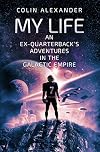
The titles of some books tell you all you need to know. Consider Colin Alexander’s My Life: An Ex-Quarterback’s Adventures in the Galactic Empire. Danny Troy is a perennial second-string quarterback in the NFL. He has had a few moments of glory, but mostly, he has been the guy on the sideline with a clipboard. It was for him a slacker’s life of easy money and easy women. When an affair with the wrong woman gets him framed as a drug dealer, he goes on the lam. A seedy-looking biker in a show more dive bar rescues him from an attempted mugging and offers him a job—as a space pirate. It seems there is an underground depot for space pirates in South Dakota. Danny is off on an old-fashioned interstellar adventure. Danny’s first-person narration makes us care about what happens to him, but the space opera is no better than average. 3.5 stars. show less
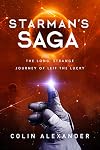
Leif Grettison, the hero of Colin Alexander’s Starman’s Saga, is an ex-military helicopter pilot working as a civilian EMT. He is at loose ends when he is told he has won a lottery to become a crewman on humanity’s first interstellar mission. He is the only non-specialist on the crew and expects to spend his time as a supercargo taking selfies. Naturally, by the time the plot gets going, he is the most competent guy on the ship. Leif is a likable character, but the mission he joins is show more a mess. The ship is supposed to carry the best and brightest, but most of their concerns are narrowly political or racist. I might read one more of this series, but I am not sure how much to expect. 3 stars. show less

Leif and his adopted sun trek across postapocalyptic America to Earthbase because they heard that the old spaceport had received a signal from an alien source. They find the community around the base divided into feuding clans, anything but ready to launch an interstellar mission.
That Leif is known as lucky does not mean that his luck is contagious, and a reader should be warned that Alexander has a noir vision of our space-faring future.
That Leif is known as lucky does not mean that his luck is contagious, and a reader should be warned that Alexander has a noir vision of our space-faring future.
Statistics
- Works
- 36
- Members
- 107
- Popularity
- #180,614
- Rating
- 3.2
- Reviews
- 7
- ISBNs
- 49
- Favorited
- 1