
Tom Ang
Author of Digital Photographer's Handbook
About the Author
Freelance photographer, and senior lecturer in photographic practice and course leader of BA (Hons) Photography and Multimedia (part-time) in the School of Communication, Design & Media at the University of Westminster. 050
Image credit: Amazon
Series
Works by Tom Ang
Fundamentals of Photography: The Essential Handbook for Both Digital and Film Cameras (2008) 113 copies, 2 reviews
Advanced Digital Photography: Techniques and Tips for Creating Professional Quality Images (2003) 54 copies
The Art of Digital Photography: A Step-By-Step Guide to Creating and Manipulating Great Images (1999) 30 copies, 1 review
Dictionary of Photography and Digital Imaging: The Essential Reference for the Modern Photograher (2001) 17 copies
Shoot Your Own Erotic Photographs: Create a Sensual Private Album Using Your Digital Camera (2006) 5 copies
Le Guide de la photographie numérique : De la prise du vue au traitement de l'image (French Edition) (2003) 2 copies
Bonniers stora bok om digitalfoto : [kom igång, bemästra tekniken, fånga motivet, förbättra dina bilder, filma i HD, redigera foto och film] (2012) 2 copies
Tagged
Common Knowledge
- Birthdate
- 1952
- Gender
- male
- Education
- University of London (University College, BA- Philosophy)
- Organizations
- National Union of Journalists
Royal Geographical Society - Nationality
- Singapore
UK - Birthplace
- Singapore
- Places of residence
- Singapore
UK
New Zealand - Associated Place (for map)
- Singapore
Members
Reviews
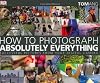
In preparation for my sister-in-law's wedding, and in a general attempt to improve my photographic skill, I decided to start borrowing books on photography from the library. With a title like How to Photograph Absolutely Everything, I figured Tom Ang’s book was a decent place to start.
For a new photographer, this book is extremely helpful. It gives tips on a broad variety of photographic subjects; pointers for weddings, portraits, children, vacation photos, and more. At the beginning of show more each section, Ang also gives some suggestions for camera settings to capture a given subject type. What’s more, the book is filled with large, full color photos to reinforce the tips.
However, if you’re anything other than a new photographer, this book might not be as helpful. It becomes clear rather quickly that this book is geared towards users with little experience, as the suggested camera settings at the beginning of each new section are often as simple as “use landscape mode on your camera.” As far as content goes, it gives a few pointers for each topic, but due to the broad nature of the book, lacks depth on any given subject. And while the book seems aimed at the newer, less experienced photographer, it doesn’t really cover the basics of photography.
What I would have loved to have seen was something a bit more informative as far as settings go. Perhaps including the EXIF data on sample pictures, so the reader has a better starting point. Or ignore the “camera mode” and stick to suggestions for aperture, shutter, focal length and sensitivity.
Overall, I think this book would make a lovely coffee table book, as the photos are quite lovely, and make up the bulk of the book. I might recommend it to a new digital photographer, or a film photographer just making the switch to digital. If you’re looking for a general reference book that is more inspiration than reference, this is probably the book for you. However, if you want more in depth information on any given subject matter, I’d keep looking. show less
For a new photographer, this book is extremely helpful. It gives tips on a broad variety of photographic subjects; pointers for weddings, portraits, children, vacation photos, and more. At the beginning of show more each section, Ang also gives some suggestions for camera settings to capture a given subject type. What’s more, the book is filled with large, full color photos to reinforce the tips.
However, if you’re anything other than a new photographer, this book might not be as helpful. It becomes clear rather quickly that this book is geared towards users with little experience, as the suggested camera settings at the beginning of each new section are often as simple as “use landscape mode on your camera.” As far as content goes, it gives a few pointers for each topic, but due to the broad nature of the book, lacks depth on any given subject. And while the book seems aimed at the newer, less experienced photographer, it doesn’t really cover the basics of photography.
What I would have loved to have seen was something a bit more informative as far as settings go. Perhaps including the EXIF data on sample pictures, so the reader has a better starting point. Or ignore the “camera mode” and stick to suggestions for aperture, shutter, focal length and sensitivity.
Overall, I think this book would make a lovely coffee table book, as the photos are quite lovely, and make up the bulk of the book. I might recommend it to a new digital photographer, or a film photographer just making the switch to digital. If you’re looking for a general reference book that is more inspiration than reference, this is probably the book for you. However, if you want more in depth information on any given subject matter, I’d keep looking. show less
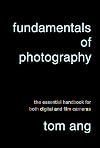
Tom Ang’s Fundamentals of Photography is aptly subtitled “the essential handbook for both digital and film cameras.” As a very amateur photographer, I was fascinated by the technical explanations for photography: how cameras work, how light is best captured, and how to process photographs appealingly. While I will never again photograph using film cameras, I was likewise fascinated to learn the technical aspects of film photography. For, just as Tom Ang seamlessly wove both film and show more digital photography together throughout his handbook, understanding how film photography works should be seamlessly tied to understanding the tools available to a digital photographer. I am convinced that understanding film technology (of which I was woefully ignorant) will help me in my digital processes.
Fundamentals of Photography is a dense book, full of technical terms, explanations, and diagrams. As such, it was challenging to read it cover to cover. Besides, it was a new book at the library, so I had a three-week time limit, which made it all the more challenging. I would have loved to study it over the course of an entire semester in school or maybe during my lifetime - for there are so many details within it that were unfamiliar to me. Despite the difficulty, reading it was incredibly rewarding.
More detailed review on my blog show less
Fundamentals of Photography is a dense book, full of technical terms, explanations, and diagrams. As such, it was challenging to read it cover to cover. Besides, it was a new book at the library, so I had a three-week time limit, which made it all the more challenging. I would have loved to study it over the course of an entire semester in school or maybe during my lifetime - for there are so many details within it that were unfamiliar to me. Despite the difficulty, reading it was incredibly rewarding.
More detailed review on my blog show less
A great beginner overview of photography (both film and digital). It covers everything from what light is to how CCDs and film differ to the different types of lens and how they work. It even spends a few chapters on the post-processing of photos such as scanning, developing, enlarging and archiving. I was especially happy to see some top level discussions on basic optical principles like diffraction, aberrations, MTF and sampling. I would have liked to see more discussion on composition and show more the artistic side of photography; this book deals mostly with the technical aspects. show less
How to photograph absolutely everything : Introduction to photography : successful pictures from your digital camera by Tom Ang

Thorougly effective introduction to digital photography, this extract of the first chapter from Ang's book is a self-contained bite that covers all the bases clearly with apposite ilustrations from a master photographer.
Lists
Awards

You May Also Like


Statistics
- Works
- 88
- Members
- 2,733
- Popularity
- #9,399
- Rating
- 3.6
- Reviews
- 11
- ISBNs
- 243
- Languages
- 17
- Favorited
- 1