
Bryan Peterson
Author of Understanding Exposure
About the Author
Image credit: Babelio
Works by Bryan Peterson
Learning to See Creatively: Design, Color & Composition in Photography (Updated Edition) (2003) 531 copies, 5 reviews
Understanding Shutter Speed: Creative Action and Low-Light Photography Beyond 1/125 Second (2008) 177 copies, 1 review
Bryan Peterson's Understanding Photography Field Guide: How to Shoot Great Photographs with Any Camera (2009) 169 copies, 1 review
Understanding Close-Up Photography: Creative Close Encounters with Or Without a Macro Lens (2009) 143 copies
Learning to See Creatively, Third Edition: Design, Color, and Composition in Photography (2015) 74 copies, 3 reviews
Understanding Flash Photography: How to Shoot Great Photographs Using Electronic Flash (2011) 64 copies
Bryan Peterson's Understanding Composition Field Guide: How to See and Photograph Images with Impact (2012) 45 copies, 1 review
Bryan Peterson's Exposure Solutions: The Most Common Photography Problems and How to Solve Them (2012) 45 copies
Understanding Color in Photography: Using Color, Composition, and Exposure to Create Vivid Photos (2017) 35 copies, 2 reviews
Tagged
Common Knowledge
- Birthdate
- 1952
- Gender
- male
- Places of residence
- Orlando, Florida, USA
- Map Location
- USA
Members
Reviews
Learning to See Creatively, Third Edition: Design, Color, and Composition in Photography by Bryan Peterson
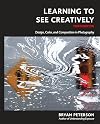
Useful for Beginners and Pros Alike
(Full disclosure: I received a free book for review through Blogging for Books.)
Originally published in 1988 and revised in 2003, the third edition of Bryan Peterson's Learning to See Creatively is all-new, completely rewritten and re-illustrated, with a brand new section on Photoshop. This is my first Peterson book but, judging from some of the other reviews, he seems to be a well-known and respected photography author and instructor.
And it's easy to see show more why: Learning to See Creatively is accessible and well-written, with a positive, can-do attitude and plenty of helpful illustrations and activities to help get those creative juices flowing. Peterson frequently includes photos of the same subject, taken from multiple angles and perspectives and with different composition and framing, to give the reader an idea of what works - and what works better. (His eight-photo spread of the Dutch windmill is my favorite use of this technique.) There's a decided emphasis on personal vision with creative exercises to help you find your own.
The book's divided into five sections, which you can either browse or read straight through. "Expanding Your Vision" challenges the reader to think about what you see - vs. what your camera sees. There's also an excellent primer on choosing the right camera lens for the job. The "Elements of Design" introduces us to line, shape, form, texture, pattern, and color, exploring how they work in harmony - and how we can best coax them into working for us. "Composition" covers everything from the basics (horizontal vs. vertical orientation; the rule of thirds; contrast) to more advanced topics (working your subject; breaking the rules). Last but not least are the chapters on "The Magic of Light" (direction, color, overcast and rainy days) and "Photoshop."
Peterson includes a fair amount of technical detail, including information on the camera and settings used to take each picture. While the more advanced stuff made my beginner's head spin, I wouldn't steer newbies clear of this book: the many lovely photos offer readers new and exciting ways of approaching photography. From portraits to landscapes to abstract macro artwork and tourist attractions that have been done to death, examples run the gamut and provide a wealth of inspiration.
Professionals might find some of Peterson's views controversial (he's pro-staging and pro-Photoshop - as long as it doesn't make you lazy IRL), but being a beginner, I didn't really see the big deal. Live and let live. Unless you're a photojournalist, then staging becomes a little more problematic, methinks.
My only caveat: if you like what you see re: Photoshop, don't begin and end with the last chapter. Definitely pick up a dedicated Photoshop guide (or two) in order to get the most of it.
http://www.easyvegan.info/2015/08/24/learning-to-see-creatively-third-edition-by... show less
(Full disclosure: I received a free book for review through Blogging for Books.)
Originally published in 1988 and revised in 2003, the third edition of Bryan Peterson's Learning to See Creatively is all-new, completely rewritten and re-illustrated, with a brand new section on Photoshop. This is my first Peterson book but, judging from some of the other reviews, he seems to be a well-known and respected photography author and instructor.
And it's easy to see show more why: Learning to See Creatively is accessible and well-written, with a positive, can-do attitude and plenty of helpful illustrations and activities to help get those creative juices flowing. Peterson frequently includes photos of the same subject, taken from multiple angles and perspectives and with different composition and framing, to give the reader an idea of what works - and what works better. (His eight-photo spread of the Dutch windmill is my favorite use of this technique.) There's a decided emphasis on personal vision with creative exercises to help you find your own.
The book's divided into five sections, which you can either browse or read straight through. "Expanding Your Vision" challenges the reader to think about what you see - vs. what your camera sees. There's also an excellent primer on choosing the right camera lens for the job. The "Elements of Design" introduces us to line, shape, form, texture, pattern, and color, exploring how they work in harmony - and how we can best coax them into working for us. "Composition" covers everything from the basics (horizontal vs. vertical orientation; the rule of thirds; contrast) to more advanced topics (working your subject; breaking the rules). Last but not least are the chapters on "The Magic of Light" (direction, color, overcast and rainy days) and "Photoshop."
Peterson includes a fair amount of technical detail, including information on the camera and settings used to take each picture. While the more advanced stuff made my beginner's head spin, I wouldn't steer newbies clear of this book: the many lovely photos offer readers new and exciting ways of approaching photography. From portraits to landscapes to abstract macro artwork and tourist attractions that have been done to death, examples run the gamut and provide a wealth of inspiration.
Professionals might find some of Peterson's views controversial (he's pro-staging and pro-Photoshop - as long as it doesn't make you lazy IRL), but being a beginner, I didn't really see the big deal. Live and let live. Unless you're a photojournalist, then staging becomes a little more problematic, methinks.
My only caveat: if you like what you see re: Photoshop, don't begin and end with the last chapter. Definitely pick up a dedicated Photoshop guide (or two) in order to get the most of it.
http://www.easyvegan.info/2015/08/24/learning-to-see-creatively-third-edition-by... show less
Understanding Exposure: How to Shoot Great Photographs with a Film or Digital Camera by Bryan Peterson
After just having read "The Photographer's Eye", a book so dense I couldn't consume more than four pages or so per day, I started "Understanding Exposure"—and read it in just a couple of days. Not because I liked it so much, but because it just didn't contain that much information.
The author is implicitly assuming that your main goal is slow-paced, methodical landscape photography. He literally scoffs at you for not carrying your tripod everywhere, for not using a full-frame camera, or for show more using any kind of automation. If you're not shooting everything in manual, at base ISO, you are not a real photographer, he seems to say.
So take out your light meter, go to manual exposure, and switch off your autofocus, or this book is probably not for you. It was certainly not for me. As an amateur, I don't have infinite time to set up the perfect shot, and wait for the perfect dawn light. I even like to—gasp—use auto-ISO, -focus, and -white balance.
There is a lot of good information, and practical wisdom in this book, if you can read between the lines, ignore scores of irrelevant descriptions of camera settings, and generally translate knowledge from the film days to your modern camera. I just wish it were updated to account for modern technology, and didn't come off quite as condescendingly as it does. show less
The author is implicitly assuming that your main goal is slow-paced, methodical landscape photography. He literally scoffs at you for not carrying your tripod everywhere, for not using a full-frame camera, or for show more using any kind of automation. If you're not shooting everything in manual, at base ISO, you are not a real photographer, he seems to say.
So take out your light meter, go to manual exposure, and switch off your autofocus, or this book is probably not for you. It was certainly not for me. As an amateur, I don't have infinite time to set up the perfect shot, and wait for the perfect dawn light. I even like to—gasp—use auto-ISO, -focus, and -white balance.
There is a lot of good information, and practical wisdom in this book, if you can read between the lines, ignore scores of irrelevant descriptions of camera settings, and generally translate knowledge from the film days to your modern camera. I just wish it were updated to account for modern technology, and didn't come off quite as condescendingly as it does. show less
This is the best photography book I've ever read. I've read several books over the years about photography, but most have been three times as thick and one-tenth as practical as this one. This is a very down-to-earth guide on what effects exposure and how to use it creatively. The author doesn't bore you with a lot of technical rubbish you never wanted to know (that bores even a tech-head like me) and he doesn't lecture you on what makes a good photograph(er). He simply tells you how to show more manipulate film, shutter speed, and aperture to achieve what you want and shows you comparative samples of what happens as you manipulate each element. show less
Understanding Exposure: How to Shoot Great Photographs with a Film or Digital Camera (Updated Edition) by Bryan Peterson
This was recommended to me in an online photography course I'm taking. Very clear explanations of the "triangle" of exposure (aperture, shutter speed, ISO) and how to use them together (along with light and metering) to get not just correct but also creative photos. Offers occasional exercises as well as explanations of the included photos.
So far, very useful, helpful, inspiring.
So far, very useful, helpful, inspiring.
Lists
You May Also Like


Statistics
- Works
- 37
- Members
- 3,394
- Popularity
- #7,509
- Rating
- 4.1
- Reviews
- 34
- ISBNs
- 84
- Languages
- 9
- Favorited
- 2