
Tom M. Apostol (1923–2016)
Author of Calculus, Vol. 1: One-Variable Calculus, with an Introduction to Linear Algebra
About the Author
Image credit: Tom Mike Apostol
Series
Works by Tom M. Apostol
Calculus, Vol. 1: One-Variable Calculus, with an Introduction to Linear Algebra (1967) 346 copies, 4 reviews
Calculus, Vol. 2: Multi-Variable Calculus and Linear Algebra with Applications (1962) 297 copies, 3 reviews
Mathematical Analysis, Second Edition 26 copies
A Century of Calculus: Part I 1894-1968 (The Raymond W Brink Selected Mathematical Papers) (1972) 21 copies
An introduction to integral and differential calculus, (Notes for freshman mathematics) (1958) 1 copy
Sines and cosines. Part I 1 copy
Calcolo. Vol. I: Analisi 1 1 copy
Introductory differential equations, vector algebra, and analytic geometry, (Notes for freshman mathematics) (1959) 1 copy
Calculus. Volumen 2 1 copy
The mean value theorem and its applications, infinite sequences and infinite series, (Notes for freshman mathematics) (1959) 1 copy
Tagged
Common Knowledge
- Legal name
- Apostol, Tom Mike
- Birthdate
- 1923
- Date of death
- 2016
- Gender
- male
- Education
- University of Washington
University of California, Berkeley - Organizations
- University of California, Berkeley
Massachusetts Institute of Technology
California Institute of Technology - Awards and honors
- Trevor Evans Award (1998)
Member of the Academy of Athens (2001)
Lester R. Ford Award (2005)
Lester R. Ford Award (2008) - Nationality
- USA
- Associated Place (for map)
- USA
Members
Reviews

Where are the zeros of zeta of s?
G.F.B. Riemann has made a good guess;
They’re all on the critical line, saith he,
And their density’s one over 2pi log t.
This statement of Riemann’s has been like a trigger
And many good men, with vim and with vigor,
Have attempted to find, with mathematical rigor,
What happens to zeta as mod t gets bigger.
The efforts of Landau and Bohr and Cramer,
And Littlewood, Hardy and Titchmarsh are there,
In spite of their efforts and skill and finesse,
In locating the show more zeros there’s been little success.
In 1914 G.H. Hardy did find,
An infinite number that lay on the line,
His theorem however, won’t rule out the case,
There might be a zero at some other place.
Let P be the function of pi minus li,
The order of P is not known for x high,
If square root of x times log x we could show,
Then Riemann’s conjecture would surely be so.
Related to this is another enigma,
Concerning the Lindelof function mu (sigma)
Which measures the growth in the critical strip,
On the number of zeros it gives us a grip.
But nobody knows how this function behaves,
Convexity tells us it can have no waves,
Lindelof said that the shape of its graph,
Is constant when sigma is more than one-half.
Oh, where are the zeros of zeta of s?
We must know exactly, we cannot just guess,
In order to strengthen the prime number theorem,
The integral’s contour must not get too near ‘em. show less
G.F.B. Riemann has made a good guess;
They’re all on the critical line, saith he,
And their density’s one over 2pi log t.
This statement of Riemann’s has been like a trigger
And many good men, with vim and with vigor,
Have attempted to find, with mathematical rigor,
What happens to zeta as mod t gets bigger.
The efforts of Landau and Bohr and Cramer,
And Littlewood, Hardy and Titchmarsh are there,
In spite of their efforts and skill and finesse,
In locating the show more zeros there’s been little success.
In 1914 G.H. Hardy did find,
An infinite number that lay on the line,
His theorem however, won’t rule out the case,
There might be a zero at some other place.
Let P be the function of pi minus li,
The order of P is not known for x high,
If square root of x times log x we could show,
Then Riemann’s conjecture would surely be so.
Related to this is another enigma,
Concerning the Lindelof function mu (sigma)
Which measures the growth in the critical strip,
On the number of zeros it gives us a grip.
But nobody knows how this function behaves,
Convexity tells us it can have no waves,
Lindelof said that the shape of its graph,
Is constant when sigma is more than one-half.
Oh, where are the zeros of zeta of s?
We must know exactly, we cannot just guess,
In order to strengthen the prime number theorem,
The integral’s contour must not get too near ‘em. show less
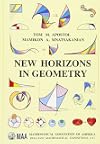
The arguments and theorems presented are genuinely done in the style of classical geometry, with lots and lots of necessary, illuminating, colorful diagrams. Many of the statements are surprisingly simple, but deceptively so: the proofs are intuitive, but require true insight into both geometry and differential geometry. This is a well done presentation of new results, and every student of geometry and analysis should read through it at least once.
My two volumes of Apostol originally belonged to my father. Once when I was about twelve I tried to learn the sigma summation notation from the beginning of the first volume and got confused, but all things in due time I suppose. I've never read either of these books and hold onto them for sentimental reasons. Nevertheless, they appear to be perfectly good introductory calculus textbooks.
Calculus, Vol. 1: One-Variable Calculus with an Introduction to Linear Algebra (Second Edition) by Tom M. Apostol
My two volumes of Apostol originally belonged to my father. Once when I was about twelve I tried to learn the sigma summation notation from the beginning of the first volume and got confused, but all things in due time I suppose. I've never read either of these books and hold onto them for sentimental reasons. Nevertheless, they appear to be perfectly good introductory calculus textbooks.
Lists
You May Also Like


Statistics
- Works
- 35
- Members
- 1,249
- Popularity
- #20,539
- Rating
- 4.1
- Reviews
- 13
- ISBNs
- 67
- Languages
- 4