
Yoshitaka Amano
Author of The Sandman: The Dream Hunters [Novella]
About the Author
Image credit: Luthwyhn
Series
Works by Yoshitaka Amano
Yoshitaka Amano Maten Acryl Watercolor Pen and Ink (in Japanese) (Japanese Edition) (1984) 13 copies
Amano Tarot Deck: Finding Happiness with Tarot Fortune-Telling (Shiwase o Tsukamu Tarot Uranai: Amano Yoshitaka Originaru Kaado 78 Mai) (in Japanese) (2002) 12 copies
Genmukyu (Genmukyu) (in Japanese) 9 copies
Yoshitaka Amano: The Illustrated Biography Beyond the Fantasy Limited Edition (2018) — Illustrator — 8 copies
The Return of the Thin White Duke 4 copies
Princess Grape (Japanese Edition) 2 copies
COLLECTED PAINTINGS OF AMANO'S WORLD 2 copies
Nippon Evolution 1 copy
THINK LIKE AMANO 1 copy
Think Like Amano 1 copy
Think like Amano 1 copy
Katen 1 copy
Associated Works
Hawkmoon: The History of the Runestaff (1969) — Cover artist, some editions — 974 copies, 12 reviews
Vampire Hunter D Volume 25: Undead Island — Illustrator — 1 copy
Tagged
Common Knowledge
- Birthdate
- 1952-06-28
- Gender
- male
- Occupations
- artist
character designer
illustrator - Awards and honors
- Seiun Award
Dragon Con Award
Julie Award - Nationality
- Japan
- Birthplace
- Shizuoka City, Japan
- Places of residence
- Shizuoka City, Japan (born)
- Associated Place (for map)
- Shizuoka City, Japan
Members
Reviews
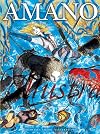
I love art books, but damn do they make me want to either create more myself or get my hands on even more of the artist’s work - both challenging endeavors considering my continual lack of time, the expense of art books, and my out of control TBR. Yoshitaka Amano is definitely one of those artists that I adore, but who I need to spend copious more time with, since his art is the perfect blend of lovely technique and strange intrigue. This slim volume feels like the most delicate taster of show more his work, even though it does cover a solid breadth of his artistic range and includes a hefty interview/discussion. Included are design concepts for his work with the Final Fantasy franchise, examples of his nocturnal style for Vampire Hunter D, and an adorable scattering of vegetable fairies from his sojourn in New York City - which may just be my new obsession. How can you resist the cuteness of these minute characters! While I am predictably annoyed that the book is going to be a bit of a challenge to track down in real life, I am infinitely glad that Amano’s editor bullied him into giving these sketches a proper life and story in a finished book - and that I got to meet them briefly in this overview volume. show less
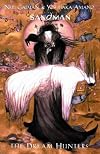
The Sandman, as written by Neil Gaiman and penciled and inked by a phenomonal cast (Sam Keith, Mike Dringenberg, and so many more) has a justified place in the list of all-time greatest works in comic book history. We can and should revise our assessment of art when the artist has failed us, but the experience of Sandman is a work of many hearts, all of them carrying their own secret pain, and one of them is me.
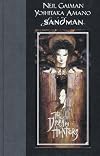
If I remember right, this is Neil Gaiman's first return to The Sandman after the series concluded its venerable run. It's not a comic book, but a prose novella with illustrations on almost every page. And it's brilliant-- possibly the second-best Sandman story after Brief Lives. It's a fairy tale in a vaguely Japenese style about a monk and the fox who loves him. Like many Gaiman stories, it doesn't know what its focus is, but that works so well here, as the story gently drifts from tangent show more to tangent, showing love at its best and its worse. The illustrations by Yoshitaka Amano are gorgeous, and invite the eye to linger over them slowly. It's hard to explain why I liked this so much; it just hits that primal nerve good stories should hit-- you feel like you've learned something new that you've always known.
Neil Gaiman's The Sandman Spin-Offs: « Previous in sequence | Next in sequence » show less
Neil Gaiman's The Sandman Spin-Offs: « Previous in sequence | Next in sequence » show less

3 years after the Sandman called it quits, and just over 10 years after issue #1 hit the stands, the Dream Hunters was the best return the King of All Night's Dreaming could've asked for.
[N.B. This review includes images, and was formatted for my site, dendrobibliography -- located here.]
I was nervous about this story: It's structure is a departure for the Dreaming, being a novella with accompanying illustrations instead of a 'comic book.' I didn't expect it could capture Dream's trademark show more twinkle nearly so well--and I was wrong. This is the Sandman, and it's one of Dream's most powerful stories. Gaiman spent years evoking the style of myths of all colors to tell stories about--well--stories, and this is him exercising that experience to pay homage to Japanese and Chinese folklore.*
This isn't a continuation of the original series, either, making it a safe read for new-comers. The nods are there--and satisfying--but they're unimportant to the story itself. The Dream Hunters is all Morpheus and his fatal hubris from beginning to end. He guides two potential lovers, a fox-spirit and a monk, to care for one another despite their doomed situation. Theirs is a sly, sad defense of forbidden love only Morpheus could deliver.
The illustrations decorating every other page were provided by Yoshitaka Amano, best known for his iconic Final Fantasy artwork. Amano's simple, yet complex images go hand-in-hand with Gaiman's prose. They're both detached and maybe a bit cold in the same fairy-tale way, gently carrying a story for any time and as old as time to the reader. His pencil lines are sparse, but still provide fine details to strike humanity in his characters. (& his ethereal style captures the '80s goth-punk vibe of Morpheus' (contextually-ridiculous) figure so well!)
I loved it. It was sad, tender, cute 'n' sweet, and oh-so-powerful: The best collaboration you could want from these two artists.
*The Dream Hunters has a Japanese flavor. Gaiman cites a collection (pub. 1908) of Japanese myths by Yei Theodora Ozaki as the source (with minimal alterations to fit in with the Dreaming) in the afterword. He was wrong, for whatever reason; it's source is Pu Songling (c. 1700) of the Qing Dynasty--though how similar it is, I have no idea. show less
[N.B. This review includes images, and was formatted for my site, dendrobibliography -- located here.]
I was nervous about this story: It's structure is a departure for the Dreaming, being a novella with accompanying illustrations instead of a 'comic book.' I didn't expect it could capture Dream's trademark show more twinkle nearly so well--and I was wrong. This is the Sandman, and it's one of Dream's most powerful stories. Gaiman spent years evoking the style of myths of all colors to tell stories about--well--stories, and this is him exercising that experience to pay homage to Japanese and Chinese folklore.*
This isn't a continuation of the original series, either, making it a safe read for new-comers. The nods are there--and satisfying--but they're unimportant to the story itself. The Dream Hunters is all Morpheus and his fatal hubris from beginning to end. He guides two potential lovers, a fox-spirit and a monk, to care for one another despite their doomed situation. Theirs is a sly, sad defense of forbidden love only Morpheus could deliver.
The illustrations decorating every other page were provided by Yoshitaka Amano, best known for his iconic Final Fantasy artwork. Amano's simple, yet complex images go hand-in-hand with Gaiman's prose. They're both detached and maybe a bit cold in the same fairy-tale way, gently carrying a story for any time and as old as time to the reader. His pencil lines are sparse, but still provide fine details to strike humanity in his characters. (& his ethereal style captures the '80s goth-punk vibe of Morpheus' (contextually-ridiculous) figure so well!)
I loved it. It was sad, tender, cute 'n' sweet, and oh-so-powerful: The best collaboration you could want from these two artists.
*The Dream Hunters has a Japanese flavor. Gaiman cites a collection (pub. 1908) of Japanese myths by Yei Theodora Ozaki as the source (with minimal alterations to fit in with the Dreaming) in the afterword. He was wrong, for whatever reason; it's source is Pu Songling (c. 1700) of the Qing Dynasty--though how similar it is, I have no idea. show less
Lists
Awards


You May Also Like


Associated Authors
Statistics
- Works
- 83
- Also by
- 12
- Members
- 4,784
- Popularity
- #5,251
- Rating
- 4.1
- Reviews
- 74
- ISBNs
- 106
- Languages
- 10
- Favorited
- 8