
About the Author
Image credit: Universidad Panamericana
Works by André Laks
Early Greek Philosophy, Volume III: Early Ionian Thinkers, Part 2 (Loeb Classical Library) (2016) 54 copies, 1 review
Early Greek Philosophy, Volume II: Beginnings and Early Ionian Thinkers, Part 1 (Loeb Classical Library) (2016) 49 copies, 2 reviews
Early Greek Philosophy, Volume V: Western Greek Thinkers, Part 2 (Loeb Classical Library) (2016) 46 copies
Early Greek Philosophy, Volume VI: Later Ionian and Athenian Thinkers, Part 1 (Loeb Classical Library) (2016) 40 copies
Early Greek Philosophy, Volume IV: Western Greek Thinkers, Part 1 (Loeb Classical Library) (2016) 35 copies
Early Greek Philosophy, Volume I: Introductory and Reference Materials (Loeb Classical Library) (2016) 34 copies, 1 review
Early Greek Philosophy, Volume VIII: Sophists, Part 1 (Loeb Classical Library) (2016) 32 copies, 1 review
Early Greek Philosophy, Volume VII: Later Ionian and Athenian Thinkers, Part 2 (Loeb Classical Library) (2016) 32 copies, 1 review
Early Greek Philosophy, Volume IX: Sophists, Part 2 (Loeb Classical Library) (2016) 29 copies, 1 review
Traditions of Theology: Studies in Hellenistic Theology : Its Background and Aftermath (Philosophia Antiqua) (2001) — Editor — 8 copies
Associated Works
The Cambridge History of Greek and Roman Political Thought (2000) — Contributor — 81 copies, 2 reviews
Presocratic philosophy : essays in honour of Alexander Mourelatos (2002) — Contributor — 5 copies, 1 review
Hesiod and the Beginnings of Greek Philosophy (Mnemosyne Supplements: Monographs on Greek and Latin Language and Literature, 455) (2022) — Contributor — 4 copies
Freedom, Reason, and the Polis: Essays in Ancient Greek Political Philosophy (2007) — Contributor — 3 copies
Métaphysique — Translator, some editions — 3 copies
Utopia, ancient and modern : contributions to the history of a political dream (2012) — Contributor — 1 copy
La philosophie qui vient (Le Débat : histoire, politique, société, n° 72, novembre-décembre 1992) (1992) — Contributor — 1 copy
Euphrosyne: Studies in Ancient Philosophy, History, and Literature (Beiträge zur Altertumskunde, 370) (2020) — Contributor — 1 copy
Tagged
Common Knowledge
- Canonical name
- Laks, André
- Birthdate
- 1950-05-28
- Gender
- male
Members
Reviews
Early Greek Philosophy, Volume VII: Later Ionian and Athenian Thinkers, Part 2 (Loeb Classical Library) by André Laks
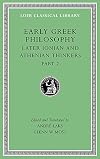
This seventh volume of the Loeb Classical Library's collection of Presocratic Greek philosophy is entirely dedicated to the original Atomists, Leucippus and Democritus. Practically, this means it's all Democritus, given that even among the ancients there was doubt whether or not Leucippus even existed; scholars today still debate this.
Regardless, Democritus's theory of Atomism is the closest the ancients got to our contemporary Western cosmology. His great innovation was to accept the show more Parmenidean challenge to the reliability of our senses by theorizing reality as a vast void filled with eternally moving particles, alternately bouncing off each other or catching hold of each other to generate gigantic aggregates that we sense (incorrectly) as the real world.
Democritus had no conception of atomic forces of attraction and repulsion, which gave the Aristotelians ground to bury his innovations beneath incisive criticisms of his inability to explain why anything happens. However, it's fascinating that despite the significant differences between ancient Atomism and modern physics, much of what Democritus wrote on the basis of sheer reason still resonates with our current conception of physical reality. His thought spawned the Epicureanism of the Hellenistic and Roman periods, as well as a vast pseudepigraphical literature; and his moral and political aphorisms still entertain 2,400 years after his death. There's ample reason to given over an entire volume solely to the remains of his writing. show less
Regardless, Democritus's theory of Atomism is the closest the ancients got to our contemporary Western cosmology. His great innovation was to accept the show more Parmenidean challenge to the reliability of our senses by theorizing reality as a vast void filled with eternally moving particles, alternately bouncing off each other or catching hold of each other to generate gigantic aggregates that we sense (incorrectly) as the real world.
Democritus had no conception of atomic forces of attraction and repulsion, which gave the Aristotelians ground to bury his innovations beneath incisive criticisms of his inability to explain why anything happens. However, it's fascinating that despite the significant differences between ancient Atomism and modern physics, much of what Democritus wrote on the basis of sheer reason still resonates with our current conception of physical reality. His thought spawned the Epicureanism of the Hellenistic and Roman periods, as well as a vast pseudepigraphical literature; and his moral and political aphorisms still entertain 2,400 years after his death. There's ample reason to given over an entire volume solely to the remains of his writing. show less
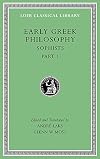
In the final two volumes of Laks's and Most's fine collection of Presocratic fragments and testimonia, they cover the sprawling set of thinkers collectively known as the Sophists. Thanks largely to Plato, these expensive itinerant teachers still have a bad reputation today, to the point that we label it 'sophistry' when someone argues in a way we find skillful but disingenuous. I leave it to the reader to decide if Plato's disgust for their fluid morality is justified or not, but these are show more the first Greek thinkers to devote lengthy treatises not to speculation on the natural world, but to subjects we would recognize today as philosophy: truth, morality, and the power of language.
This first volume includes selections of Protagoras and Gorgias, the two most well-known sophists with the largest extant collection of surviving texts and summaries. Protagoras as transmitted by Plato is an early proponent of relativism, arguing that truth is a matter of perception, and therefore that an individual's perception of truth is objectively correct for that person. Gorgias's interests lay more in rhetoric as represented by his surviving works, including a parody of Eleatic argumentation in which he uses their methods to prove that nothing exists; and a defense of Helen of Troy, in which he displays the power of rhetoric by arguing that regardless of why Helen went to Troy with Paris, she can't be held morally accountable for her action or its destructive results.
This volume also includes selections of the lesser-known but influential sophists Prodicus, Thrasymachus, and Hippias. Interestingly, Laks and Most also made the decision to include Socrates in this collection of "Presocratic" sophists. Their argument makes sense, since despite significant differences from the sophists — especially his disinterest in money and his devotion to discovering absolute and concrete righteousness rather than displaying and profiting from his skill — Socrates used many of the same rhetorical devices and shared many of the same interests. Socrates usually gets left out of accounts of the sophists, but I agree with Laks and Most that it makes sense to include him; and the reader's understanding of the Father of Western Philosophy is enriched when set against the background of the sophists with whom he sparred in his all-consuming quest for the truth about everything. show less
This first volume includes selections of Protagoras and Gorgias, the two most well-known sophists with the largest extant collection of surviving texts and summaries. Protagoras as transmitted by Plato is an early proponent of relativism, arguing that truth is a matter of perception, and therefore that an individual's perception of truth is objectively correct for that person. Gorgias's interests lay more in rhetoric as represented by his surviving works, including a parody of Eleatic argumentation in which he uses their methods to prove that nothing exists; and a defense of Helen of Troy, in which he displays the power of rhetoric by arguing that regardless of why Helen went to Troy with Paris, she can't be held morally accountable for her action or its destructive results.
This volume also includes selections of the lesser-known but influential sophists Prodicus, Thrasymachus, and Hippias. Interestingly, Laks and Most also made the decision to include Socrates in this collection of "Presocratic" sophists. Their argument makes sense, since despite significant differences from the sophists — especially his disinterest in money and his devotion to discovering absolute and concrete righteousness rather than displaying and profiting from his skill — Socrates used many of the same rhetorical devices and shared many of the same interests. Socrates usually gets left out of accounts of the sophists, but I agree with Laks and Most that it makes sense to include him; and the reader's understanding of the Father of Western Philosophy is enriched when set against the background of the sophists with whom he sparred in his all-consuming quest for the truth about everything. show less
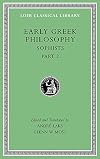
In the final two volumes of Laks's and Most's fine collection of Presocratic fragments and testimonia, they cover the sprawling set of thinkers collectively known as the Sophists. Thanks largely to Plato, these expensive itinerant teachers still have a bad reputation today, to the point that we label it 'sophistry' when someone argues in a way we find skillful but disingenuous. I leave it to the reader to decide if Plato's disgust for their fluid morality is justified or not, but these are show more the first Greek thinkers to devote lengthy treatises not to speculation on the natural world, but to subjects we would recognize today as philosophy: truth, morality, and the power of language.
This second volume closes out the series with selections from the lesser-known sophistic lights of Antiphon, Lycophron, and Xeniades; as well as surviving texts of Iamblichus's Anonymous and the Dissoi Logoi ("Pairs of Arguments"), which offer in compressed form fine examples of late-stage Greek philosophy before the double punch of Plato and Aristotle transformed Western philosophy forever. In my opinion, the best part of this final volume is the appendix of selections from Greek comedy and tragedy, which offer examples of how thoroughly the rationalizing and demythologizing power of Presocratic and Sophistic thought had transformed Greek culture, and through the Greeks and Romans the entire Western world. show less
This second volume closes out the series with selections from the lesser-known sophistic lights of Antiphon, Lycophron, and Xeniades; as well as surviving texts of Iamblichus's Anonymous and the Dissoi Logoi ("Pairs of Arguments"), which offer in compressed form fine examples of late-stage Greek philosophy before the double punch of Plato and Aristotle transformed Western philosophy forever. In my opinion, the best part of this final volume is the appendix of selections from Greek comedy and tragedy, which offer examples of how thoroughly the rationalizing and demythologizing power of Presocratic and Sophistic thought had transformed Greek culture, and through the Greeks and Romans the entire Western world. show less
Early Greek Philosophy, Volume II: Beginnings and Early Ionian Thinkers, Part 1 (Loeb Classical Library) by André Laks
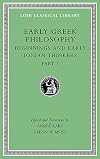
Unlike volume 1 in the series on Early Greek Philosophy from Loeb, volume 2 – “Early Greek Philosophy – Beginnings and Early Ionians Thinkers” has a wealth of information. For these early Greek Philosophers, we have very few, if any, writings remaining from them to know exactly what they believed, and in some cases we don’t know if there were any writings at all. However, what we do have is other people writing about them, who write about what they have been told, or read about show more these early Philosophers.
The book has a “Preliminaries” section which includes a section on Doxography and successions, and this is followed by a “Background” section which discusses what was thought about the cosmos and gods and men. This sets up the first discussions on the earliest philosophers of which we have any kind of evidence. The four earliest philosophers discussed are Pherecydes, Thales, Anaximander, and Anaximenes. We get an impression of what was thought about each of these philosophers, but this serves more as a foundation for learning about Greek Philosophy and how it evolved than it does as evidence of what any of these Philosophers actually said or potentially wrote.
I would have preferred if Loeb and merged this volume with volume 1 to provide the full foundation of the methodology and earliest thoughts in one volume to provide a great start for this series of books, but even without that this volume has a lot of value in and of itself. show less
The book has a “Preliminaries” section which includes a section on Doxography and successions, and this is followed by a “Background” section which discusses what was thought about the cosmos and gods and men. This sets up the first discussions on the earliest philosophers of which we have any kind of evidence. The four earliest philosophers discussed are Pherecydes, Thales, Anaximander, and Anaximenes. We get an impression of what was thought about each of these philosophers, but this serves more as a foundation for learning about Greek Philosophy and how it evolved than it does as evidence of what any of these Philosophers actually said or potentially wrote.
I would have preferred if Loeb and merged this volume with volume 1 to provide the full foundation of the methodology and earliest thoughts in one volume to provide a great start for this series of books, but even without that this volume has a lot of value in and of itself. show less
Awards

You May Also Like


Associated Authors
Statistics
- Works
- 23
- Also by
- 14
- Members
- 491
- Popularity
- #50,319
- Rating
- 4.2
- Reviews
- 7
- ISBNs
- 36
- Languages
- 4