
Clément Oubrerie (1966–2026)
Author of Aya
About the Author
Image credit: Clément Oubrerie, à Saint-Malo (Ille-et-Vilaine), le 29 octobre 2017
Series
Works by Clément Oubrerie
Associated Works
Tagged
Common Knowledge
- Canonical name
- Oubrerie, Clément
- Legal name
- Oubrerie, Clément José
- Birthdate
- 1966-12-23
- Date of death
- 2026-03-01
- Gender
- male
- Education
- Ecole supérieure d'arts graphiques
- Occupations
- illustrator
- Relationships
- Abouet, Marguerite (ex-wife)
Birmant, Julie (wife) - Cause of death
- motor neuron disease
- Nationality
- France
- Birthplace
- Neuilly-sur-Seine, Hauts-de-Seine, Île-de-France, France
- Place of death
- Saint-Georges-de-Didonne, Charente-Maritime, Nouvelle-Aquitaine, France
- Map Location
- France
- Associated Place (for map)
- Île-de-France, France
Members
Reviews

Aya is a university student in 1970s Abidjan, Ivory Coast, in a working class neighborhood they call Yop City. Her two best friends, Adjoua and Bintou, are always getting into trouble in search of love. They all live with their parents and siblings, who get into almost as much trouble as they do. In volume 1, Aya is set up with her father’s boss’s son Moussa, to her chagrin. Adjoua and Bintou are newly interested in Moussa now that they know his family is wealthy, and Adjoua gets show more pregnant so she and Moussa get married. Bintou’s cousin Herve is interested in Aya, but she tells him he should find a career and date her maid Felicite instead. In volume 2, the father of Adjoua’s baby is revealed, and Herve starts a car mechanic business. Adjoua, Bintou, and Felicite enter a beauty contest, in which their frenemy Rita, just returned from Paris, is also a contestant. Things at Aya’s father’s job are not going well, and the whole family finds out when his mistress drops their two kids off at his house. In volume 3, Bintou’s father announces he’s going to take a second wife - Bintou’s rival Rita. Aya’s mother is pissed about her husband’s mistress. Herve and Adjoua go into business together, and we finally find out who Adjoua’s brother Albert has been secretly sleeping with this whole time.
I love Aya’s close-knit little neighborhood. Everyone is always in everyone else’s business, but mostly in a good way. The story isn’t really a slice-of-life, it’s heightened like a soap opera, which really highlights the changing times. Aya and her friends are smart and educated women, but their community (including themselves) sometimes struggle to break out of a more old-fashioned society where marriages are arranged by their fathers and women stay home to take care of many babies and do whatever the men tell them to. It makes for a very enjoyable read while also providing a lot to think about. The only thing missing, really, is Aya herself. She serves as an observer, helping her friends get jobs and sort out their lives and helping her mother stand up to her father, but we don’t get to see much of her own life. I’m hoping to get more in the future.
The art really suits the material, with lots of browns and yellows and greens. The backgrounds are interesting but not overwhelming. He does a great job with varying skin tones and depicting complex hairstyles. I did sometimes struggle to read the lettering (as far as I can tell, Oubrerie did all the lettering himself) but that improved over the course of the volume. show less
I love Aya’s close-knit little neighborhood. Everyone is always in everyone else’s business, but mostly in a good way. The story isn’t really a slice-of-life, it’s heightened like a soap opera, which really highlights the changing times. Aya and her friends are smart and educated women, but their community (including themselves) sometimes struggle to break out of a more old-fashioned society where marriages are arranged by their fathers and women stay home to take care of many babies and do whatever the men tell them to. It makes for a very enjoyable read while also providing a lot to think about. The only thing missing, really, is Aya herself. She serves as an observer, helping her friends get jobs and sort out their lives and helping her mother stand up to her father, but we don’t get to see much of her own life. I’m hoping to get more in the future.
The art really suits the material, with lots of browns and yellows and greens. The backgrounds are interesting but not overwhelming. He does a great job with varying skin tones and depicting complex hairstyles. I did sometimes struggle to read the lettering (as far as I can tell, Oubrerie did all the lettering himself) but that improved over the course of the volume. show less
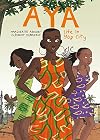
This is a delightful Young Adult graphic novel set in Yopougan, (Yop City) in Abidjan, the capital city of Côte d’Ivoire 1978. The author Marguerite Abouet was born in Côte d’Ivoire in 1972, leaving for France when she was 12. The story focuses on the lives of Aya and her friends Bintou and Adjoua and their families. Partly it revolves around the joyful aspects of everyday life, with parties, boyfriends and beauty pageants. It also highlights the way the women in the story found a show more voice and ways to deal with the difficulties of life, including unexpected pregnancy, unfaithful husbands and boyfriends, polygamy and the unwanted advances of men. The tone is light and there is a wry humour throughout. I found it refreshing to read a book set in Africa that deals with the joys and hardships of everyday life rather than the usual trauma porn of famines, wars and HIV-AIDS the Western world seems to feast on.
I read this as part of my read around the world challenge and the book itself provides interesting historical and cultural details about Côte d’Ivoire, including recipes and how to wear a pagne. I learnt that granted independence from the French in 1960, Côte d’Ivoire flourished under the thirty year leadership President Félix Houphouët-Boigny who encouraged local landownership and clearing, causing a boom in the economy dubbed the Ivorian miracle, and the creation of a middle class. The glamorous capital Abidjan was known as “the Paris of West Africa” and in the 1970s was home to chic cafés and hotels in what was later dubbed the “la Belle Époque.” The economy began to stagnate in the 1980s as crop prices fell. This led to resentment towards the remaining French and non-Ivorian Africans, particularly after the death of Houphouët-Boigny, culminating in civil wars and unrest.
The illustrations by Clément Oubriere were brilliant, conveying the characters' expressions and feelings. I don’t usually read either YA or graphic novels but this was an entertaining and enlightening read and I would be keen to read the sequel to find out what happens to Aya and her friends. show less
I read this as part of my read around the world challenge and the book itself provides interesting historical and cultural details about Côte d’Ivoire, including recipes and how to wear a pagne. I learnt that granted independence from the French in 1960, Côte d’Ivoire flourished under the thirty year leadership President Félix Houphouët-Boigny who encouraged local landownership and clearing, causing a boom in the economy dubbed the Ivorian miracle, and the creation of a middle class. The glamorous capital Abidjan was known as “the Paris of West Africa” and in the 1970s was home to chic cafés and hotels in what was later dubbed the “la Belle Époque.” The economy began to stagnate in the 1980s as crop prices fell. This led to resentment towards the remaining French and non-Ivorian Africans, particularly after the death of Houphouët-Boigny, culminating in civil wars and unrest.
The illustrations by Clément Oubriere were brilliant, conveying the characters' expressions and feelings. I don’t usually read either YA or graphic novels but this was an entertaining and enlightening read and I would be keen to read the sequel to find out what happens to Aya and her friends. show less
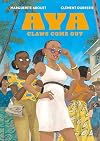
It's been almost 11 years since I came across a new Aya book. It's basically a soap opera set in Côte d'Ivoire (the Ivory Coast) in the early 1980s. Amidst all the romantic travails, the storylines also cover a starlet with violent stalkers, homophobia, student protests, police brutality, and tension with immigrants in Paris under the administration of the newly-elected president, François Mitterrand.
I felt comfortable sliding back into all the action with the large cast. I admit that I show more made a cheat sheet from the series' Wikipedia page before starting though. There's a lot to remember.
I'm very glad that the next volume is coming out this month because this entry ends on not one but five (5!!!) cliffhangers. I wonder if this new cycle is a trilogy or a duology? I don't yet see a tome 9 solicited in the original French. show less
I felt comfortable sliding back into all the action with the large cast. I admit that I show more made a cheat sheet from the series' Wikipedia page before starting though. There's a lot to remember.
I'm very glad that the next volume is coming out this month because this entry ends on not one but five (5!!!) cliffhangers. I wonder if this new cycle is a trilogy or a duology? I don't yet see a tome 9 solicited in the original French. show less
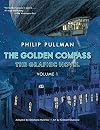
His Dark Materials is one of my favourite book series of all time, so I was totally shocked and excited to stumble upon this graphic novel adaptation during a random browse of my local library's comic book section. The story a bit more simplified than I would like to see, but it's a long and complicated book, so I'll forgive them somewhat since they get the main gist of the story. What doesn't really make this a higher rated book is that the artwork falls somewhat short. In most graphic show more novels the emphasis is on the dialogue, with the visual narration meant to fill in any descriptive elements that the book would normally contain. The style of artwork used in this book - which to me is immediately identifiable as being quite French and highly simplified without being truely minimal - doesn't really convey the full depth of Pullman's literary masterpiece. His narrative style is both subtle and rich in description, which creates a highly atmospheric text that just doesn't mesh well with this style of art. It largely left me feeling like I was reading a story for little children with no active imagination, and left me yearning for the dusky eves of Lyra's gambols around Oxford, the majesty of Lord Asrael's daemon snow leopard, and the highly tense atmosphere of Lyra's time with her mother - as originally described by Pullman. I'll read the second volume to complete the story, but I wish that a better artist would have gotten hold of the story or that they had left it alone completely. show less
Lists
Awards


You May Also Like


Associated Authors
Statistics
- Works
- 28
- Also by
- 6
- Members
- 2,099
- Popularity
- #12,261
- Rating
- 3.8
- Reviews
- 121
- ISBNs
- 116
- Languages
- 10

