
Laura Martin (4)
Author of The Stand: Captain Trips
For other authors named Laura Martin, see the disambiguation page.
Laura Martin (4) has been aliased into Laura DePuy.
Works by Laura Martin
Works have been aliased into Laura DePuy.
Whedon Three Way Oneshot 1 copy
Associated Works
Works have been aliased into Laura DePuy.
Comics for Choice: Illustrated Abortion Stories, History, and Politics (2017) — Contributor — 86 copies, 5 reviews
A-Force, Vol. 1 #2 — Illustrator — 13 copies
Tagged
Common Knowledge
- Canonical name
- Martin, Laura
- Legal name
- Martin, Laura DePuy
- Other names
- DePuy, Laura
- Occupations
- colorist
Members
Reviews
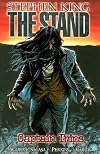
I had a horrible bout of insomnia last night, so I managed to finish almost all the books.
This was an outstanding comic book. I've read The Stand so many times that I can quote parts of it. I first read it in high school in 1978. In fact, I still have my first edition copy (“T39” is printed on
This comic was very faithful to the original story and added bits and pieces to the story that I'd not thought about for some time. Trashcan Man always seemed like such a huge part of the original book, but as I read the comic, I realized that he wasn't. He was deus ex machina from the beginning.
I completely forgot about Nick's eye.
I am not normally a fan of American comics. In general, I find the illustrations over the top and distracting. I really dislike super-hero comics. Some comics have surprised me though. The Walking Dead is one of them. This one was another. I loved the way that the artists drew Nadine and her progression. The illustrations of her post-Free Zone are particularly good, especially her final act. I also liked Frannie's portrayal. Good stuff.
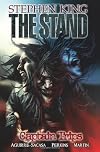
The interlude in chapter two is a perfect example of how the virus spread. Scary perfect! “… the Captain Trips chain letter, was working very well indeed.”
“All the chickens were coming home to roost.”
Indeed they were! I haven't read "The Stand" for a while, so returning to it after the COVID epidemic is pretty dang creepy! This comic adaptation is pretty good, and really well drawn, and was a nice refresher for me. It's only the beginning of the story, but like I said, in light of show more the recent pandemic, it hits pretty hard! I just may have to take up the novel again! show less
“All the chickens were coming home to roost.”
Indeed they were! I haven't read "The Stand" for a while, so returning to it after the COVID epidemic is pretty dang creepy! This comic adaptation is pretty good, and really well drawn, and was a nice refresher for me. It's only the beginning of the story, but like I said, in light of show more the recent pandemic, it hits pretty hard! I just may have to take up the novel again! show less
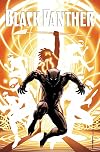
This book needs to be saved from itself, post haste. It still suffers from being a convoluted diatribe about fictional diplomacy and machinations far too subtle for the visual medium. The "Crew" issue even manages to only be worth reading when the guest stars are in effect - and the brief dialogs between BP and Ororo were the highlight of the book (all two or three panels of them).
There's comics, and there's this. Marvel had the opportunity to really build on the super-massive success of show more the movie - and instead this happened. Marvel rubs some salt into the wound by only filling 1/2 of this trade with actual comic pages from the series. The rest is absurd cross-promotional alternative covers that cheapen the whole industry, and reprints of old mediocre BP comics unrelated to the narrative in the current story (of course they are... the current story is like watching paint dry on the walls of a room during a congressional hearing).
Would never have kept reading if it weren't a library borrow. show less
There's comics, and there's this. Marvel had the opportunity to really build on the super-massive success of show more the movie - and instead this happened. Marvel rubs some salt into the wound by only filling 1/2 of this trade with actual comic pages from the series. The rest is absurd cross-promotional alternative covers that cheapen the whole industry, and reprints of old mediocre BP comics unrelated to the narrative in the current story (of course they are... the current story is like watching paint dry on the walls of a room during a congressional hearing).
Would never have kept reading if it weren't a library borrow. show less

Book Two of A Nation Under Our Feet picks up more or less where Book One left off, and shows much the same promise of brilliance and suffers from much the same flaws as the first volume. It is clear that Coates wants to write a story about the morality of power - who gets to wield it and how it may be used in a just manner - but he keeps stumbling over the inherent contradictions of a world in which hereditary rulers with powers that make them literally superhuman are the heroes and they are show more opposed by (among others) people advocating for representative government. It seems that in this installment of the story Coates has recognized this paradox, and has tried to work around it, but it still seems like the world the story is set in is simply getting in the way of the story Coates wants to tell. This isn't to say that this is a bad book, but it is rather an attempt to do something that may be bigger than the genre it takes place in can allow, and as a result, it struggles against these constraints. Ultimately, Coates resolves this issue by mostly abandoning the nuance of the first volume in favor of paring the story down to T'Challa against a collection of over-the-top villains who can be punched into submission.
The political situation at the opening of this book is essentially the same as it was at the end of the last. The shaman Tatu, assisted by the mind-controlling witch Zenzi is fomenting a rebellion he calls "the People" among the Wakandan people with the aim of wresting control of the country away from T'Challa. The disaffected dora milaje Aneka and Ayo are off in a corner of the country seemingly intent on setting up a woman-controlled enclave. Changamire is still preaching the benefits of representative government and denouncing what he sees as T'Challa's dictatorial control over Wakanda. Against this, T'Challa is trying to regain control of the nation he rules, navigating a political situation in which the ability to punch one's enemies into submission is not always all that useful. T'Challa also continues to deal with the fact that his sister Shuri is locked in a prolonged coma from which he is unable to wake her. With all the pieces in place from the first volume, Coates proceeds to move them about the board, showing the various back and forth machinations as "the People" try to make inroads against T'Challa's power and T'Challa, in response, tries to locate his enemies and bring them to heel, using the teleportation capabilities of his ally Manifold to hop around the country to do so.
The net result of all this motion is mostly anticlimactic and almost disappointingly predictable. Tatu tries to recruit Changamire to his cause, but Changamire refuses, pointing out that Tatu's vision is little more than replacing T'Challa's monarchical rule with his own. This serves to more or less take Changamire out of the "rebellion" part of the story, and sidelines him for the rest of the book. When T'Challa sends soldiers to try to subdue the wayward dora milaje, Tatu shows up with Zenzi to mind control the Wakandan troops, but his attempts to take over Aneka and Ayo's forces is rebuffed and he settles for something of a tacit alliance. In these sequences, Coates seems to be taking T'Challa's various morally "grey" opponents off of the board one by one, clearing the board for a showdown between a heroic Black Panther and a villainous evil shaman. As if to drive the point home just a little harder, the story reveals that Tatu's efforts are funded by the duplicitous Zeke Stane, and has the rebellion engage in some underhanded deceptive video editing to make T'Challa look bad.
The conflict in this volume comes to a head when T'Challa flips the script on his opponents, engaging in a little subterfuge of his own so he can record them making a damning confession and then calling in Luke Cage, Misty Knight, and Storm -collectively called "the Crew" - to help him brawl with Stane and his team of super-villains. Despite the complex machinations that created a multi-faction civil war, this book reduces the conflict to little more than Black Panther having a throw-down with an unscrupulous foreign interloper who is motivated almost entirely by the prospect of monetary gain. All of the philosophical questions concerning the nature of government raised by Changamire or concerning the role of women raised by Aneka and Ayo are set aside so the story can be simplified to a good and evil punching match with a few guest stars involved in the fracas. After the build-up in the first volume, this sequence almost feels like little more than filler, and to a certain extent undercuts the rest of the story even more. The story was already kind of floundering due to the fact that the rebellion was being sparked by Zenzi's mind-control powers, calling into question whether "the People" actually had any kind of legitimate grievance, and now the fact that it is funded by Stane for purely mercenary reasons opens up even more questions about the legitimacy of the rebel faction. Instead of posing hard questions about the nature of power and who has the right to wield it, the story descends into a simplistic tale of white hats against black hats.
The volume is intercut with sequences in which Shuri explores what amounts to a dream-like version of Wakanada, guided by an ancestral spirit as she navigates the history and folklore of her nation. Each vignette illustrates some lesson about Wakandan culture and the proper use of authority. In a way, it seems like Coates is trying to rehabilitate the notion of rule by a hereditary monarch through the application of mystical wisdom from beyond the grave. This section feels like an attempt to back away from the hard questions posed earlier in the story about the nature of Black Panther's role as the unelected ruler of a nation and make it palatable for T'Challa to emerge victorious in the end. Oddly, despite being isolated from the rest of the narrative (or perhaps because of it), Shuri's story ends up being the most interesting part of this book, filling in Wakandan history and fleshing out her character more fully than just about any other in the volume. This story ends just as T'Challa and Manifold appear to have found their way into the dream world where Shuri is, presumably setting up Shuri passing on these lessons in rulership to her brother.
As with the first volume, this book has a "throwback" story, this time the opening of the 1973 Don McGregor story Panther's Rage, featuring Killmonger and Venomm as antagonists. In the first section, Black Panthers tracks down Killmonger and unsuccessfully faces off against him, with Killmonger assuming the hero is dead following their encounter. In the second, section, the reader is introduced to Killmonger's ally Venomm, who then learns to his dismay that Black Panther is not actually dead, leading to a confrontation between the two. The super-hero stuff in this part of the book is pretty standard stuff: Villains do bad stuff, Black Panther tracks them down, they fight. What is interesting about this selection is the background - T'Challa has apparently been away from Wakanda for a while, and his subjects repeatedly chastise him for ignoring his responsibility to protect the people of Wakanda. The question that looms large in McGregor's piece is simply this: Can someone serve as a super-hero and be a responsible leader for a nation? This sentiment is echoed in the Coates' authored portion of the book, where one of T'Challa's advisors says that T'Challa doesn't want to rule, but rather wants to be a hero. The tension engendered by T'Challa being both the Black Panther and the King of Wakanda readily apparent in McGregor's story, which, in a way, serves as a precursor to Coates' story. The McGregor work contained in this volume is not the complete run of Panther's Rage, but it is so good that it makes me want to dig out a copy and read it in full.
Book Two of A Nation under Our Feet is, as Book One was, a tantalizing but flawed book. The difference is that it is flawed in completely different ways, While Book One tried to fit a complex political story of competing philosophies of government into a super-hero story, Book Two more or less abandons most of the nuance that had been present in the story to focus on some punching. While the first installment in this series seemed overly ambitious, this volume reveals the cracks in the patina, and simply feels vaguely unsatisfying. That may be due to the fact that this is neither the beginning nor the end of the overall story, and thus kind of has to avoid any real substantive resolution, but even so, the direction the story appears to be going as revealed in this volume feels somewhat disappointing. One can't really conclusively call this a bad story, at least not yet, but one can't really call it a good story yet either. I suppose the most accurate description would be "ambitious and potentially great, but kind of adrift and unfocused at this point".
This review has also been poted to my blog Dreaming About Other Worlds. show less
The political situation at the opening of this book is essentially the same as it was at the end of the last. The shaman Tatu, assisted by the mind-controlling witch Zenzi is fomenting a rebellion he calls "the People" among the Wakandan people with the aim of wresting control of the country away from T'Challa. The disaffected dora milaje Aneka and Ayo are off in a corner of the country seemingly intent on setting up a woman-controlled enclave. Changamire is still preaching the benefits of representative government and denouncing what he sees as T'Challa's dictatorial control over Wakanda. Against this, T'Challa is trying to regain control of the nation he rules, navigating a political situation in which the ability to punch one's enemies into submission is not always all that useful. T'Challa also continues to deal with the fact that his sister Shuri is locked in a prolonged coma from which he is unable to wake her. With all the pieces in place from the first volume, Coates proceeds to move them about the board, showing the various back and forth machinations as "the People" try to make inroads against T'Challa's power and T'Challa, in response, tries to locate his enemies and bring them to heel, using the teleportation capabilities of his ally Manifold to hop around the country to do so.
The net result of all this motion is mostly anticlimactic and almost disappointingly predictable. Tatu tries to recruit Changamire to his cause, but Changamire refuses, pointing out that Tatu's vision is little more than replacing T'Challa's monarchical rule with his own. This serves to more or less take Changamire out of the "rebellion" part of the story, and sidelines him for the rest of the book. When T'Challa sends soldiers to try to subdue the wayward dora milaje, Tatu shows up with Zenzi to mind control the Wakandan troops, but his attempts to take over Aneka and Ayo's forces is rebuffed and he settles for something of a tacit alliance. In these sequences, Coates seems to be taking T'Challa's various morally "grey" opponents off of the board one by one, clearing the board for a showdown between a heroic Black Panther and a villainous evil shaman. As if to drive the point home just a little harder, the story reveals that Tatu's efforts are funded by the duplicitous Zeke Stane, and has the rebellion engage in some underhanded deceptive video editing to make T'Challa look bad.
The conflict in this volume comes to a head when T'Challa flips the script on his opponents, engaging in a little subterfuge of his own so he can record them making a damning confession and then calling in Luke Cage, Misty Knight, and Storm -collectively called "the Crew" - to help him brawl with Stane and his team of super-villains. Despite the complex machinations that created a multi-faction civil war, this book reduces the conflict to little more than Black Panther having a throw-down with an unscrupulous foreign interloper who is motivated almost entirely by the prospect of monetary gain. All of the philosophical questions concerning the nature of government raised by Changamire or concerning the role of women raised by Aneka and Ayo are set aside so the story can be simplified to a good and evil punching match with a few guest stars involved in the fracas. After the build-up in the first volume, this sequence almost feels like little more than filler, and to a certain extent undercuts the rest of the story even more. The story was already kind of floundering due to the fact that the rebellion was being sparked by Zenzi's mind-control powers, calling into question whether "the People" actually had any kind of legitimate grievance, and now the fact that it is funded by Stane for purely mercenary reasons opens up even more questions about the legitimacy of the rebel faction. Instead of posing hard questions about the nature of power and who has the right to wield it, the story descends into a simplistic tale of white hats against black hats.
The volume is intercut with sequences in which Shuri explores what amounts to a dream-like version of Wakanada, guided by an ancestral spirit as she navigates the history and folklore of her nation. Each vignette illustrates some lesson about Wakandan culture and the proper use of authority. In a way, it seems like Coates is trying to rehabilitate the notion of rule by a hereditary monarch through the application of mystical wisdom from beyond the grave. This section feels like an attempt to back away from the hard questions posed earlier in the story about the nature of Black Panther's role as the unelected ruler of a nation and make it palatable for T'Challa to emerge victorious in the end. Oddly, despite being isolated from the rest of the narrative (or perhaps because of it), Shuri's story ends up being the most interesting part of this book, filling in Wakandan history and fleshing out her character more fully than just about any other in the volume. This story ends just as T'Challa and Manifold appear to have found their way into the dream world where Shuri is, presumably setting up Shuri passing on these lessons in rulership to her brother.
As with the first volume, this book has a "throwback" story, this time the opening of the 1973 Don McGregor story Panther's Rage, featuring Killmonger and Venomm as antagonists. In the first section, Black Panthers tracks down Killmonger and unsuccessfully faces off against him, with Killmonger assuming the hero is dead following their encounter. In the second, section, the reader is introduced to Killmonger's ally Venomm, who then learns to his dismay that Black Panther is not actually dead, leading to a confrontation between the two. The super-hero stuff in this part of the book is pretty standard stuff: Villains do bad stuff, Black Panther tracks them down, they fight. What is interesting about this selection is the background - T'Challa has apparently been away from Wakanda for a while, and his subjects repeatedly chastise him for ignoring his responsibility to protect the people of Wakanda. The question that looms large in McGregor's piece is simply this: Can someone serve as a super-hero and be a responsible leader for a nation? This sentiment is echoed in the Coates' authored portion of the book, where one of T'Challa's advisors says that T'Challa doesn't want to rule, but rather wants to be a hero. The tension engendered by T'Challa being both the Black Panther and the King of Wakanda readily apparent in McGregor's story, which, in a way, serves as a precursor to Coates' story. The McGregor work contained in this volume is not the complete run of Panther's Rage, but it is so good that it makes me want to dig out a copy and read it in full.
Book Two of A Nation under Our Feet is, as Book One was, a tantalizing but flawed book. The difference is that it is flawed in completely different ways, While Book One tried to fit a complex political story of competing philosophies of government into a super-hero story, Book Two more or less abandons most of the nuance that had been present in the story to focus on some punching. While the first installment in this series seemed overly ambitious, this volume reveals the cracks in the patina, and simply feels vaguely unsatisfying. That may be due to the fact that this is neither the beginning nor the end of the overall story, and thus kind of has to avoid any real substantive resolution, but even so, the direction the story appears to be going as revealed in this volume feels somewhat disappointing. One can't really conclusively call this a bad story, at least not yet, but one can't really call it a good story yet either. I suppose the most accurate description would be "ambitious and potentially great, but kind of adrift and unfocused at this point".
This review has also been poted to my blog Dreaming About Other Worlds. show less
Lists
You May Also Like
Associated Authors
Statistics
- Works
- 3
- Also by
- 35
- Members
- 1,155
- Popularity
- #22,249
- Rating
- 4.1
- Reviews
- 37
- ISBNs
- 309
- Languages
- 6