
Paige Britt
Author of The Lost Track of Time
Works by Paige Britt
Tagged
Common Knowledge
- Gender
- female
Members
Reviews
The Lost Track of Time
Paige Britt
320 page
Copy: ARC, publication date: 31 March 2015
Read: not sure; probably back in January
Spoilers: A fair bit, including ones for The Phantom Tollbooth
Crossposted: Children of an Idle Mind, Life Piled on Life
I adored this book. Scholastic has really hit it out of the park for the 2015 (more on this in later reviews), but this one has the making of a classic. Remember The Phantom Tollbooth? Or, at any rate, hopefully you remember it? (When I finished reading show more this book, and gushed about it to my best friend, she informed me that she hadn't actually read Tollbooth, and if she were living near me, I would have thrown copies at her. As it was, I just mailed one)
Most of the point of Phantom Tollbooth, aside from the word-play--complete with vocabulary: that's how I learned words like dodecahedron and din and doldrum and a lots of words starting with letters other than d--and the sheer adventure of the story, was that one needs to use one's mind. It was aimed at teaching young readers that boredom is laziness and that intelligence creates the best kind of adventure. It is, in short, truly inspiring.
But in multiple re-readings over time, I came up with a few quibbles. Firstly, the main character Milo is a boy. Now, there is nothing inherently wrong with being a boy. I suppose we need a few of those hanging around, and, frankly, at this point in children's literature, it is actually becoming more and more difficult to find books for intelligent boys who don't like spaceships or Greek gods. However, Tollbooth was published in 1961, and the only female characters are the Princesses of Rhyme and Reason, who have disappeared and are waiting to be rescued up in their Castle in the Air. Although I love the book, we don't need more princesses-in-need-of-rescue and, to be perfectly frank, why the fuck didn't a pair of sisters named Rhyme and Reason rescue themselves? (In more sympathetic moments, I suspect that they were taking a nice vacation and Milo's rescue was something of a nuisance). So: feminism is quibble one.
Quibble two: from what I can see, as neither child nor parent, kids don't seem to have any time to be bored. Sports, and lessons, and enforced hobbies; camps, clubs, classes; the horror that is smart phones: I don't actually think that middle class kids with well meaning parents actually have time to get bored. Getting bored is really important--as long as one doesn't get too bored, of course. Getting bored is what makes one's imagination kick into gear, it's what makes us go on adventures. No one goes on a true adventure because it would look good on a college transcript.
The Lost Track of Time addresses both of these quibbles. To be honest, my beef with Tollbooth was mostly subconscious until I came across this book. Penelope, the intrepid adventurer, suffers under a well-meaning organizational development type mother who runs her daughter's life like Penelope is another event to plan. Their various schedules--during which every fifteen minutes is accounted for--might be humorous to the target audience (8-12), but was verging on tear-jerking for me. To never have any free time! It is bad enough as an adult(ish), but for a child! Heartbreaking and all too much a part of reality.
Penelope, like Milo, escapes her predicament into an allegorical world of word-play and adventure, complete with anthropomorphized puns (my favorite was the Wild Bore), and a mythic figure to be rescued (The Great Moodler, moodling being day-dreaming). Her journey teaches the reader that schedules, just like boredom, can always go overboard.
Recommended for over-scheduled girls (if they can sneak away from their mothers to read it); for grandmothers to give to over-scheduled girls; and for anyone who has been an over-scheduled girl (warning: in that case, there could be tears.) show less
Paige Britt
320 page
Copy: ARC, publication date: 31 March 2015
Read: not sure; probably back in January
Spoilers: A fair bit, including ones for The Phantom Tollbooth
Crossposted: Children of an Idle Mind, Life Piled on Life
I adored this book. Scholastic has really hit it out of the park for the 2015 (more on this in later reviews), but this one has the making of a classic. Remember The Phantom Tollbooth? Or, at any rate, hopefully you remember it? (When I finished reading show more this book, and gushed about it to my best friend, she informed me that she hadn't actually read Tollbooth, and if she were living near me, I would have thrown copies at her. As it was, I just mailed one)
Most of the point of Phantom Tollbooth, aside from the word-play--complete with vocabulary: that's how I learned words like dodecahedron and din and doldrum and a lots of words starting with letters other than d--and the sheer adventure of the story, was that one needs to use one's mind. It was aimed at teaching young readers that boredom is laziness and that intelligence creates the best kind of adventure. It is, in short, truly inspiring.
But in multiple re-readings over time, I came up with a few quibbles. Firstly, the main character Milo is a boy. Now, there is nothing inherently wrong with being a boy. I suppose we need a few of those hanging around, and, frankly, at this point in children's literature, it is actually becoming more and more difficult to find books for intelligent boys who don't like spaceships or Greek gods. However, Tollbooth was published in 1961, and the only female characters are the Princesses of Rhyme and Reason, who have disappeared and are waiting to be rescued up in their Castle in the Air. Although I love the book, we don't need more princesses-in-need-of-rescue and, to be perfectly frank, why the fuck didn't a pair of sisters named Rhyme and Reason rescue themselves? (In more sympathetic moments, I suspect that they were taking a nice vacation and Milo's rescue was something of a nuisance). So: feminism is quibble one.
Quibble two: from what I can see, as neither child nor parent, kids don't seem to have any time to be bored. Sports, and lessons, and enforced hobbies; camps, clubs, classes; the horror that is smart phones: I don't actually think that middle class kids with well meaning parents actually have time to get bored. Getting bored is really important--as long as one doesn't get too bored, of course. Getting bored is what makes one's imagination kick into gear, it's what makes us go on adventures. No one goes on a true adventure because it would look good on a college transcript.
The Lost Track of Time addresses both of these quibbles. To be honest, my beef with Tollbooth was mostly subconscious until I came across this book. Penelope, the intrepid adventurer, suffers under a well-meaning organizational development type mother who runs her daughter's life like Penelope is another event to plan. Their various schedules--during which every fifteen minutes is accounted for--might be humorous to the target audience (8-12), but was verging on tear-jerking for me. To never have any free time! It is bad enough as an adult(ish), but for a child! Heartbreaking and all too much a part of reality.
Penelope, like Milo, escapes her predicament into an allegorical world of word-play and adventure, complete with anthropomorphized puns (my favorite was the Wild Bore), and a mythic figure to be rescued (The Great Moodler, moodling being day-dreaming). Her journey teaches the reader that schedules, just like boredom, can always go overboard.
Recommended for over-scheduled girls (if they can sneak away from their mothers to read it); for grandmothers to give to over-scheduled girls; and for anyone who has been an over-scheduled girl (warning: in that case, there could be tears.) show less
A magical fantasy, an allegorical cautionary tale, a feast of language, a celebration of creativity--this dazzling debut novel is poised to become a story for the ages! Penelope is running out of time! She dreams of being a writer, but how can she pursue her passion when her mother schedules every minute of her life? And how will she ever prove that writing is worthwhile if her mother keeps telling her to "get busy!" and "be more productive"? Then one day, Penelope discovers a hole in her show more schedule--an entire day completely unplanned!--and she mysteriously falls into it. What follows is a mesmerizing journey through the Realm of Possibility where Penelope sets out to find and free the Great Moodler, the one person who may have the answers she seeks. Along the way, she must face an army of Clockworkers, battle the evil Chronos, take a daring Flight of Fancy, and save herself from the grip of time. Brimming with clever language and masterful wordplay, The Lost Track of Time is a high-stakes adventure that will take you to a place where nothing is impossible and every minute doesn't count--people do! show less
Recommended by a patron (Winchester PL)
Penelope's whole life is scheduled by her mother, an event planner in thrall to the sayings in Poor Richard's Almanac; though Penelope dreams of writing, and has notebooks full of ideas under her bed, her mother doesn't think that's a good use of her time, and her father rubber-stamps everything her mother says.
When Penelope discovers a whole free day in her calendar, she runs to her friend Miss Maddie's house before her mother can fill in the day - show more and there, she slips into the blank page and has a marvelous adventure. She visits the Realm of Possibility and Chronos City, meets Dill and the Timekeeper and Chronos himself and the Great Moodler, rides a Fancy, and comes up with a Least Possibility that saves everything and everyone - even herself.
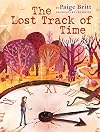
Wholly delightful and clever, with watercolor and digital mixed media illustrations by Lee White.
See also: The Phantom Tollbooth, Alice's Adventures in Wonderland, Rosencrantz and Guildenstern Are Dead
*
Re-read June 2024
See also: A Wrinkle in Time
Quotes
As far as Penelope was concerned, time was like a bank account, and she was overdrawn. (13)
The off thing was, however, that no matter how much time people saved, there never seemed to be enough left over. The more things got done, the faster time ran out....Before long, everyone's internal clock - the clock that told them when to do things in their own time - was completely drowned out. (69)
"Do you have any idea how many different types of time there are? There's high time, big time, and fun time. Down time, prime time, small time, short time, and dark times. There's time in, time out, time up, time tables, and time frames." (The Timekeeper to Penelope, 167)
"The distance between the impossible and the possible is just a hairsbreadth, but few people make the trip." (The Great Moodler to Penelope, 211)
"If anything is possible, then nothing is impossible." (Great Moodler to Penelope, 212)
"I want you to make time for yourself. No one else will." (Miss Maddie to Penelope, 305) show less
Penelope's whole life is scheduled by her mother, an event planner in thrall to the sayings in Poor Richard's Almanac; though Penelope dreams of writing, and has notebooks full of ideas under her bed, her mother doesn't think that's a good use of her time, and her father rubber-stamps everything her mother says.
When Penelope discovers a whole free day in her calendar, she runs to her friend Miss Maddie's house before her mother can fill in the day - show more and there, she slips into the blank page and has a marvelous adventure. She visits the Realm of Possibility and Chronos City, meets Dill and the Timekeeper and Chronos himself and the Great Moodler, rides a Fancy, and comes up with a Least Possibility that saves everything and everyone - even herself.
Wholly delightful and clever, with watercolor and digital mixed media illustrations by Lee White.
See also: The Phantom Tollbooth, Alice's Adventures in Wonderland, Rosencrantz and Guildenstern Are Dead
*
Re-read June 2024
See also: A Wrinkle in Time
Quotes
As far as Penelope was concerned, time was like a bank account, and she was overdrawn. (13)
The off thing was, however, that no matter how much time people saved, there never seemed to be enough left over. The more things got done, the faster time ran out....Before long, everyone's internal clock - the clock that told them when to do things in their own time - was completely drowned out. (69)
"Do you have any idea how many different types of time there are? There's high time, big time, and fun time. Down time, prime time, small time, short time, and dark times. There's time in, time out, time up, time tables, and time frames." (The Timekeeper to Penelope, 167)
"The distance between the impossible and the possible is just a hairsbreadth, but few people make the trip." (The Great Moodler to Penelope, 211)
"If anything is possible, then nothing is impossible." (Great Moodler to Penelope, 212)
"I want you to make time for yourself. No one else will." (Miss Maddie to Penelope, 305) show less
First thing I noticed - book design is reminiscent of The Neverending Story (which didn't impress me), what with heavy paper, monochrome illustrations, etc. Second, the adventure that's dependent on word-play, metaphor, and philosophy owes a huge debt to [b:The Phantom Tollbooth|378|The Phantom Tollbooth|Norton Juster|https://d.gr-assets.com/books/1438887022s/378.jpg|1782584] (which I've loved for over 4 decades). (Juster's book is mentioned in the acknowledgements.)
When I was able to stop show more making comparisons and immerse myself in the book, I began to enjoy it a lot more. Besides all the Worry Warts and Flights of Fancy etc., the messages & morals are worth thinking about. Less sly & subtle than PT, and at the same time less LOL absurd, I don't *imagine* that it has the re-readability of the classic. But, since I'm encountering this as an adult, I really can't know what the intended audience thinks of it.
"Humming drives away the trees [of the Naughty Woulds]. They can't catch you if you're listening to your own tune." show less
When I was able to stop show more making comparisons and immerse myself in the book, I began to enjoy it a lot more. Besides all the Worry Warts and Flights of Fancy etc., the messages & morals are worth thinking about. Less sly & subtle than PT, and at the same time less LOL absurd, I don't *imagine* that it has the re-readability of the classic. But, since I'm encountering this as an adult, I really can't know what the intended audience thinks of it.
"Humming drives away the trees [of the Naughty Woulds]. They can't catch you if you're listening to your own tune." show less
Awards


You May Also Like


Associated Authors
Statistics
- Works
- 2
- Members
- 814
- Popularity
- #31,348
- Rating
- 3.9
- Reviews
- 16
- ISBNs
- 20
- Languages
- 1