
Edward Eager (1911–1964)
Author of Half Magic
About the Author
Edward Eager (1911-1964) worked primarily as a playwright and lyricist. It wasn't until 1951, while searching for books to read to his young son, that he began writing children's stories. In each of his books, he carefully acknowledges his indebtedness to E. Nesbit, whom he considered the best show more children's writer of all time -- "so that any child who likes my books and doesn't know hers may be led back to the master of us all" show less
Image credit: GoodReads
Series
Works by Edward Eager
Tagged
Common Knowledge
- Legal name
- Eager, Edward McMaken
- Birthdate
- 1911-06-20
- Date of death
- 1964-10-23
- Gender
- male
- Education
- Harvard University
- Occupations
- playwright
novelist
lyricist
children's book author - Short biography
- Began writing children's books after searching for books to read to his son. His popular "magic" stories are heavily influenced by the works of E. Nesbit.
- Cause of death
- lung cancer
- Nationality
- USA (birth)
- Birthplace
- Toledo, Ohio, USA
- Places of residence
- Toledo, Ohio, USA
New York, New York, USA
New Canaan, Connecticut, USA - Place of death
- Stamford, Connecticut, USA
- Map Location
- Ohio, USA
Members
Reviews
I still love this book, though I think I love it a little less than I did when I read it as a kid. As a kid, I could blithely skim over the racism and mild sexism in the book and enjoy it for the wonderful fantastical journey that it was. As an adult, I find it harder to excuse the caricatures of non-white side characters, even given that the book was written in 1954. It wasn't called out in that era, but that didn't make it right, and while I would still recommend this as a fun book for show more kids I would also highly recommend that their parents read alongside them and discuss the problematic parts.
However. The plot is still a ton of fun, and I loved revisiting the ways that the children got themselves in trouble by getting only half of their wishes. The art was included in my ebook version, and I loved seeing that again, too. One interesting point I noticed: I found myself interpreting the “this took place thirty years ago” in the opener to be thirty years from when I first read it in the mid-to-late eighties, not thirty years before now, or thirty years from when it was written. I wonder when in time new readers coming to this book would mentally place this book? show less
However. The plot is still a ton of fun, and I loved revisiting the ways that the children got themselves in trouble by getting only half of their wishes. The art was included in my ebook version, and I loved seeing that again, too. One interesting point I noticed: I found myself interpreting the “this took place thirty years ago” in the opener to be thirty years from when I first read it in the mid-to-late eighties, not thirty years before now, or thirty years from when it was written. I wonder when in time new readers coming to this book would mentally place this book? show less

Very happy to be re-reading this with my daughter. The humor holds up quite well -- my 6yo is laughing quite a lot at the antics of Carrie the half-talking cat, for instance. There's some cultural history to explain -- what's "Western Union", for instance ("texting before we had cell phones," I said).
There's also some racist language and some gender issues. The "shifty" Arab they encounter, for instance, and then they wish him to have what he deserves and he gets a wife and six children. show more Even though Eager ended up using it to discuss colonialism, basically, the language and characterization was problematic and shouldn't pass without discussion.
* Update: Now that I've finished, I have a few more comments to make along similar lines. There's a continued thread of what I would call minor sexism. The girls do the dishes; the boy & man start the fire. Minor enough that you can re-gender as you read aloud, or discuss it in a joint read. There's a scene with two burglars where they're using some kind of vernacular. The race of the characters isn't mentioned, but the vernacular reads to me like it's intended to be African-American rather than, say, New Jersey. This was unpleasant to read, saved only because I let myself think maybe it was just some kind of weird New Jersey (or similar regional) accent.
But his characterizations of the main characters are pretty solid. The girls are diverse and have strong opinions and distinct characters, just like the boy, which is half the battle, I think.
And the stories retain their humor and winsomeness. So, we'll pick up the next one (Magic by the Lake), which was one of my absolute favorites as a kid. show less
There's also some racist language and some gender issues. The "shifty" Arab they encounter, for instance, and then they wish him to have what he deserves and he gets a wife and six children. show more Even though Eager ended up using it to discuss colonialism, basically, the language and characterization was problematic and shouldn't pass without discussion.
* Update: Now that I've finished, I have a few more comments to make along similar lines. There's a continued thread of what I would call minor sexism. The girls do the dishes; the boy & man start the fire. Minor enough that you can re-gender as you read aloud, or discuss it in a joint read. There's a scene with two burglars where they're using some kind of vernacular. The race of the characters isn't mentioned, but the vernacular reads to me like it's intended to be African-American rather than, say, New Jersey. This was unpleasant to read, saved only because I let myself think maybe it was just some kind of weird New Jersey (or similar regional) accent.
But his characterizations of the main characters are pretty solid. The girls are diverse and have strong opinions and distinct characters, just like the boy, which is half the battle, I think.
And the stories retain their humor and winsomeness. So, we'll pick up the next one (Magic by the Lake), which was one of my absolute favorites as a kid. show less

"The adventures that are written down in books have already been. If we try to horn in on them, we'd just be tagging along. So we have to make our own adventures."
Well, I gotta say, revisiting this classic children's fantasy book was quite a big adventure for me—in large part because finding the book took decades.
It's one of the first fantasy books I read as a child. A checkout from the library. But in the years that followed, when I wanted to find the book again, I couldn't remember the show more title. I couldn't remember the author's name. I couldn't remember the plot. I had no idea what year or decade the book was published in, especially given that pretty much all books are new-to-you when you're a little kid.
I only remembered one of the illustrations inside, along with the reddish book cover but not the cover art exactly, and most of all, I remembered how much I liked the story...whatever it was about.
So. It took combing through books and books of vintage fantasy KidLit, hoping to come across a reddish cover that might ring a bell in my unclear memory. Even once I found a blurry thumbnail image of the cover and took a chance to buy a newer edition with different cover art, I still wasn't 100% sure I'd ordered the right book.
Not until I received it, flipped through it, and found the one inside illustration I remembered.
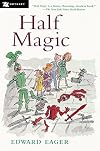
I wound up making my own dust jacket for the book, using a high-res copy of the old, reddish cover image because every element of the artwork on it is such a significant reflection of the story.
A story in which the main characters discover the significance of a certain shabby, red book. A library checkout. Even though they can't make out the book's title—much like my memory couldn't.
Wowzers. I enjoyed rediscovering the oddness, the humor, and the delightfulness of this old-fashioned tale.
Granted, not everything I now recognized as an adult was a pleasure to find, namely the two instances of dated slurs in the book. (i.e., "gyps" and "Indian giver")
However, it was satisfying to recognize more of the influences that factor into the story, like that of George MacDonald and Wordsworth. And I appreciate the way the tale speaks to the magic of books. show less
Well, I gotta say, revisiting this classic children's fantasy book was quite a big adventure for me—in large part because finding the book took decades.
It's one of the first fantasy books I read as a child. A checkout from the library. But in the years that followed, when I wanted to find the book again, I couldn't remember the show more title. I couldn't remember the author's name. I couldn't remember the plot. I had no idea what year or decade the book was published in, especially given that pretty much all books are new-to-you when you're a little kid.
I only remembered one of the illustrations inside, along with the reddish book cover but not the cover art exactly, and most of all, I remembered how much I liked the story...whatever it was about.
So. It took combing through books and books of vintage fantasy KidLit, hoping to come across a reddish cover that might ring a bell in my unclear memory. Even once I found a blurry thumbnail image of the cover and took a chance to buy a newer edition with different cover art, I still wasn't 100% sure I'd ordered the right book.
Not until I received it, flipped through it, and found the one inside illustration I remembered.
I wound up making my own dust jacket for the book, using a high-res copy of the old, reddish cover image because every element of the artwork on it is such a significant reflection of the story.
A story in which the main characters discover the significance of a certain shabby, red book. A library checkout. Even though they can't make out the book's title—much like my memory couldn't.
Wowzers. I enjoyed rediscovering the oddness, the humor, and the delightfulness of this old-fashioned tale.
Granted, not everything I now recognized as an adult was a pleasure to find, namely the two instances of dated slurs in the book. (i.e., "gyps" and "Indian giver")
However, it was satisfying to recognize more of the influences that factor into the story, like that of George MacDonald and Wordsworth. And I appreciate the way the tale speaks to the magic of books. show less
I wanted to like this, but I think time has not been kind to it. The Arab character made me cringe, as did the mother quitting her job and other bits of sexism. It does pretty well with the subject of stepfathers ("Uncle Huge" was maybe the funniest thing in the book besides the half-talking cat) and I can totally see how this would be beloved by earlier generations, but I just didn't enjoy it that much. I very nearly quit 3/4 of the way through.
On the other hand, there is something to be show more said for little children who talk like the Queen of England. show less
On the other hand, there is something to be show more said for little children who talk like the Queen of England. show less
Lists
Sonlight Books (1)
Five star books (1)
Book Hoppers (1)
4th Grade Books (1)
al.vick-series (1)
Elementary Reads (1)
Elevenses (2)
Awards


You May Also Like


Associated Authors
Statistics
- Works
- 18
- Members
- 13,398
- Popularity
- #1,733
- Rating
- 4.1
- Reviews
- 196
- ISBNs
- 147
- Languages
- 5
- Favorited
- 38