
Elizabeth Enright (1907–1968)
Author of Gone-Away Lake
About the Author
Series
Works by Elizabeth Enright
Associated Works
Tagged
Common Knowledge
- Legal name
- Gillham, Elizabeth Wright Enright
- Birthdate
- 1907-09-17
- Date of death
- 1968-06-08
- Gender
- female
- Education
- Art Students League of New York
Parsons School of Design - Occupations
- illustrator
teacher (Barnard College ∙ creative writing)
children's book author
children's book illustrator
short story writer
book critic - Relationships
- Wright, Frank Lloyd (uncle)
Barney, Maginel Wright (mother)
Enright, Walter J. (father) - Short biography
- Elizabeth Enright's mother, Maginel Wright Enright, was a popular magazine and children's book illustrator, and her father, Walter J. Enright, was a political cartoonist. The couple divorced when Elizabeth was 11 years old, and she was sent to a boarding school in Connecticut. She spent summers on Nantucket and on her uncle Frank Lloyd Wright's farm in Wisconsin, locations she later used in some of her works. She studied dancing for time under Martha Graham, and attended the Art Students League of New York, Parsons School of Design, and studied art in Paris. In 1930, she married Robert Gillham, an advertising executive, with whom she had three sons. She created her first book, Kintu: A Congo Adventure, in 1935. Among her beloved children's books are those featuring the Melendy family, including The Saturdays (1941). Elizabeth Enright also wrote short stories for adults, and her work was published in national publications such as The New Yorker, Ladies Home Journal, Cosmopolitan, Harper’s, and The Saturday Evening Post. She also taught creative writing at Barnard College and reviewed children's literature for The New York Times. writing. She won many awards in her career, including the 1939 Newbery Medal for Thimble Summer and a 1958 Newbery Honor for Gone-Away Lake.
- Nationality
- USA
- Birthplace
- Oak Park, Illinois, USA
- Places of residence
- New York, New York, USA
- Place of death
- Wainscott, New York, USA
- Burial location
- Wainscott Cemetery, Suffolk County, New York, USA
- Associated Place (for map)
- New York, USA
Members
Discussions
Help with two books! in Name that Book (May 2016)
Unknown title in Name that Book (August 2010)
Reviews
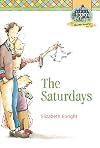
Elizabeth Enright captures the drama, joy, and adventure of childhood in the books that make up her Melendy family series—true classics of children’s literature. The Saturdays, originally published in 1941 and the first novel in the series, introduces us to the New York City based family: Mona (13), Rush (12), Miranda/“Randy” (10½), Oliver (6), Mr. Melendy (a writer), Cuffy (the beloved housekeeper), and Willy Sloper (the handyman, who maintains the old coal furnace).
The story show more begins on a rainy summer afternoon. The children, lounging distractedly in the “Office”, their attic playroom, are thoroughly bored when Randy has the brilliant idea of pooling the siblings’ weekly allowances so each of the four can have a solo outing. And so “ISAAC”—the Independent Saturday Afternoon Adventure Club—is born. Randy goes first, since she came up with the idea. On the Saturdays that follow, each of her siblings will also venture out alone onto the streets of New York and return with a story that ultimately enriches the lives of the entire family. All of the children have particular artistic or scientific interests—Mona, in theatre; Rush, in classical music; Randy, in the visual arts and dance; and Oliver, in engineering, particularly trains. These interests guide what the kids will choose to do when their special Saturday comes..
In the course of the story, the children gain a dog, aptly named Isaac, whose breed Rush jokingly identifies variously as a “Bronx Beagle”, a “Central Park setter”, and an “Interborough Rapid Transit retriever” to anyone who inquires. They meet up with Mrs. Oliphant (an old family friend who knew their parents when young and who, herself, had a very surprising adventure of her own in childhood). They also experience excitement, fear, and alarm when their ramshackle house catches fire one afternoon and when the ancient coal furnace acts up in the middle of another night. There is a fascinating sequence in which Rush and Randy separately have very similar near-death-experience “dreams” (well before the details of such experiences were commonly documented for the public) apparently due to incipient carbon monoxide poisoning—caught in the nick of time.
The kids make some interesting and surprising discoveries about the world on their solo adventures. The girls hear stories from adults they meet, and realize that “Sometimes people are not the way they look.” Rush, who comes out of an opera matinee to find the city’s snow-clearing equipment fully engaged in battling the season’s biggest snowstorm, hears an old man make a strikingly modern observation: “Used to take a team of hosses pullin’ a snowplow to do a job like that . . . And hundreds of fellas out shovelin’ the way. Nowadays they do it all by machinery. Ain’t no work for nobody. That’s what’s the trouble with this world.” The man goes on to muse that he sometimes thinks a day will come “when these fellas build so much machinery that it will revolt; turn on ’em and swalla ’em up!”
So many contemporary works of children’s literature focus on afflictive emotions and the grudges between family members. That’s why reading about the energetic, loving (but never saccharine) Melendy siblings is such a delight. They genuinely like and care about each other.
I have never forgotten Enright’s The Four Story Mistake, which I read and loved as a child, and which I now plan to re-read. I wasn’t certain if I’d also read The Saturdays when young, but I know now that I did not. show less
The story show more begins on a rainy summer afternoon. The children, lounging distractedly in the “Office”, their attic playroom, are thoroughly bored when Randy has the brilliant idea of pooling the siblings’ weekly allowances so each of the four can have a solo outing. And so “ISAAC”—the Independent Saturday Afternoon Adventure Club—is born. Randy goes first, since she came up with the idea. On the Saturdays that follow, each of her siblings will also venture out alone onto the streets of New York and return with a story that ultimately enriches the lives of the entire family. All of the children have particular artistic or scientific interests—Mona, in theatre; Rush, in classical music; Randy, in the visual arts and dance; and Oliver, in engineering, particularly trains. These interests guide what the kids will choose to do when their special Saturday comes..
In the course of the story, the children gain a dog, aptly named Isaac, whose breed Rush jokingly identifies variously as a “Bronx Beagle”, a “Central Park setter”, and an “Interborough Rapid Transit retriever” to anyone who inquires. They meet up with Mrs. Oliphant (an old family friend who knew their parents when young and who, herself, had a very surprising adventure of her own in childhood). They also experience excitement, fear, and alarm when their ramshackle house catches fire one afternoon and when the ancient coal furnace acts up in the middle of another night. There is a fascinating sequence in which Rush and Randy separately have very similar near-death-experience “dreams” (well before the details of such experiences were commonly documented for the public) apparently due to incipient carbon monoxide poisoning—caught in the nick of time.
The kids make some interesting and surprising discoveries about the world on their solo adventures. The girls hear stories from adults they meet, and realize that “Sometimes people are not the way they look.” Rush, who comes out of an opera matinee to find the city’s snow-clearing equipment fully engaged in battling the season’s biggest snowstorm, hears an old man make a strikingly modern observation: “Used to take a team of hosses pullin’ a snowplow to do a job like that . . . And hundreds of fellas out shovelin’ the way. Nowadays they do it all by machinery. Ain’t no work for nobody. That’s what’s the trouble with this world.” The man goes on to muse that he sometimes thinks a day will come “when these fellas build so much machinery that it will revolt; turn on ’em and swalla ’em up!”
So many contemporary works of children’s literature focus on afflictive emotions and the grudges between family members. That’s why reading about the energetic, loving (but never saccharine) Melendy siblings is such a delight. They genuinely like and care about each other.
I have never forgotten Enright’s The Four Story Mistake, which I read and loved as a child, and which I now plan to re-read. I wasn’t certain if I’d also read The Saturdays when young, but I know now that I did not. show less
How did I miss reading this lovely book series as a kid?? I was a voracious reader....and I loved books like this! But....some things are best saved for a later day? Maybe? I'm 51...and just now discovering these delightful books! I did not discover the joy that Enright's writing can bring until I came across Gone-Away Lake and Return to Gone-Away, totally by accident. I read those two books first (loved them!)...and then moved on to this series.
OMG...I had such fun reading this story! It is show more a bit dated (first published in 1941), but it didn't put a damper on my enjoyment of the story one bit. There are four children in the Melendy family -- Mona, Rush, Miranda, and 6-year old Oliver. They live with their father and a housekeeper, Cuffy. Cuffy is a beloved member of the family, stepping in as a substitute mom of sorts for the throng after the death of their mother. Father writes for a living, and offers up common sense wisdom when needed. He also complains about coal furnaces, the price of everything, and the woes of home repair, as all dads do. Mona wants to be an actress. Rush likes to joke around and loves the theater, especially opera. Miranda is a free spirit and just wants to be herself. And Oliver.....he's just a bit tired of being too little to do things like his siblings do. The kids are bored. Saturdays should be a day where they get to go out and do things...but money is a bit of a crunch. So, they decide to form a club and pool their money. Every Saturday one of them will get to go out and do something fun...whatever they choose. It's the 1940s....a kid can do a lot with $1.60! Each section of this book is a different Saturday....and a new adventure for each kid in the Melendy family and some shared excitement. Even some danger!
I listened to the audio book version of this story. Narrated by Pamela Dillman, the audio is just over 4 hours long. Dillman gives a great performance. And the story is just enchantingly fun! Every Saturday is an adventure! Fun is had -- lessons are learned -- life is lived. :)
When the book finished, I found myself wondering what I would have chosen to do on MY Saturday, if I had been a Melendy. At 12, I probably would have chosen a day at the zoo where I could wander at will and look at my favorite animals as long as I wanted to. Then a trip to a nearby bookstore, where I could browse the shelves and buy one book I really wanted....then sit outside in the sunshine for awhile and read. Then back home. :) That would have been the perfect day for me at 12. And, you know.....I think it would be a perfect day for me at 51, too!! :)
Moving on to the next book -- The Four-Story Mistake. There are four books in the series. And luckily my library has them all on audio! show less
OMG...I had such fun reading this story! It is show more a bit dated (first published in 1941), but it didn't put a damper on my enjoyment of the story one bit. There are four children in the Melendy family -- Mona, Rush, Miranda, and 6-year old Oliver. They live with their father and a housekeeper, Cuffy. Cuffy is a beloved member of the family, stepping in as a substitute mom of sorts for the throng after the death of their mother. Father writes for a living, and offers up common sense wisdom when needed. He also complains about coal furnaces, the price of everything, and the woes of home repair, as all dads do. Mona wants to be an actress. Rush likes to joke around and loves the theater, especially opera. Miranda is a free spirit and just wants to be herself. And Oliver.....he's just a bit tired of being too little to do things like his siblings do. The kids are bored. Saturdays should be a day where they get to go out and do things...but money is a bit of a crunch. So, they decide to form a club and pool their money. Every Saturday one of them will get to go out and do something fun...whatever they choose. It's the 1940s....a kid can do a lot with $1.60! Each section of this book is a different Saturday....and a new adventure for each kid in the Melendy family and some shared excitement. Even some danger!
I listened to the audio book version of this story. Narrated by Pamela Dillman, the audio is just over 4 hours long. Dillman gives a great performance. And the story is just enchantingly fun! Every Saturday is an adventure! Fun is had -- lessons are learned -- life is lived. :)
When the book finished, I found myself wondering what I would have chosen to do on MY Saturday, if I had been a Melendy. At 12, I probably would have chosen a day at the zoo where I could wander at will and look at my favorite animals as long as I wanted to. Then a trip to a nearby bookstore, where I could browse the shelves and buy one book I really wanted....then sit outside in the sunshine for awhile and read. Then back home. :) That would have been the perfect day for me at 12. And, you know.....I think it would be a perfect day for me at 51, too!! :)
Moving on to the next book -- The Four-Story Mistake. There are four books in the series. And luckily my library has them all on audio! show less

When I was a girl I loved checking this book out at our library, both for the beautiful illustrations and for Tatsinda herself. Of course Tatsinda would have had no difficulty having her beauty appreciated in the USA. It could have been her personal tragedy that she has brown eyes and golden hair in a land where everyone else has blue eyes and white hair, so she's considered disfigured. Tatsinda does not allow the rude opinion of those around her to sour her personality. The strength and show more courage of this extraordinary young woman are proved in a daring adventure. In the end, she is instrumental in changing her community's narrow point of view. Besides the heroine, I love the wise woman who knew Tatsinda's true worth before anyone else did. I also liked the woman's attitude toward people who wanted to consult her. I don't have the book with me at the moment, so I hope I'm quoting her correctly: "Waste not my time, waste not your own. Ask only that which MUST be known." My review's title comes from the fact that this wonderful book was out of print for many years. Back when I was in library school ['76-'77] and had no car, another student from my dormitory was nice enough to give several of us a lift to a local used bookstore. There I spotted a copy of TATSINDA. I bought it even though the driver saw it and exclaimed that she loved that book. I felt horrible because she would have been able to buy it for herself if she hadn't done me a kindness, but my better nature did not prevail. I never saw her again after graduation, so I couldn't even mail her another used copy I found. I'm so glad the book is in print again, not just for all the readers who now have a chance to be as enchanted as I was, but because that nice lady can get her own copy. show less
Parts of this book were very powerful and/or very amusing, but the gender roles seem to be getting more strict now that the girls are getting older, and I find that a little wearing. It's extra wearing since I recognize that in our household, I tend to reinforce these gender stereotypes by doing most of the cooking and cleaning, not because it's my duty as a woman to cook and clean but just because people are hungry and things are messy and someone's got to do something about it. The result show more is the same, though, I fear. show less
Lists
Newbery Adjacent (11)
Unmarried women (1)
Best Beach Reads (1)
Nifty Fifties (1)
Favorite Series (1)
Five in a Row (1)
1950s (1)
Female Author (1)
Urban Fiction (1)
Comfort Reads (1)
Ambleside Year 3 (4)
Ambleside Y3 (4)
Ambleside Books (4)
4th Grade Books (2)
Sonlight Books (2)
Five star books (1)
Five in a Row (1)
Awards


You May Also Like


Associated Authors
Statistics
- Works
- 26
- Also by
- 12
- Members
- 12,387
- Popularity
- #1,892
- Rating
- 4.2
- Reviews
- 168
- ISBNs
- 167
- Languages
- 5
- Favorited
- 27