
Gottlob Frege (1848–1925)
Author of The Foundations of Arithmetic: A Logico-Mathematical Enquiry into the Concept of Number
About the Author
The creator of modern logic was born in the Pomeranian town of Wismar. His father was headmaster at a school for young ladies, which Frege's mother took over after her husband's early death. Frege studied mathematics at the University of Jena. His studies were encouraged by Ernst Abbe, who show more encouraged him to obtain a doctorate at Gottingen and then helped him secure a position as lecturer at Jena in 1874. Although trained as a mathematician, Frege also studied with Lotze at Gottingen, and his work shows the influence of both Leibniz and Kant. After the publication in 1879 of Frege's first important work, the Begriffschrift (Conceptual Notation), he was promoted to professor, and he remained at the University of Jena the rest of his life. The Begriffschrift was the basis of his new system of logic, which he then sought to apply to the task of deriving number theory entirely from logic, via the theory of classes. This he did in The Foundations of Arithmetic (1884). The next decade saw several of Frege's other important papers on the philosophy of logic and language, including "Function and Concept" (1891), "Concept and Object" (1892), and "Sense and Reference" (1892). Frege was an extreme critic of "psychologism" in logic, mathematics, and philosophy of language---that is, of any view that attempts to treat logic or other sciences pursuing necessary truth as sciences whose subject matter is the actual functioning of the human mind as it can be empirically observed. His critique of psychologism had a far-reaching impact on philosophy in the twentieth century, strongly influencing the development not only of logical positivism and analytical philosophy in English-speaking countries, but also of neo-Kantianism and the phenomenological movement on the continent. After the publication of the Foundations, Frege became aware of certain deficiencies in the logical basis of his theory, which he attempted to remedy in his two-volume Fundamental Laws of Arithmetic (1893--1903). Shortly thereafter, Frege received a letter from Bertrand Russell, which pointed out a contradiction in his theory, since it allowed classes to include themselves as members. Take the class of all classes that are not members of themselves, Russell said; if you assume it is a member of itself, then it follows that it is not, and if you assume it is not, then it follows that it is. Frege attempted to evade the Russell Paradox in a hastily composed appendix, but it was ad hoc and has generally been viewed as unsuccessful. Even apart from this, he later became convinced that the whole project of founding mathematics on logic was doomed to failure. (Bowker Author Biography) show less
Image credit: PhiloThek Bildarchiv
Series
Works by Gottlob Frege
The Foundations of Arithmetic: A Logico-Mathematical Enquiry into the Concept of Number (1884) — Author — 587 copies, 4 reviews
Gottlob Freges Briefwechsel mit D. Hilbert, E. Husserl, B. Russell, sowie ausgewählte Einzelbriefe Freges (1980) 4 copies
Logica e aritmetica 4 copies
Scrieri logico-filosofice I 2 copies
Alle origini della nuova logica. Epistolario scientifico con Hilbert Husserl Peano Russell Vailati e altri (2020) 2 copies
The Foundations of Geometry 1 copy
Zwei Schriften zur Arithmetik: Function und Begriff. Ueber die Zahlen des Herrn H. Schubert (1999) 1 copy
Nachgelassene Schriften 1 copy
Grundgesetze der Arithmetik: Introduction to Vol 1; Exposition of the Begriffschrift; Appendices 1 copy
Lógica y semántica 1 copy
Associated Works
Reading Philosophy of Language: Selected Texts with Interactive Commentary (2005) — Contributor — 12 copies
Tagged
Common Knowledge
- Legal name
- Frege, Friedrich Ludwig Gottlob
- Other names
- FREGE, Friedrich Ludwig Gottlob
FREGE, Gottlob - Birthdate
- 1848-11-08
- Date of death
- 1925-07-26
- Gender
- male
- Education
- University of Jena
- Occupations
- logician
mathematician
philosopher - Relationships
- Fischer, Kuno (teacher)
Clebsch, Alfred (teacher)
Weber, Wilhelm (teacher)
Carnap, Rudolf (student) - Nationality
- Germany
- Birthplace
- Wismar, Mecklenburg-Schwerin, Germany
- Places of residence
- Jena, Thuringia, Germany
- Place of death
- Bad Kleinen, Mecklenburg-Schwerin, Germany
- Associated Place (for map)
- Mecklenburg-Schwerin, Germany
Members
Reviews
The Foundations of Arithmetic: A Logico-Mathematical Enquiry into the Concept of Number by Gottlob Frege
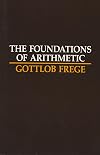
“The laws of numbers, therefore, are not really applicable to external things; they are not laws of nature. They are, however, applicable to judgements holding good of things in the external world: they are laws of the laws of nature” (99)
A deep dive into the concept of Number and an attempt to “prove” arithmetic functions to the same degree of rigor the Euclid brought to geometry. Frege spends the early part of the book examining various philosophical treatments of how we fix our show more idea of Number. Following Kant, Frege asks whether numbers are parts of analytic judgements where the meaning is contained in a definitions of itself or if they are parts of synthetic judgements where their meaning is grounded in the world. And are numbers known a priori (as a matter of reason) or a posteriori (known by experience). Eventually he decides that numbers are analytic judgements that we understand a priori (118).
Frege reaches this conclusion, interestingly, by focusing on language use and how numbers are deployed in how we talk about the world. In a statement like “There are three books on the table” the number “three” is used to add meaning to the concept “books on the table” where “books on the table” is something that we can conceive of conceptually, even in the absence of a context where this is true and there are three actual books on the table in front of you. Furthermore, it is a concept that allows for use of a number … in this case three. We would not say of the same of “There are lazy books on the table” because the idea of “laziness” does not belong to the concept of books in the same way. Numbers appearing in sentences with concepts make propositions about those concepts and allow us to formulate judgements about the world that then support claims, intuitions, and applications of those in the world.
In principle, following from Frege’s arguments, it seems possible to work from language and expressions that are allowed and sensible (as described in the Tractatus) to derive a sense of the rules of reason that are at work. However, as someone who works in language, I would say that what we say is at best an unreliable source from which to understand applicable analytic judgements or a priori acts of knowledge. People say things they don’t mean or say things imprecisely all the time. Our choices of grammar, which Frege is taking as an accurate and rule-governed way of determining the edges of the concepts at play, is more driven by intuitive internalization of rules rather than linguistic expressions of a priori rationality.
Still, I like the idea of looking at our choices in language to determine how they define the edges of concepts (via determiners, articles, and pronouns), identify properties about them (via adjectives), locate them in contexts (via prepositions), position interlocutors to them (via metadiscourse), and provide guidance for their uptake and understanding (via verbs). show less
A deep dive into the concept of Number and an attempt to “prove” arithmetic functions to the same degree of rigor the Euclid brought to geometry. Frege spends the early part of the book examining various philosophical treatments of how we fix our show more idea of Number. Following Kant, Frege asks whether numbers are parts of analytic judgements where the meaning is contained in a definitions of itself or if they are parts of synthetic judgements where their meaning is grounded in the world. And are numbers known a priori (as a matter of reason) or a posteriori (known by experience). Eventually he decides that numbers are analytic judgements that we understand a priori (118).
Frege reaches this conclusion, interestingly, by focusing on language use and how numbers are deployed in how we talk about the world. In a statement like “There are three books on the table” the number “three” is used to add meaning to the concept “books on the table” where “books on the table” is something that we can conceive of conceptually, even in the absence of a context where this is true and there are three actual books on the table in front of you. Furthermore, it is a concept that allows for use of a number … in this case three. We would not say of the same of “There are lazy books on the table” because the idea of “laziness” does not belong to the concept of books in the same way. Numbers appearing in sentences with concepts make propositions about those concepts and allow us to formulate judgements about the world that then support claims, intuitions, and applications of those in the world.
In principle, following from Frege’s arguments, it seems possible to work from language and expressions that are allowed and sensible (as described in the Tractatus) to derive a sense of the rules of reason that are at work. However, as someone who works in language, I would say that what we say is at best an unreliable source from which to understand applicable analytic judgements or a priori acts of knowledge. People say things they don’t mean or say things imprecisely all the time. Our choices of grammar, which Frege is taking as an accurate and rule-governed way of determining the edges of the concepts at play, is more driven by intuitive internalization of rules rather than linguistic expressions of a priori rationality.
Still, I like the idea of looking at our choices in language to determine how they define the edges of concepts (via determiners, articles, and pronouns), identify properties about them (via adjectives), locate them in contexts (via prepositions), position interlocutors to them (via metadiscourse), and provide guidance for their uptake and understanding (via verbs). show less

É chato ter de criticar um livro mais com base em sua edição do que nos textos, ainda mais quando a edição física afigura-se com um certo luxo, em um bom papel, impressão sólida, formato inusitadamente largo, design elegante. Mas é fato de que se a introdução de Alcoforado já não contribui para aumentar o interesse sobre Frege, suas inúmeras notas de tradutor no meio dos textos geram, se observadas, uma leitura aos tropeços, de ritmo ruim, e cujas intervenções conseguem ser show more notas acadêmicas mas que não esclarecem o leitor preocupado com o conteúdo. Somado a isso, embora os artigos Função e conceito, Sobre o conceito e o objeto, Sobre o sentido e a referência, Digressões sobre o sentido e a referência e Que é uma função são todos beirando o genial e recomendadíssimos (****), é de se pensar sobre a escolha da inclusão de outros. Alguns que se assemelham a notas de curiosidade para fãs, outros não são compreensíveis sem adições, e 17 Sentenças Básicas da Lógica é um exemplo que combina ambos, embora bonito e instigante. Enfim, leiam sem olhar as notas de rodapé. show less
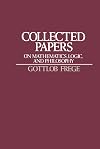
There is much duplication of works published elsewhere, but that is a small price to pay to have the rarer articles and papers previously unavailable in English.
Lists
You May Also Like


Associated Authors
Statistics
- Works
- 49
- Also by
- 3
- Members
- 1,405
- Popularity
- #18,284
- Rating
- 4.1
- Reviews
- 13
- ISBNs
- 112
- Languages
- 17
- Favorited
- 4
