
Ludwig Wittgenstein (1889–1951)
Author of Tractatus Logico-Philosophicus
About the Author
Born in Vienna, Ludwig Josef Johann Wittgenstein was educated at Linz and Berlin University. In 1908 he went to England, registering as a research student in engineering at the University of Manchester. There he studied Bertrand Russell's (see also Vol. 5) Principles of Mathematics by chance and show more decided to study with Russell at Cambridge University. From 1912 to 1913, he studied under Russell's supervision and began to develop the ideas that crystallized in his Tractatus. With the outbreak of World War I, he returned home and volunteered for the Austrian Army. During his military service, he prepared the book published in 1921 as the Tractatus, first translated into English in 1922 by C. K. Ogden. Wittgenstein emerged as a philosopher whose influence spread from Austria to the English-speaking world. Perhaps the most eminent philosopher during the second half of the twentieth century, Wittgenstein had an early impact on the members of the Vienna Circle, with which he was associated. The logical atomism of the Tractatus, with its claims that propositions of logic and mathematics are tautologous and that the cognitive meaning of other sorts of scientific statements is empirical, became the fundamental source of logical positivism, or logical empiricism. Bertrand Russell adopted it as his position, and A. J. Ayer was to accept and profess it 15 years later. From the end of World War I until 1926, Wittgenstein was a schoolteacher in Austria. In 1929 his interest in philosophy renewed, and he returned to Cambridge, where even G. E. Moore came under his spell. At Cambridge Wittgenstein began a new wave in philosophical analysis distinct from the Tractatus, which had inspired the rise of logical positivism. Whereas the earlier Wittgenstein had concentrated on the formal structures of logic and mathematics, the later Wittgenstein attended to the fluidities of ordinary language. His lectures, remarks, conversations, and letters made lasting imprints on the minds of his most brilliant students, who have long since initiated the unending process of publishing them. During his lifetime Wittgenstein himself never published another book after the Tractatus. However, he was explicit that the work disclosing the methods and topics of his later years be published. This work, Philosophical Investigations (1953), is esteemed to be his most mature expression of his philosophical method and thought. (Bowker Author Biography) show less
Image credit: Photo by Moritz Nähr / Ludwig Wittgenstein circa 1930 / Photo © ÖNB/Wien
Series
Works by Ludwig Wittgenstein
The Blue and Brown Books (Preliminary Studies for the Philosophical Investigations) (1958) 1,456 copies, 5 reviews
Lectures & conversations on aesthetics, psychology and religious belief (1966) 576 copies, 3 reviews
Wittgenstein's Lectures on the foundations of mathematics, Cambridge, 1939 : from the notes of R.G. Bosanquet, Norman Malcolm, Rush Rhees, and Yorick Smythies (1976) 121 copies, 1 review
Tractatus logico-philosophicus. Tagebücher 1914 - 1916. Philosophische Untersuchungen. (1984) 115 copies
Last Writings on the Philosophy of Psychology: Preliminary Studies for Part II of Philosophical Investigations, Vol. 1 (1982) 68 copies
Wittgenstein's Lectures, Cambridge, 1930-1932: From the notes of John King and Desmond Lee (Phoenix Series) (1980) 53 copies
Last Writings on the Philosophy of Psychology: The Inner and the Outer, 1949 - 1951, Volume 2 (1993) 42 copies
Letters to C.K. Ogden With Comments on the English Translation of the Tractatus Logico-Philosophicus (1973) 37 copies, 1 review
Ludwig Wittgenstein, Cambridge Letters: Correspondence With Russell, Keynes, Moore, Ramsey and Sraffa (1995) 12 copies
Movements of Thought: Ludwig Wittgenstein's Diary, 1930–1932 and 1936–1937 (2022) 8 copies, 1 review
Wiener Ausgabe Studien Texte: Band 2: Philosophische Betrachtungen. Philosophische Bemerkungen. (1999) 3 copies
Bd. 2. Philosophische Bemerkungen 3 copies
Wiener Ausgabe Studien Texte: Band 4: Bemerkungen Zur Philosophie. Bemerkungen Zur Philosophischen Grammatik (1999) 3 copies
Last Writings on the Phiosophy Pt 2 V 1 (Last Writings of the Philosophy of Psychology Vol. 2) 3 copies
Wittgenstein 2 copies
Briefwechsel mit B. Russell, G. E. Moore, J. M. Keynes, F. P. Ramsey, W. Eccles, P. Engelmann, L. v. Ficker (1980) 2 copies
Últimos escritos sobre filosofía de la psicología: Vol I y II (Clásicos - Clásicos Del Pensamiento) (2008) 2 copies
Wittgenstein in Cambridge 1 copy
Revue Europe 906, Octobre 2004 : Wittgenstein — Contributor — 1 copy
Wittgenstein Os Pensadores 1 copy
色彩について 1 copy
Rules and Private Language 1 copy
Wittgenstein 1 copy
Wittgenstein [Opere di] 1 copy
Beiheft 1 copy
Ludwig Wittgenstein, Briefe und Begegnungen — Author — 1 copy
درباره اخلاق و دین 1 copy
Obras Wittegenstein I 1 copy
Isomorfismo 1 copy
Lectures, Cambridge 1 copy
Annotazioni filosofiche 1 copy
Wittgenstein (Volume terzo) 1 copy
Wittgenstein Ludwig 1 copy
Scritti scelti 1 copy
Nachlass 1 copy
Ricerche filosofiche [in I grandi filosofi. Vita, pensiero, opere scelte : 29 - Wittgenstein] 1 copy
Una conferencia sobre ética 1 copy
Zettelsammlung Aus Den Synopsen Der Manuskriptbande I Bis X (2) (Wittgenstein Wiener Ausgabe, 10) (German Edition) (2023) 1 copy
Du 586: Weiss 1 copy
Some Remarks on Logical Form 1 copy
Wittgenstein's Nachlass: Network Version, Text and Facsimiles (Wittgenstein's Nachlass: The Bergen Electronic Edition) (2000) 1 copy
Wittgenstein (Volume quarto) 1 copy
Associated Works
The Philosopher's Handbook: Essential Readings from Plato to Kant (2000) — Contributor — 235 copies, 1 review
Tagged
Common Knowledge
- Canonical name
- Wittgenstein, Ludwig
- Legal name
- Wittgenstein, Ludwig Josef Johann
- Birthdate
- 1889-04-26
- Date of death
- 1951-04-29
- Gender
- male
- Education
- University of Cambridge (PhD|Philosophy|1929)
Technical University of Berlin (Dipl.|1908)
Victoria University of Manchester - Occupations
- philosopher
professor
logician
mathematician - Organizations
- University of Cambridge
Austro-Hungarian Army (WWI) - Awards and honors
- Band of the Military Service Medal with Swords (1918)
Silver Medal for Valour, First Class (1917)
Military Merit Medal with Swords on the Ribbon (1916) - Relationships
- Russell, Bertrand (teacher)
Moore, G. E. (teacher)
Anscombe, G. E. M. (student)
Black, Max (student)
Geach, Peter (student)
Malcolm, Norman (student) (show all 9)
Wright, Georg Henrik von (student)
Engelmann, Paul (friend)
Ambrose, Alice (student) - Short biography
- Ludwig Wittgenstein, born in Vienna, Austria to a wealthy family, is considered by some to have been the greatest philosopher of the 20th century. He continues to influence philosophical thought in topics as varied as logic and language, perception and intention, ethics and religion, aesthetics and culture. As a soldier in the Austrian army in World War I, he was captured in 1918 and spent the remaining months of the war in a prison camp, where he wrote the notes and drafts of his first book, Tractatus Logico-Philosophicus. It was published in 1921 in German and then translated into English the following year. In the 1930s and 1940s, he conducted seminars at Cambridge University, his alma mater, and wrote his second book, Philosophical Investigations, which was published posthumously. His conversations, lecture notes, and letters, have since been published in several volumes, including Ludwig Wittgenstein and the Vienna Circle, The Blue and Brown Books, and Philosophical Grammar.
- Cause of death
- prostate cancer
- Nationality
- Austria (birth)
UK (naturalized 1939) - Birthplace
- Vienna, Austria-Hungary
- Places of residence
- Vienna, Austria
Linz, Austria
Berlin, Germany
Manchester, England, UK
Cambridge, Cambridgeshire, England, UK
Skjolden, Norway (show all 7)
Trattenbach, Austria - Place of death
- Cambridge, Cambridgeshire, England, UK
- Burial location
- Ascension Parish Burial Ground, Cambridge, Cambridgeshire, England, UK
- Map Location
- Austria
Members
Discussions
Arion Press On Certainty? in Fine Press Forum (November 2021)
Reviews

There are not many books like this. Its tone is brash, irreverent, and cocksure. Its points are painstakingly enumerated; the words are carefully chosen, and many points are stubbornly but alluringly confusing. And despite being uncertain that I fully understand Wittgenstein at each step in his argument, I am convinced that his critique is right but not one that undermines the possibility of analysis.
Trying to sum up, Wittgenstein is wary of the truth function of analytic language (logic in show more particular) that is true only in the logic of its form and in the symbolism of its expression. At some point, the aims of analysis go beyond the description of elementary propositions about the world and attempt to posit relationships between objects. It then assigns object status to those conclusions about states of affairs and at each step retreats a little further from making statements that propose anything verifiable by reference to the world and the states of affairs among things in it. Eventually, analytic statements make claims about the world and assert relationships that are true only by definition. The language of analysis starts to refer only to itself and its own products. It becomes “senseless” in Wittgenstein’s terms, meaning that it follows a logic of form but that it is ultimately not verifiable.
Sensible propositions assert falsifiable truths whereby language can be tested against a state of affairs in the world of things. To drive at more certainty requires unpacking more elementary propositions about the world, chasing atomic facts and inventing additional objects and assigning unique signs and symbols to them. It is, however, futile because the world of things is endlessly divisible into more and more atomic facts and objects that need names. It is another form of Zeno’s paradox. To drive to more complex assertions, analysis needs to build on itself and even if that analysis builds on a firm foundation of elementary propositions, forms of logic used to pull those elementary propositions together then slips into place as the object of analysis and then we are studying things that are not in the world.
These are the limits of analytic language, but I’m not bothered by Wittgenstein’s claims about the senselessness of logic and other kinds of interpretive and analytical language. It does seem true that there is a point at which the level of claims that we want to make and support with analytic language escape the bounds of verifiability against a world of atomic facts. However, if we believe Wittgenstein’s claim that philosophy is an “activity’ for the clarification of thought then it retains its value despite working in the medium of language.
It is also true that philosophy and logic are not the only modes of analysis we have. Consider other modes of analytic expression, ways of saying something about the world, such as through art, music, literature. Then, just like with senseless philosophy that follows the form of its logic, art, music, and literature follows form as well and form expands the limits of the possible, a point that Wittgenstein develops later into proposition 6.
The famous ending: proposition 7: “Whereof one cannot speak, thereof one must be silent” seems a little less final. The problem may not be that there are things about which nothing can be spoken. Part of the problem may be the limited repertoire of ways we have for speaking. Forms of “speaking” like art and literature retain more of the experiential in a way that, to me, seems to allow for the kind of progress toward truth telling that Wittgenstein assigns to living. show less
Trying to sum up, Wittgenstein is wary of the truth function of analytic language (logic in show more particular) that is true only in the logic of its form and in the symbolism of its expression. At some point, the aims of analysis go beyond the description of elementary propositions about the world and attempt to posit relationships between objects. It then assigns object status to those conclusions about states of affairs and at each step retreats a little further from making statements that propose anything verifiable by reference to the world and the states of affairs among things in it. Eventually, analytic statements make claims about the world and assert relationships that are true only by definition. The language of analysis starts to refer only to itself and its own products. It becomes “senseless” in Wittgenstein’s terms, meaning that it follows a logic of form but that it is ultimately not verifiable.
Sensible propositions assert falsifiable truths whereby language can be tested against a state of affairs in the world of things. To drive at more certainty requires unpacking more elementary propositions about the world, chasing atomic facts and inventing additional objects and assigning unique signs and symbols to them. It is, however, futile because the world of things is endlessly divisible into more and more atomic facts and objects that need names. It is another form of Zeno’s paradox. To drive to more complex assertions, analysis needs to build on itself and even if that analysis builds on a firm foundation of elementary propositions, forms of logic used to pull those elementary propositions together then slips into place as the object of analysis and then we are studying things that are not in the world.
These are the limits of analytic language, but I’m not bothered by Wittgenstein’s claims about the senselessness of logic and other kinds of interpretive and analytical language. It does seem true that there is a point at which the level of claims that we want to make and support with analytic language escape the bounds of verifiability against a world of atomic facts. However, if we believe Wittgenstein’s claim that philosophy is an “activity’ for the clarification of thought then it retains its value despite working in the medium of language.
It is also true that philosophy and logic are not the only modes of analysis we have. Consider other modes of analytic expression, ways of saying something about the world, such as through art, music, literature. Then, just like with senseless philosophy that follows the form of its logic, art, music, and literature follows form as well and form expands the limits of the possible, a point that Wittgenstein develops later into proposition 6.
The famous ending: proposition 7: “Whereof one cannot speak, thereof one must be silent” seems a little less final. The problem may not be that there are things about which nothing can be spoken. Part of the problem may be the limited repertoire of ways we have for speaking. Forms of “speaking” like art and literature retain more of the experiential in a way that, to me, seems to allow for the kind of progress toward truth telling that Wittgenstein assigns to living. show less

Philosophy is not a body of doctrine but an activity.
—Ludwig Wittgenstein
I took medialunas and a corto doble at Las Juventus off the Plaza del Congreso every morning on my way to work. A pretty girl had the table set and the coffee poured before I could unfold the Clarín early edition. One morning I read an article about Wittgenstein, how he carried a copy of the Tractatus in his knapsack along the frontlines during WWI, about his rejection and subsequent return to academia, and his show more checkered career as a village headmaster. Ever since, when I think of Wittgenstein, I think of breakfast in Buenos Aires, and the face of that girl.
It is difficult, at this far remove from its initial publication, to read the Tractatus pure, straight, and so some passages read like a prose poem—“the way a picture touches reality”—and some bits sound like fortune cookie wisdom:
The world of the happy man is a different one from that of an unhappy man;
It is clear that there are no grounds for believing that the simplest eventuality will in fact be realized.
'Wittgenstein was preoccupied with the scope and limits of language, and in the Tractatus he was concerned primarily with language as a representing medium, a means of conveying how things are in the world' (Antony Flew). He also wanted to correct some mistakes in the logics of Frege and Russell. Wittgenstein thought that fundamental confusions could be avoided by constructing a sign-language that was governed by logical grammar and syntax, so he wrote what he thought would, nay, must be true if language was to accurately represent the world. Of course, since he himself deployed a language of signs and symbols in the presentation of his thoughts, all kinds of ‘meta’ possibilities and interpretations pop up in the Tractatus. Some parts are aphoristic, like Zen koans:
Language disguises thought;
The world and life are one;
Eternal life belongs to those who live in the present;
When no questions are left, that itself is the answer.
Other bits are seemingly nonsensical—
A picture contains the possibility of the situation it represents;
The propositions of logic demonstrate the logical properties of propositions by combining them so as to form propositions that say nothing—
others vaguely profound—
The limits of my language are the limits of my world;
Whatever we see could be other than it is;
The totality of true thoughts is a picture of the world—
and some are all of the above:
The riddle does not exist;
Outside logic everything is accidental.
There are sketches illustrating the rules of logical syntax that resemble the pincers of Triassic crustaceans.
In Wittgenstein’s version of a world precisely represented by language, propositions were their own proofs, and “inevitable” signs spoke for themselves. His model of a perfectly logical system, as it was for Frege and Russell, was mathematics. This set him off in search of invariant functions and operations and applications, the pursuit of which (ironically) revealed the limits of formal logic. Wittgenstein’s perfectly logical reality was paradoxically unreal, impossible, and disconnected from actual lived experience—which is more ambiguous, complex and uncertain than formal logic can abide.
For the Wittgenstein of the Tractatus, a proposition of perfect logic restricted reality to two alternatives: yes or no. Logic precluded surprise or doubt. Whatever was ineffable was unreal. There was no place for wonder. Too much, finally, was left unaccounted for by cold, austere logic. To his credit, Wittgenstein in his later work undertook an analysis of how language actually functioned, signs and symbols still failing us. Thus was the Tractatus part of the activity that was Wittgenstein’s philosophy, less a conclusive, fully realized credo than a springboard to further reflection. As it would be for its readers. show less
—Ludwig Wittgenstein
I took medialunas and a corto doble at Las Juventus off the Plaza del Congreso every morning on my way to work. A pretty girl had the table set and the coffee poured before I could unfold the Clarín early edition. One morning I read an article about Wittgenstein, how he carried a copy of the Tractatus in his knapsack along the frontlines during WWI, about his rejection and subsequent return to academia, and his show more checkered career as a village headmaster. Ever since, when I think of Wittgenstein, I think of breakfast in Buenos Aires, and the face of that girl.
It is difficult, at this far remove from its initial publication, to read the Tractatus pure, straight, and so some passages read like a prose poem—“the way a picture touches reality”—and some bits sound like fortune cookie wisdom:
The world of the happy man is a different one from that of an unhappy man;
It is clear that there are no grounds for believing that the simplest eventuality will in fact be realized.
'Wittgenstein was preoccupied with the scope and limits of language, and in the Tractatus he was concerned primarily with language as a representing medium, a means of conveying how things are in the world' (Antony Flew). He also wanted to correct some mistakes in the logics of Frege and Russell. Wittgenstein thought that fundamental confusions could be avoided by constructing a sign-language that was governed by logical grammar and syntax, so he wrote what he thought would, nay, must be true if language was to accurately represent the world. Of course, since he himself deployed a language of signs and symbols in the presentation of his thoughts, all kinds of ‘meta’ possibilities and interpretations pop up in the Tractatus. Some parts are aphoristic, like Zen koans:
Language disguises thought;
The world and life are one;
Eternal life belongs to those who live in the present;
When no questions are left, that itself is the answer.
Other bits are seemingly nonsensical—
A picture contains the possibility of the situation it represents;
The propositions of logic demonstrate the logical properties of propositions by combining them so as to form propositions that say nothing—
others vaguely profound—
The limits of my language are the limits of my world;
Whatever we see could be other than it is;
The totality of true thoughts is a picture of the world—
and some are all of the above:
The riddle does not exist;
Outside logic everything is accidental.
There are sketches illustrating the rules of logical syntax that resemble the pincers of Triassic crustaceans.
In Wittgenstein’s version of a world precisely represented by language, propositions were their own proofs, and “inevitable” signs spoke for themselves. His model of a perfectly logical system, as it was for Frege and Russell, was mathematics. This set him off in search of invariant functions and operations and applications, the pursuit of which (ironically) revealed the limits of formal logic. Wittgenstein’s perfectly logical reality was paradoxically unreal, impossible, and disconnected from actual lived experience—which is more ambiguous, complex and uncertain than formal logic can abide.
For the Wittgenstein of the Tractatus, a proposition of perfect logic restricted reality to two alternatives: yes or no. Logic precluded surprise or doubt. Whatever was ineffable was unreal. There was no place for wonder. Too much, finally, was left unaccounted for by cold, austere logic. To his credit, Wittgenstein in his later work undertook an analysis of how language actually functioned, signs and symbols still failing us. Thus was the Tractatus part of the activity that was Wittgenstein’s philosophy, less a conclusive, fully realized credo than a springboard to further reflection. As it would be for its readers. show less
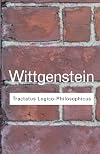
Get your P's and Q's ready, folks, because we're in for the ride of our lives.
Or not.
Wittgenstein was living proof that androids were around and functioning during WWI. That at least this single android had a sense of humor dry enough to turn the Mariana Trench into the Mojave Desert, too.
Or was this a joke at all? Let's see.
Most of the numbered propositions were imminently clear and devoted to a single purpose: describing reality.
Language is the big limiter, which should never be a big show more surprise, but he insists that all reality that is, can be explained clearly.
Unfortunately, Wittgenstein, the big brilliant man that he is, was fundamentally incapable of describing or CLEARLY STATING his philosophy. Or using any object in his philosophy for the purposes of further elucidation.
The resulting numbered tracts and use of Formal Logic were used to numb the biological minds reading it... but there is good news! It did help out with the translation problems for future AIs reviewing this work!
Difficult to read? You have no idea. Really. Or perhaps you do if you use chalkboards. But THIS work of philosophy is the target for that old joke:
"What's the difference between a mathematician and a philosopher?
Mathematicians know how to use an eraser."
The logical problem of describing only physics in any positive way while never coming down hard on absolute statements -- like the way we only hypothesize that the sun will come up tomorrow -- eventually curled around itself in very strange ways, like the problem of including your own description in with the description itself.
It keeps adding to the problem of description, mathematically, until the recursion explodes your head or makes you divide by zero. (Same difference, really.)
It presages, at least in part, Goedel's Incompleteness Theorem. Also, P=NP. As in, is it possible to include the index to your library in with the library itself, or do you need to make a brand new card catalog system every time to include the original index? The time it takes to prove a thing is disproportionately large (or impossible) compared to the FACT OF THE SOLUTION.
This goes beyond logical fallacy. It's a real thing we still deal with. And yet, Wittgenstein throws out the baby with the bathwater at the very end. He makes a beautiful house of cards and claps his hands, making us wake up after the long novel with a classic, "and it was only a dream."
Am I kinda pissed? First by having been bored to tears and misunderstanding a handful of DENSE and OBLIQUE propositions that refer to undefined and objectless other works, unlike the careful analysis he made at the start? Yeah. I am.
And like his reference to covering your right hand with your left while also covering your left with your right, this text attempts to disprove everything -- firmly.
It makes me believe, once again, that formal logic, while glorious in one way, is an absolute horseradish in another.
I recommend this for anyone in love with highly complicated logical mazes and other computer science majors. YOU MUST HAVE A SENSE OF HUMOR OR YOU WILL DIE. Or kill someone. One, or the other. show less
Or not.
Wittgenstein was living proof that androids were around and functioning during WWI. That at least this single android had a sense of humor dry enough to turn the Mariana Trench into the Mojave Desert, too.
Or was this a joke at all? Let's see.
Most of the numbered propositions were imminently clear and devoted to a single purpose: describing reality.
Language is the big limiter, which should never be a big show more surprise, but he insists that all reality that is, can be explained clearly.
Unfortunately, Wittgenstein, the big brilliant man that he is, was fundamentally incapable of describing or CLEARLY STATING his philosophy. Or using any object in his philosophy for the purposes of further elucidation.
The resulting numbered tracts and use of Formal Logic were used to numb the biological minds reading it... but there is good news! It did help out with the translation problems for future AIs reviewing this work!
Difficult to read? You have no idea. Really. Or perhaps you do if you use chalkboards. But THIS work of philosophy is the target for that old joke:
"What's the difference between a mathematician and a philosopher?
Mathematicians know how to use an eraser."
The logical problem of describing only physics in any positive way while never coming down hard on absolute statements -- like the way we only hypothesize that the sun will come up tomorrow -- eventually curled around itself in very strange ways, like the problem of including your own description in with the description itself.
It keeps adding to the problem of description, mathematically, until the recursion explodes your head or makes you divide by zero. (Same difference, really.)
It presages, at least in part, Goedel's Incompleteness Theorem. Also, P=NP. As in, is it possible to include the index to your library in with the library itself, or do you need to make a brand new card catalog system every time to include the original index? The time it takes to prove a thing is disproportionately large (or impossible) compared to the FACT OF THE SOLUTION.
This goes beyond logical fallacy. It's a real thing we still deal with. And yet, Wittgenstein throws out the baby with the bathwater at the very end. He makes a beautiful house of cards and claps his hands, making us wake up after the long novel with a classic, "and it was only a dream."
Am I kinda pissed? First by having been bored to tears and misunderstanding a handful of DENSE and OBLIQUE propositions that refer to undefined and objectless other works, unlike the careful analysis he made at the start? Yeah. I am.
And like his reference to covering your right hand with your left while also covering your left with your right, this text attempts to disprove everything -- firmly.
It makes me believe, once again, that formal logic, while glorious in one way, is an absolute horseradish in another.
I recommend this for anyone in love with highly complicated logical mazes and other computer science majors. YOU MUST HAVE A SENSE OF HUMOR OR YOU WILL DIE. Or kill someone. One, or the other. show less
Philosophical Investigations: The German Text, with a Revised English Translation 50th Anniversary Commemorative Edition by Ludwig Wittgenstein
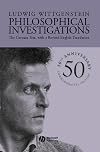
It's more than a little presumptuous to attempt a short review of Wittgenstein's Philosophical Investigations. After all, it's one of the few most important philosophical works of the twentieth century. This edition is sorely awaited by some, after years of close examination and criticism of the Anscombe translation.
First, the geeky stuff on the translation and editing. Like the Anscombe translation, this one with Hacker and Schulte joining their efforts to Anscombe's, presents the original show more German and the English translation on facing pages. As a reader with a spotty knowledge of German, this gives me the opportunity to refer to the original where the English seems obscure, ambiguous, or just plain impenetrable. If you're a student of Wittgenstein, Hacker and Schulte have helpfully addressed numerous, controversial aspects of Anscombe's translation -- many of these, such as the difficulty with the German "Satz" (translated relative to context by "sentence" or "proposition", two very different English words) and "Seele" ("soul" sometimes but "mind" others by context in English), are discussed in their Preface.
If you are a quasi-casual reader, many of these points of translation are probably less important than overall readability. And I think Hacker and Schulte have improved readability, updating the feel of Wittgenstein's writing, which is often colloquial, to something more modern.
They've also added over 20 pages of sometimes helpful footnotes, where additional information about the translation or about Wittgenstein's thoughts are enlightening. And they've recast "Part II" of the Investigations itself as "Philosophy of Psychology -- A Fragment" -- their reasoning for that is given in their Preface.
Like most great philosophical texts, no matter how many times I read the Investigations, it's different each time, and I feel foolish for having understood so little the previous time. The new translation offers a great excuse to give it another read.
There are many themes to pick up, including the great variety of linguistic behavior (as contrasted with naive views of language as representing or naming, or with Wittgenstein's own view in the Tractatus), the illusions of distinctive mental activities (such as "meaning" a word while uttering it, or translating the inner to the outer or public), and the general theme of philosophical problems arising when "language goes on holiday".
It's the last that continues to grab my attention, persistently through readings, with different remarks jumping out of the text each time. The simple view is that Wittgenstein thinks ordinary language (what we all say and do in practical contexts every day) is fine as it is, but that it's when we detach ordinary language from those practical contexts that we get in trouble. We fall into perplexing philosophical quandaries, supposing ourselves to really wonder whether the external world or other minds exist, or whether objects are material or ideal.
But philosophical exercises of language are exercises of language, after all. It's not as though we can simply say, "Don't do that" when philosophers speak, and point out that they've left the "ordinary" behind. It's not a simple mistake, and the line between the "ordinary" and the "philosophical" is crossed sometimes without special notice. And it's not even the exclusive province of professional philosophers (amateurs seem even more impressed than the professionals sometimes by their own metaphysical musings).
Certainly, there is more to say about the mistake that philosophers, amateur and professional, make. In particular, there is Wittgenstein's distinction between empirical remarks (remarks about facts in the world) and grammatical remarks (by contrast, remarks about how we speak or are to speak about those facts in the world). The philosopher mistakes the one for the other, thinking that, for example, by adopting what we call an idealist grammatical position (when we talk of objects in the world, we are really talking of mental or ideal objects) we have really discovered something about the objects and not just made a statement about how we should speak of them. Much more to say on this, of course -- which is why a short review is so presumptuous. In fact, it's Wittgenstein's thoughts on why we fall victim to such a misunderstanding that I puzzle most about. show less
First, the geeky stuff on the translation and editing. Like the Anscombe translation, this one with Hacker and Schulte joining their efforts to Anscombe's, presents the original show more German and the English translation on facing pages. As a reader with a spotty knowledge of German, this gives me the opportunity to refer to the original where the English seems obscure, ambiguous, or just plain impenetrable. If you're a student of Wittgenstein, Hacker and Schulte have helpfully addressed numerous, controversial aspects of Anscombe's translation -- many of these, such as the difficulty with the German "Satz" (translated relative to context by "sentence" or "proposition", two very different English words) and "Seele" ("soul" sometimes but "mind" others by context in English), are discussed in their Preface.
If you are a quasi-casual reader, many of these points of translation are probably less important than overall readability. And I think Hacker and Schulte have improved readability, updating the feel of Wittgenstein's writing, which is often colloquial, to something more modern.
They've also added over 20 pages of sometimes helpful footnotes, where additional information about the translation or about Wittgenstein's thoughts are enlightening. And they've recast "Part II" of the Investigations itself as "Philosophy of Psychology -- A Fragment" -- their reasoning for that is given in their Preface.
Like most great philosophical texts, no matter how many times I read the Investigations, it's different each time, and I feel foolish for having understood so little the previous time. The new translation offers a great excuse to give it another read.
There are many themes to pick up, including the great variety of linguistic behavior (as contrasted with naive views of language as representing or naming, or with Wittgenstein's own view in the Tractatus), the illusions of distinctive mental activities (such as "meaning" a word while uttering it, or translating the inner to the outer or public), and the general theme of philosophical problems arising when "language goes on holiday".
It's the last that continues to grab my attention, persistently through readings, with different remarks jumping out of the text each time. The simple view is that Wittgenstein thinks ordinary language (what we all say and do in practical contexts every day) is fine as it is, but that it's when we detach ordinary language from those practical contexts that we get in trouble. We fall into perplexing philosophical quandaries, supposing ourselves to really wonder whether the external world or other minds exist, or whether objects are material or ideal.
But philosophical exercises of language are exercises of language, after all. It's not as though we can simply say, "Don't do that" when philosophers speak, and point out that they've left the "ordinary" behind. It's not a simple mistake, and the line between the "ordinary" and the "philosophical" is crossed sometimes without special notice. And it's not even the exclusive province of professional philosophers (amateurs seem even more impressed than the professionals sometimes by their own metaphysical musings).
Certainly, there is more to say about the mistake that philosophers, amateur and professional, make. In particular, there is Wittgenstein's distinction between empirical remarks (remarks about facts in the world) and grammatical remarks (by contrast, remarks about how we speak or are to speak about those facts in the world). The philosopher mistakes the one for the other, thinking that, for example, by adopting what we call an idealist grammatical position (when we talk of objects in the world, we are really talking of mental or ideal objects) we have really discovered something about the objects and not just made a statement about how we should speak of them. Much more to say on this, of course -- which is why a short review is so presumptuous. In fact, it's Wittgenstein's thoughts on why we fall victim to such a misunderstanding that I puzzle most about. show less
Lists
Awards


You May Also Like


Associated Authors
Statistics
- Works
- 163
- Also by
- 9
- Members
- 17,488
- Popularity
- #1,266
- Rating
- 4.1
- Reviews
- 125
- ISBNs
- 761
- Languages
- 28
- Favorited
- 85
