
Frank Barlow (1911–2009)
Author of Thomas Becket
About the Author
Image credit: Frank Barlow [credit: The Guardian]
Works by Frank Barlow
The Life of King Edward Who Rests at Westminster: attributed to a monk of Saint-Bertin (1962) 21 copies
Winchester in the Early Middle Ages: An Edition and Discussion of the Winton Domesday (1976) 12 copies
English Monarchs: William The Conqueror, Henry VIII, Edward The Confessor, Henry VII, Henry II, Edward IV, Richard III (7 Volume Set Complete) (1964) 8 copies
Leofric of Exeter: Essays in Commemoration of the Foundation of Exeter Cathedral Library, A.D.1072 (1972) 8 copies
Durham jurisdictional peculiars 3 copies
1066 commemoration lectures 1 copy
Tagged
Common Knowledge
- Canonical name
- Barlow, Frank
- Birthdate
- 1911-04-19
- Date of death
- 2009-06-27
- Gender
- male
- Education
- Newcastle Grammar School
University of Oxford (St John's College) - Occupations
- historian
- Organizations
- University of Exeter
British Academy
Royal Society of Literature
University of Oxford
University College London
British Army Intelligence Corps - Awards and honors
- Order of the British Empire (Commander, 1989)
Royal Society of Literature (Fellow) - Nationality
- UK
- Birthplace
- Wolstanton, Staffordshire, England, UK
- Places of residence
- Wolstanton, Staffordshire, England, UK (birth)
Exeter, Devon, England, UK - Associated Place (for map)
- England, UK
Members
Reviews
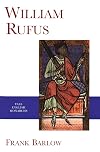
Biographers of William Rufus have to get used to being challenged, "Prove it!"
The reign of Rufus, the son of William the Conqueror, raises a lot of difficult questions. Was he homosexual? (Probably, but we don't have the direct evidence.) Was he murdered? (Probably, but we don't have the direct evidence.) Did his father really designate him as his successor in England while making his older brother Robert heir of Normandy? (Probably, but we don't.... you get the idea.)
The lack of sources show more makes things difficult. This is visible even on the cover of the paperback edition, which shows a picture of William II from British Library MS. Cotton Claudius B VI. It's not contemporary, but it's about all we have. And the face is grey-brown, not pink or another flesh color. The white lead used to paint it has gone dark.
And so have most of the sources. We know even less about Rufus than about his father; the Anglo-Saxon Chronicle doesn't have as many details as we would like, the Domesday Book is completed, the household records haven't started yet -- and the church just plain didn't like Rufus, and either ignored or blackwashed him. It makes life very difficult for a biographer.
Frank Barlow's book does all it can to clear that up. He sorts through all kinds of sources -- not just chronicles and charters but saints' lives and faint hints in literature and non-English writings. It's hard to imagine someone wringing much more out of the data.
Sadly, Barlow's writing skill did not match his research skills. His books tend to be ponderous, and even though this one involves a truly interesting subject, he hasn't managed to produce a particularly good read. As a scholarly work, this ranked very high. As a piece of writing, it stands somewhat below the average of the English Monarchs series. Still, if you want to know about this period of English history, this is a must-have book.
And that statement hardly requires proof. show less
The reign of Rufus, the son of William the Conqueror, raises a lot of difficult questions. Was he homosexual? (Probably, but we don't have the direct evidence.) Was he murdered? (Probably, but we don't have the direct evidence.) Did his father really designate him as his successor in England while making his older brother Robert heir of Normandy? (Probably, but we don't.... you get the idea.)
The lack of sources show more makes things difficult. This is visible even on the cover of the paperback edition, which shows a picture of William II from British Library MS. Cotton Claudius B VI. It's not contemporary, but it's about all we have. And the face is grey-brown, not pink or another flesh color. The white lead used to paint it has gone dark.
And so have most of the sources. We know even less about Rufus than about his father; the Anglo-Saxon Chronicle doesn't have as many details as we would like, the Domesday Book is completed, the household records haven't started yet -- and the church just plain didn't like Rufus, and either ignored or blackwashed him. It makes life very difficult for a biographer.
Frank Barlow's book does all it can to clear that up. He sorts through all kinds of sources -- not just chronicles and charters but saints' lives and faint hints in literature and non-English writings. It's hard to imagine someone wringing much more out of the data.
Sadly, Barlow's writing skill did not match his research skills. His books tend to be ponderous, and even though this one involves a truly interesting subject, he hasn't managed to produce a particularly good read. As a scholarly work, this ranked very high. As a piece of writing, it stands somewhat below the average of the English Monarchs series. Still, if you want to know about this period of English history, this is a must-have book.
And that statement hardly requires proof. show less

WHOAAAAAA. What a snoozer this is. It is interesting enough. But how do you write an entire book about two spoiled brats? Thomas Becket by Frank Marlow is informative and gives a good insight into the cat and mouse antics of the King and Archbishop. The outcome is of course sad and pathetic. Ending with the murder of a man who for all apparent purposes was just sticking to his guns and doing what he was appointed to do by the church. The book drones on and on about sooooo many other people show more involved in Becket's exile and eventual gruesome murder. Very tough read...…even for a history buff. This is a classic and tragic tale of medieval cancel culture. show less

I often founder on histories of the Dark Ages, given the obstacles presented by the sketchy documentation and the unfamiliar political structure (such as it was). This book manoeuvered through some of these problems with a measure of success. The author does an extraordinary job of setting out how many and how reliable the sources which he has for any given topic are, and invites the reader to speculate along with him as he tries to cut through the murk to what was actually going on in a show more given moment. When he's operating chronologically for most of the first half of the book, he always uses his chapter title to tell you which years you're going to be reading about and a little headline about his main theme therein. Withal, we still end up with the usual medieval snoozers such as the royal treasury and, in this case, an anticlimactic final chapter about the century-long, off-and-on campaign to make Edward a saint. The favorite question of most--why isn't he Edward I, goes unanswered, indeed unaddressed. The vast supporting cast could have been better introduced; indeed, I wouldn't have minded a bit had he relaxed the historiographical rule that each character is to be introduced once and once only. Yes, the book has a good index and thus inheres a facility for flipping back to first mention of each actor, but I was already spending too much time writing down words to look up and couldn't get too interested in further distraction. And I've never read a medieval history which wouldn't be improved with a glossary, and I still haven't. In balance, this struck me as superb history, readability fair-to-partly cloudy. show less
This is a good, fairly short account of the rise and fall of the Godwins as a family throughout the course of the 11th century. It identifies a likely ancestry for Godwin, seven generations descended from King Ethelred I, one of Alfred's elder brothers. Much of the book deals with events with which I am very familiar with in other works and there is nothing terribly new here, although useful to have it in easily digestible form. The final chapter usefully examines the eventual fate of Harold show more Godwinsson's offspring - generally unknown, they had all faded into history by the end of the century. 4/5 show less
Lists
You May Also Like


Associated Authors
Statistics
- Works
- 24
- Members
- 1,319
- Popularity
- #19,487
- Rating
- 3.9
- Reviews
- 7
- ISBNs
- 58
- Languages
- 1
- Favorited
- 3
